B2.1 AND D2.3 REVISION
B2.1
Fluid Mosaic Model = explains how the plasma membrane is a flexible and dynamic structure that is composed of various components, each with specific roles, and is capable of changing its shape and composition over time.
Glycocalyx: long carbohydrate molecules attached to membrane proteins and membrane lipids.
Substances a cell needs to let in or out
Glucose, Water, Oxygen, Proteins, Fats, Vitamins
Types of cellular transport
Active transport - ATP
Passive transport: No ATP required
Factors affecting rate of diffusion
Concentration
Size + type of molecule
Surface area
Moisture
| Simple diffusion | Facilitated diffusion |
Similarities |
| |
Differences | Hydrophobic/Non polar Molecules can pass directly through the membrane | Hydrophilic/Polar Molecules need a membrane protein to pass through 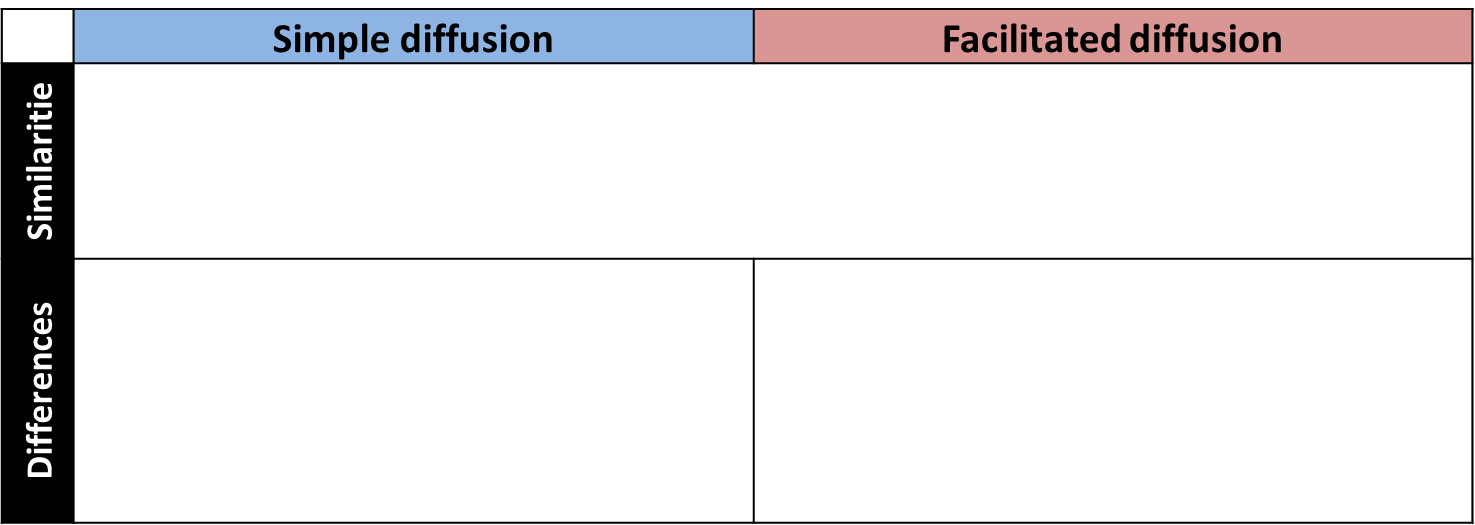 |
Passive transport: Simple diffusion, Facilitated diffusion, Osmosis
Simple diffusion: the net movement of molecules from an area of high concentration to a low concentration across a semi-permeable membrane
Facilitated diffusion: the process by which specific molecules are transported across a membrane via protein channels without the expenditure of energy.
Osmosis: the net movement of water molecules from an area of low solute concentration to an area of high solute concentration through a semi-permeable membrane.
Active transport: the movement of molecules against their concentration gradient, from an area of low concentration to high concentration, utilizing energy in the form of ATP.
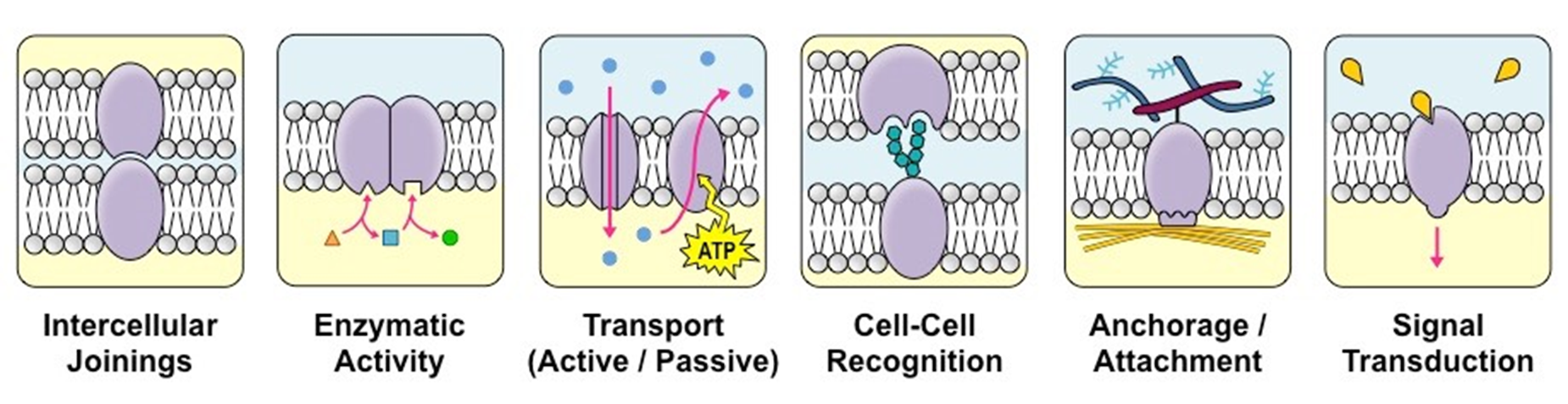
•Glycoproteins have 2 main roles:
•Cell-cell adhesion
•Cell recognition
Oxygen and Carbon dioxide are non polar molecules
Glycoproteins and glycolipids form the glycocalyx – a carbohydrate rich layer on the outer surface of the plasma membrane of animal cells, with an aqueous solution in the gaps between the sugars.
The function of glycoproteins and glycolipids is mostly cell-to-cell recognition and the formation of tissues by forming a glycocalyx. Cell recognition is an important feature of the immune system, as it helps cells to distinguish between self- and non-self cells.
•The membrane proteins are obviously made up of protein and the following elements (C;H;O;N)
FUNCTION OF MEMBRANE PROTEINS
D2.3
Hypertonic: A solution with a higher concentration of solutes than inside the cell.
Hypotonic: A solution with a lower concentration of solutes than inside the cell.
Isotonic - A solution with the same solute concentration as inside the cell.
Water potential = Pressure potential + Solute potential
Water moves out of the cell through the phospholipid bilayer