IB Psychology: Learning and cognition
Cerebral cortex
Thin layer that covers all our brain
Inhibitory control
Our ability to control our actions
Prefrontal cortex
Part of the prefrontal lobe (layer)
in charge of commanding our thoughts and behaviours
Executive chief of all the brain
Attention, memory, etc.
Differentiates us from other animals
Cognitive processes
Processing of information in our brains is the main approach of cognition
Cognitive Biases “Rule of thumb”
Confirmation bias
A tendency to seek out information that confirms preexisting beliefs and avoids information that contradicts them
People are easily susceptible because rejecting one’s established beliefs is psychologically uncomfortable.
Only remembering certain facts that support our beliefs
Ignoring information that contradicts our beliefs
Failing to seek out objective information
Misinterpret new information to fit with existing beliefs
How to avoid
Recognize it
What if the opposite were true?
Seek out objective data
Anchoring Bias
Decisions are influenced by the initial piece of information provided, even when that information is not very relevant
Dual-process model
There are two very distinct systems of thinking
System 1:
Fast, intuitive, automatic
Making quick judgements based on past experience
Already established schema: how our neural connections are wired
Prone to error because it’s not an educated decision
Uses shortcuts called heuristics to save time
Focuses on what it sees and ignores absent evidence
Operates automatically
Why do we use it?
Cognitive misers: want to use as little energy as we can to think. Lazy thinkers.
Sometimes we have too many things going on in our mind to allocate energy to solve a problem. This happens when your cognitive load is too high
Law of least effort: if there are several ways of achieving the same goal, people will choose the least demanding course of action
Economize mental resources and energy
System 2:
Slow, effortful, controlled, and rational
Requires concentration
Works with abstract concepts
Works through logic
Uses conscious reasoning
More reliable, but slow
Advantages
Biological evidence that abstract and concrete thinking is processed in different parts of the brain
Tests are reliable
Schema:
A mental framework that helps us organize and interpret information.
Mental template built from past experiences and knowledge that allows us to quickly make sense of new situations, people, or events
Helps us:
Predict what to expect in familiar situations
Interpret new information based on what we already know
Fill in gaps in our memory or understanding by predicting the most likely situation or information
How does it work?
As active processors of information, humans combine new information with what they already know
When we encounter new information, our brain tries to match it with an existing schema
It helps us make sense of it quickly without having to process everything from scratch
Making associations
We tend to notice and remember information that fits our schema and may ignore details that don’t
This can lead to confirmation bias, where we interpret information in a way that confirms what we already believe
Example in memory
Barlett showed that schema plays an important role in how we encode information
He studied 2 situations
Participants telling other participants a story: like the telephone game
Participants repeating the story to themselves and writing down what they can remember after different time intervals
The story was from a Native American culture
It was unusual for the people from the Western culture to understand because it had supernatural concepts and a non-Western storyline
He found that their memories of the story were distorted in ways that made the story more consistent with their own culture
Findings:
Rationalization: Made the story more typically Western. Changing canoes to boats or changing the order of events to make it more logical
Leveling: Leaving out information that was not essential to the understanding of the story or was incongruent with their schema
Sharpening: Adding details to fill in the gaps of the story and make it make more sense to them.
Example in emotions:
We interpret an event based on our past experiences and self-schema. Schemas filter how we see whats happening around us
If your past experience has taught you that you are not “good enough”, you might interpret a neutral comment as criticism and feel shame, anxiety, or sadness
If you have a schema that “people can’t be trusted”, you might respond to kindness with suspicion or fear.
Cognitive behavioral therapy identifies unhelpful schema and with the help of a therapist, hopes to change a client's automatic negative thinking
This is done through validity testing
When someone has a schema that everyone hates them, a therapist will ask for evidence with the hope of showing the client that this belief is not true.
Example in relationships
Play a big role in dating by shaping our expectations, reactions, and the kind of partners we’re drawn to
If someone has a schema that love equals rejection due to past experiences, they might unconsciously sabotage connections or cling too tightly.
If someone has a schema of a healthy relationship they might communicate more openly and build trust more easily.
Example in consumer behavior
Influence consumer behavior by shaping how people perceive and respond to brands, products, and marketing messages
If someone has a schema that luxury equals quality, they may be willing to pay a premium price for high end brands, even if similar products exist at lower prices
Marketers often tap into familiar schemas to build trust, trigger emotions, or reinforce brand identity.
Social learning theory
Albert Bandura created the theory
to explain the phenomenon of observational learning, but it expanded over years into a much more general theoretical framework explaining all human behaviour.
We learn through role models
Ex. Kids learn through parents how to behave
4 Cognitive mechanisms
Attention
The ability to be attentive to a certain behavior in order to imitate it
Retention
The ability to store it in memory so that we can later retrieve it to imitate it
Potential/Motor reproduction
Our ability to perform the behavior, or our belief that we are able to perform it
Motivation
The rewards or punishments that the model received
We are more likely to imitate the models behavior when vicariously reinforced or punished for it
The role of the model
The model has to be appealing for us to want to replicate the behavior
Attached to the effect of that behavior
Feel reflected in the model
Consistency
You tend to follow a model who portrays consistent behavior
In childhood
A kid is going to choose a model who they think is consistent
A little girl with a mom or caregiver
If not consistent, it is less likely that the child will see them as a role model or replicate the behavior
Don’t know what to expect or if reliable or not
Identification
If you feel identified with the model
Liking
We tend to imitate the behavior of people that we like
Family, friends etc,
Rewards and punishments
If the models behavior is rewarded we are more likely to imitate it and vice versa
Memory
Simple division of different types of memory
Semantic
Factual information or knowledge
Content
Learned
Procedural
Things we learn to do with our bodies or hands
Driving, riding a bike
Motor skills
Episodic
Episodes or life events
Perceptual
Odors, noises
Localization of functions
What?
Idea that says that every cognitive process has a specific place in the brain
Biological approach: behavior may be the product of brain structure
Brain structure
The nervous system
Spinal cord
Brain
Brain
Cortex
Layer of neurons with a folded surface covering the brain on the outside
Largest part of the human brain associated with higher order functions like abstract thinking
Cortical lobes
Frontal lobe
Reasoning, planning, thinking, decision making
Parietal lobe
Movement, orientation, perception, recognition
Temporal lobe
Processing of auditory information, memory, speech
Occipital lobe
Visual processing
Cerebrum
Front
Cerebellum
Balance, coordination
In the back
“The little brain”
It has two hemispheres and a folded surface
Most primitive part of the brain
Connects the cerebrum to the brain stem
Limbic system
Inside brain
At the core of the brain
Hypothalamus
Homeostasis
Hippocampus
Memory conversion
Essential for encoding and consolidating autobiographical memories
Helps bind different elements of an experience into a cohesive memory
Thalamus
Relays information
Amygdala
Emotion
Enhances emotionally charged memories, making them more vivid and long lasting
Distribution of memory across multiple brain regions ensures long term retention, even if one area is damaged
Brain stem
What connects the cerebellum and cerebrum to the spinal cord
Underneath the limbic system
Main function
Regulate the vital processes
Breathing and heartbeat
Research that supports localizations
Paul Broca
Discovered a speech centre in the brain, while studying the case of patient “Tan”
The patient had a lesion in the frontal area of the left hemisphere, in the posterior inferior frontal gyrus
This region is known as Broca’s area
The patient lost his ability to speak when he was 30. He couldn’t speak or write but his intelligence was intact. He understood everything he was asked but couldn't utter anything other than “tan”
This condition is now known as Broca’s aphasia or Non-Fluent aphasia
Loss of articulated speech
Carl Wernicke
Wernicke’s area was discovered in 1874
In temporal lobe of the dominant hemisphere
Responsible for comprehension of written and spoken language
People with Wernicke’s aphasia or Fluent aphasia have a general impairment in of language comprehension
Speech production is intact in patients with Wernicke’s aphasia
Wilder Pennfield
Neurosurgeon who used the method of neural stimulation
Mapped brain functions on a larger scale
Treated patients with severe epilepsy by destroying nerve cells that initiated the seizures
Before doing brain surgery he would stimulate various parts of the brain while the patient was still conscious and would observe the effects on their behavior
Created a map of the sensory and motor cortex called the Cortical Homunculus
Pennfield's Homunculus shows the relative representation of various parts of the body in the sensory cortex
Karl Lashley
Used the technique of measuring behavior before and after and specific carefully controlled induce brain damage in the cortex of rats
After his research he concluded that memory was distributed rather than localized
Induced brain damage in the rats to see how they reacted
Split Brain Research
Relativity of localization
Pioneered by Roger Sperry
Lateralization: division of functions between the two hemispheres of the cortex
Lateralization is a special case of localization
Importance of the corpus callosum
What connects both hemispheres
Michael Gazzaniga: Studied human split brain patients
People that had a damage in the corpus callosum
Conclusions on Localization research
Some functions are indeed localized in very specific regions of the brain, and damage will lead to loss of the function
Broca and Wernicke
Some functions are localized weakly
Several brain areas may be responsible for a function but some areas are dominant
Scientists have been more successful in establishing strict localization for sensory and motor functions rather than higher order cognitive functions
Memory, thinking, and learning
Some functions are widely distributed
The ability of both hemispheres to to form an emotional reaction independently from each other
Some components of a function may be localized while other components of the same function are distributed in the brain
Language
Localization is not static
Functional areas move about and can respecialize after brain damage
Neuroplasticity
Neuroplasticity
Our ability to adapt to change
Plasticity of neural connections
Our ability to learn, relearn, etc
Making and breaking of synaptic connections
Remapping of the sensory cortex
The ability of the brain to change through the making and breaking of synaptic connections between neurons
Causing factors are both genetic and environmental
Synaptic plasticity
The ability of the neuron to form new synaptic connections and break up the old ones
Connecting new knowledge with prior knowledge
Cortical remapping
Phenomenon when brain area X assumes the functions of brain area Y
When one is impaired, it tends to take the function of another one
If you have a brain injury and part of your brain is impaired, and you lose a specific function, the areas of the brain that are connected to that area start to take control of that function.
Loss of the ability to name objects, as you relearn to do that through rehabilitation, other areas of the brain take charge of relearning that function.
Remapping of sensory cortex
Merzenic and colleagues in 1984 did one of the early studies of neuroplasticity on the level of cortical remapping
Studied the cortical representation of the hand in eight owl monkeys
Cortical remapping of sensory inputs from the hand occurs within 62 days in owl monkeys
Neuroplasticity as a mechanism of learning
When you learn, your brain gradually reshapes itself
Researchers
Draganski et al 2004 & 2006
Maguire et al 2000
Practical applications
The idea that other senses may be used to make up for the lost sense is known as sense substitution
If you’re blind, the other senses are heightened
Neurotransmitters and behavior
Chemical messengers in our brains
How neurons connect to each other in a chemical way
What is a neuron?
A nervous cell
Fundamental unit of the nervous system
Transmit information from one to another through electrical and chemical processes
Dendrites connect neurons
Synaptic buttons
At the end of dendrites, which hold the synaptic vesicles
The vesicles hold the neurotransmitters
The buttons open and release neurotransmitters into the synaptic gap (space between neurons)
The other neuron absorbs some of the neurotransmitters and the rest stay in the gap
Reuptake
The neurotransmitters left in the gap are taken back into the vesiclesº
The ones left in the gap after being taken back are broken down by enzymes
The ones left over after being broken down just stay in the space
Synaptic gap
Presynaptic neuron
Releases neurotransmitters
Postsynaptic neuron
Receives neurotransmitters
Neurotransmission
Chemical mechanism of transmission between neurons
Neurotransmitter
Chemical messengers
Released from the axon terminal into the synaptic gap
Different types of neurotransmitters
Divided into 2 groups
Excitatory
Allow the impulse in the other neuron to cross the synapse and travel faster
Enhance the electrical impulse through the axon
Produce stimulating effects on the brain
Ex. Dopamine
Inhibitory
Stop the impulse, preventing it to cross the synapse
Produce calming effects on the brain
Slows down the electrical impulse
Always in a state of dynamic balance
Ex. Serotonin
Neurotransmitters can be affected by
Agonists
Chemicals that enhance the action of a neurotransmitter
Antagonists
Chemicals that counteract and prevent a signal from being passed further
The role of hormones in human behavior
Hormones may be responsible for certain behaviors
What is a hormone?
Another chemical messenger
Released into the bloodstream by glands
Affects the activity of cells and tissues in our body
Adrenaline
Produced by the adrenal glands
Located in the epigastrium at the top of the kidney
In charge of releasing adrenaline
Targets vital organs
Allows the body to respond quickly in critical situations
High adrenaline
Increases heart rate
Sweating
Anxiety
Heightened alertness as part of the body’s fight or flight response
Low adrenaline
Fatigue
Low blood pressure
Difficulty in responding to stressful situations due to insufficient activation of the fight or flight response
Oxytocin
The “Love” hormone
Produced in the hypothalamus
Released by the pituitary gland
At the base of the brain under hypothalamus
Plays a role in sexual reproduction, childbirth, and social bonding
High oxytocin
Increases trust
Connection with others
Relaxation
Improves sleep cycle
Low oxytocin
Irritability
Poor communication
Sleep difficulties
High stress
Sadness and bad mood
Testosterone
Produced by the male sex gland called the testes
Controls developmental changes in males such as deeper voice, facial and pubic hair, muscle growth, and bone strength
High testosterone
Acne
Increased muscle mass
Low sperm count
Prostate enlargement
Can cause difficulties urinating
Low testosterone
Less facial and body hair
Less muscle mass
Hot flashes
Brittle bones
Oestrogen
Produced in the female sex gland called the ovary
Controls developmental changes in females like breast development, release of egg cells which marks the beginning of menstruation
High
Heavy or irregular period
Breast tenderness
Weight gain
Low
Missed menstruation cycle
Mood swings
Hot flashes and night sweats
Thyroxine
Produced in the thyroid gland
Increases rate of chemical reactions
Helps control growth and development
Controls our body's metabolism
Hypothalamus releases thyrotropin hormone which triggers the release of
Imbalanced levels
Unexplained weight loss or gain
Slow or fast heart rate
Intolerance to cold or heat
Dry or moist skin
Irregular periods
Conditions related to imbalanced levels
Hypothyroidism
Hashimoto’s disease
Hyperthyroidism
Grave’s disease
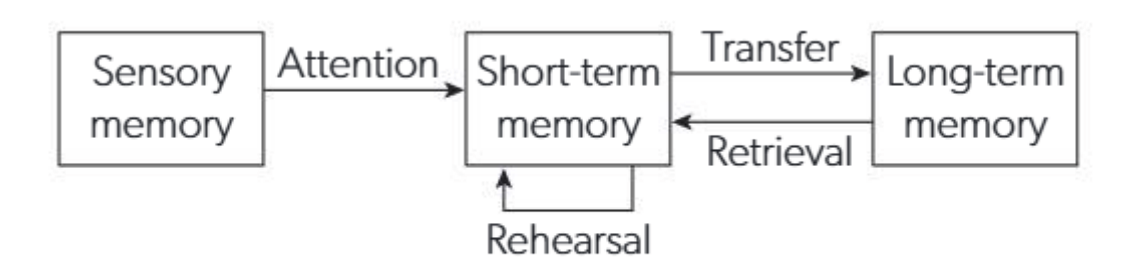
The multi-store model
Proposed by Atkinson and Shiffrin in 1971
Foundation of all cognitive model
Wanted to explain how memory works with concepts
Putting into words how memory works
Environmental input
Information from environment, stimuli
Divided memory into 3 “places of storage”
1: Sensory buffer/memory
First information received
Limited capacity and duration
If you pay attention to the information it goes through the short term memory storage
2: Short term memory storage
Limited in capacity and duration
3: Long term memory storage
According to them, unlimited in capacity and duration (Not true)
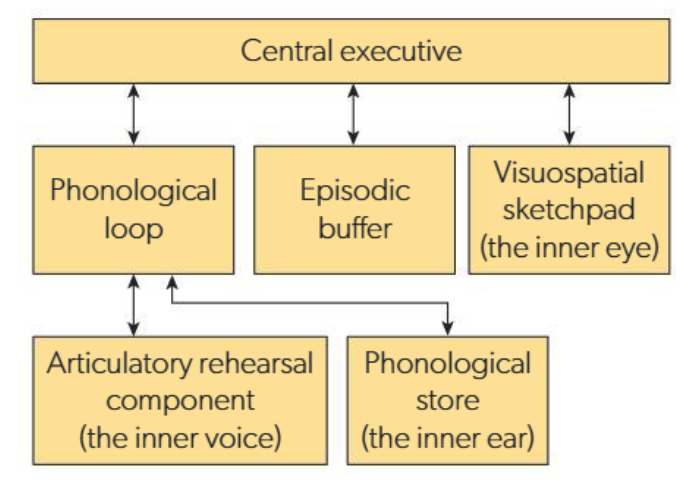
The working memory model
Central executive
Hypothetical space in out minds that has the role of receiving information and organising it
In charge of sending information to where it should be saved
Replaces the “sensory buffer”
One in short term memory
Directs attention to tasks
Phonological loop
Sent by central executive
Processes information about language and auditory information
Written and spoken
Divided into 2
Phonological store
Words heard
Articulatory process
Words heard/seen and silently repeated like an inner voice
Repetition = long term memory
Limited capacity
Episodic buffer
Sent by central executive
Holds information about everything all at once
Visual, spatial, and verbal information with time sequencing
Memory of a story or event
A picture of that moment
Not just visual, also situational
Visuo-spatial sketchpad
Holds visual and spatial information
Limited capacity
Visual cache
What things look like, form, and color
Inner scribe
Processes spatial and movement information
Repetition = long term memory
Comes back and forth
Evidence that supports the model
Dual task techniques
Allocation of attention and switch focus
Involves central executive
Struggle to manage both tasks
Overload of executive control
Word length effect
Phonological loop holds the amount of information you can say in 1.5-2 seconds
Makes it hard to remember a list of long words
Representative vs Dog
Word length disappears if a person is given an articulatory suppression task
Saying “the,the,the,the” while reading words
Repetitive task ties up the articulatory process which means you can’t rehearse the shorter words more quickly than the longer words
Articulatory suppression
Found that reciting the numbers 1 and 2 while trying to memorize a list of 7 letters caused 76% of controls recalled the list accurately and the articulatory suppression condition only 45%
Strengths of the working memory model
Supported by considerable experimental evidence
Brain scans have shown that a different area of the brain is active when carrying out verbal tasks
Limitations of the working memory model
Role of the central executive is unclear though it is said to be the most important part of the model
How the various components of the model interact is not yet clear
This model only explains short-term memory so it doesn’t tell us much about the processes involved in long-term memory
Doesn’t explain memory distortion or the role of emotion in memory formation
Levels of processing theory
Schema theory
Technology and cognitive load
Cognitive load
Total amount of mental effort used in working memory
Cognitive load theory
Humans have limited working memory capacity, and information overload occurs if they are presented with information that exceeds this capacity
Miller’s “Magic Number 7”
According to Miller, the average memory span is between 5 and 9 items
Cowan argued that it was less and short-term memory may only be 4 items
Types of cognitive load
Intrinsic load
Level of difficulty associated with a task
Ex: Solving a calculus problem has a higher intrinsic load than simple arithmetic
Extraneous load
Difficulty of processing information due to factors that are external to the task
Ex: People talking while you’re reading
Germane load
Effort needed to process information in working memory
Too high cognitive mode makes it hard to move information from STM to LTM
Factors that increase cognitive load
Complexity
How many steps a task has
Difficulty
How challenging or hard to understand a task is
Varies from person to person
Pressure
Limited time
Distractions
External stimuli
Interruptions/disruptions
Role of technology in cognitive load
Can reduce cognitive load
Dual coding activates both visual and auditory processing, making memory stronger
Organizes information clearly
Can increase cognitive load
It presents too much information at once
Computers can be a source of distraction
“Technology doesn’t make learning easier - it depends on how it’s used. Well-designed tech supports memory. Bad design or misuse overloads the brain”