PROPERTIES OF LANGUAGE
PROPERTIES OF LANGUAGE
Discreteness: Composed of discrete units used in combination to create meaning. Such as combination of words/morphemes to create a sentence that has meaning.
Displacement: The ability to communicate about something that is in the present, in immediate spacial or temporal context.
Arbitrariness: the relationship between a word or morpheme and what it refers to is not based on logic or inherent qualities. For example, there's nothing inherently "cat-like" about the word "cat"; it's simply a symbol that English speakers have agreed upon to represent the concept of a feline animal.
Infinity: Finite number of words in language but potential combination of these units to form meaningful sentences is limitless.
Recursion: Recursion is the property of language allowing for nesting structures within larger structures. This means that linguistic elements, such as phrases or clauses, can be embedded within other elements of the same type. For example, in the phrase "the book on the windowsill by the door," the prepositional phrase "on the windowsill" is nested within the larger prepositional phrase "by the door."
CORE FEATURES OF LANGUAGE
- Phonology: Governs the sequencing of phonemes (which are the basic units of sound that distinguish one word from another in a particular language, e.g., “ba” vs. “pa”)
- Morphology: Governs the sequencing of morphemes (smallest meaningful units that carry meaning (e.g., help vs. helper)
- Syntax: Arrangemnt of words into sentences in a language. (“I went to the store” vs. *”I store the to went”)
STRUCTURE OF LANGUAGE
- Semantics: deals with the meanings of words and sentences within a language. It encompasses various aspects such as vocabulary, word meanings, and the relationships between language and the world. Semantics explores how words and sentences represent concepts and how these representations relate to the external world. This involves understanding the denotative (literal) and connotative (implied) meanings of words and sentences. Furthermore, semantics examines the relationship between language and the speaker, including how speakers use language to express their thoughts, beliefs, and experiences, and how language shapes the speaker's understanding of the world.
- Pragmatics: Pragmatics refers to the knowledge underlying the use of language in context. It involves understanding how language is used to achieve communicative goals in social interactions. Pragmatics considers factors such as implied meaning, context, social norms, and the shared knowledge between speakers. It explores how speakers use language to convey meaning beyond the literal interpretation of words and sentences, including implied meanings, sarcasm, humor, and politeness. Pragmatics also encompasses aspects such as turn-taking in conversations, where speakers alternate between speaking and listening, and accounting for others' knowledge, where speakers adjust their language use based on their assumptions about what others know or believe.
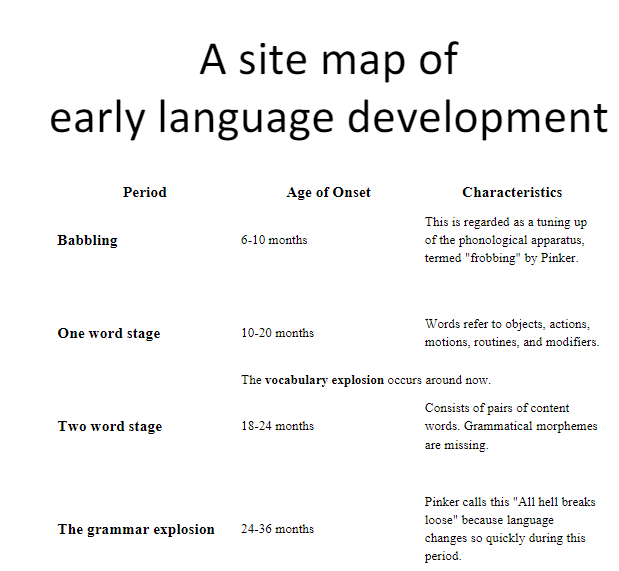
THEORIES OF LANGUAGE DEVELOPMENT
LEARNING/BEAHIORIST THEORIES
The mind is born with a blank state upon which knowledge is constructed through experience. Emphasis on the role of the environment.
- Classical conditioning: Involves learning association between stimuli. Classical conditioning may occur when a certain sound or word is associated with specific meaning or response through repeated pairing with other stimuli.
- Operant condition: Learning through the consequences of behavior. When reinforced (rewarded) for using correct language form and punished or correct when not.
- Imitation: Individuals learn by observing and imitating speech patterns.
-Critiques-
Referential Opacity: people learn by associating things they experience with specific responses they make. For example, if a child hears the word "dog" and sees a dog, they learn to associate the word with the animal. However, language can be tricky for behaviorists because sometimes words refer to things that aren't directly observable. In a sentence like "John was proud of himself," the word "himself" refers back to "John." This kind of reference isn't something you can see or touch, so it's hard to just associate it with something concrete like you would with a visible object.
Imitation: Research has shown that imitation plays a relatively minor role in language acquisition, particularly in early. Where they can demonstrate comprehension of language before producing it.
Reinforcement: people don't get consistent rewards or punishments for their language use. Also, whether a sentence is true or not doesn't always match up with whether it's grammatically correct. For example, you could say "The sky is green" grammatically correctly, but it's not true. So, behaviorist theories have a hard time explaining how reinforcement works in language learning because it's not always clear what's being rewarded or punished
Poverty of the stimulus is a concept in linguistics that addresses the discrepancy between limited input children receive and complex language systems they develop. They may hear incomplete or grammatically incorrect sentences, and caregivers may not always correct linguistic errors or deviations from the standard language. Despite the limited and sometimes imperfect input, children acquire remarkably complex language systems. They not only reproduce the language they hear but also develop grammatical rules and structures that they have never directly encountered in their input. Language development in children is generally rapid and error-free, progressing from simple utterances to more complex sentences in a relatively short period.
BIOLOGICAL/NATVIST THEORIES
Language isn't learned it's a cognitive ability
Language Acquisition Device (LAD) a theoretical concept that states we have a special language-learning mechanism inhereted in the human brain.
2 types of knowledge we have:
- Formal and substantive universals: Characteristics like language organized in levels or layers and having categories (like nouns, verbs, etc.).
- Parameters: we have parameters that vary across language but are constrained within certain limits. They are like switches in our brains that can be set differently depending on the language we're learning. They determine how certain things work in a language. For example, one parameter might decide if we usually drop subject pronouns like "I" or "he" in a sentence. In some languages, like Spanish or Italian, it's common to drop these pronouns,
The LAD is "turned on" by exposure to linguistic input. When children are exposed to language through interactions with caregivers and their environment, the LAD processes this input and extracts linguistic patterns.
Evidence for innate grammar...
- Goldin-Meadow and Senghas conducted research on congenitally deaf children born to hearing parents who were not exposed to American Sign Language (ASL) or any other formal sign language. Here's a simplified explanation of their findings:
- Homesign: When these deaf children did not have access to a formal sign language like ASL, they spontaneously created their own gestural language, often termed "homesign." This homemade sign language allowed them to communicate with their families and others around them.
- Similarity to Spoken Languages: Despite not being exposed to a formal sign language, the gestural language invented by these children showed similarities to spoken languages in several ways. For example, it displayed similar ordering of linguistic categories such as nouns and verbs. This suggests that the children's innate language-learning abilities guided the structure of their homemade sign language.
- Lenneberg’s book “biological foundations of language” describes how language acquisitor is acquired in early infancy.
Maturational process: there is a specific timeframe during which language development occurs.
Critical period: acquisitions period during first year of life and extend till puberty.
Brain development: language acquisition is easiest when brain is developing
Late acquisition of left-hemisphere damage has larger impact on language skills (than early Acquistion)
Case of genie(1977), Johnson and Newport (1989) immigrant in America study where after puberty there were significant deficits after puberty.
Area’s in left hemisphere (Broca's wernicke’s) involved in language production and processing.
-Critiques-
Lack of specificity
Grammar in Deaf Children: Studies of deaf children who are not exposed to a formal sign language like American Sign Language (ASL) have shown that their grammar is limited compared to deaf children who are exposed to ASL from birth. This supports the idea that exposure to linguistic input plays a crucial role in language development, even for innate grammar abilities to manifest fully
Complexity of Grammar: Languages with more complex grammatical structures, such as those with multi-clause sentences, tend to require more sophisticated language input for acquisition.
Culture and Neural Structure: Research suggests that cultural factors can influence the neural structure and cognitive processes involved in language. For example, different languages may be associated with distinct patterns of brain activation and connectivity. This highlights the interaction between biological and environmental factors in shaping language abilities.
INTERACTIONIST THEORIES
Language develops from the interaction of biological, cogntiive and environmental influences.
Infant-directed speech
- Caregivers and adults produce rhythmic speech with accentuated pitch. Infants prefer this speech than other types of non-speech sounds.
The use of infant direct speech consists of
- Reduplicated syllables: repeated syllables like choo-choo for train and night0night for bedtime.
- Diminutive Endings: modify word to make it smaller or cuter. Doggy for dog and blankie for blanket.
- Use of nouns: parents often use nouns rather than first or second-person pronouns. say "mummy" or "daddy" instead of "I" or "you."
- They base speech on the here and now
- Speech based on child’s interest, current situation, and needs.
BIOLOGICAL PREDISPOSITION
- Fast mapping: refers to the children learning new words learned based on minimal exposure
- Indeterminacy of Reference: Despite the fast pace of word learning, there's a challenge: the indeterminacy of reference. This means that it's not always clear what a word refers to, especially considering that words can have multiple meanings or refer to different things in different contexts.
- Quine's Gavagai Problem: Philosopher Willard Van Orman Quine illustrated this challenge with his "Gavagai problem." If someone points to a rabbit and says "gavagai," how does a learner know whether "gavagai" refers to the rabbit, its color, its movement, or something else entirely? So, how do infants navigate this problem? One theory is that they rely on various cues, such as the context in which the word is used, the gestures or actions accompanying the word, and their existing knowledge about the world. Additionally, infants may engage in hypothesis testing and trial-and-error learning to gradually refine their understanding of word meanings.
WORD-LEARNING COGNITIVE MECHANISMS
- Whole Object Assumption: Children often assume that a new word refers to the entire object, rather than just a part of it or its properties. For example, if a child hears the word "duck" while looking at a rubber duck, they will likely assume that "duck" refers to the whole object, including its shape, color, and material.
- Taxonomic Assumption: This assumption is based on the idea of categorization and similarity. Children tend to assume that objects that are similar in appearance or function share the same label or name
- Mutual Exclusivity Assumption: Children often operate under the assumption that objects have only one label or name. if a child knows the word "hammer" and is introduced to a new tool, they will likely assume that the new tool has a different name, rather than being another type of hammer. Unfamiliar objects have different names.
COGNITIVE MECHANISM FOR FURTHUR LANGUAGE LEARNING
Bootstrapping refers to using what you already know to learn something new. Children use prior knowledge of 1 aspect of langue to learn another.
Syntactic Bootstrapping: Specifically, syntactic bootstrapping involves using knowledge of grammar or sentence structure to help determine the meanings of words. For example, if a child hears a sentence like "The duck is gorping the bunny," they may not know what "gorping" means, but they can infer that it's likely a verb based on its position in the sentence (between the subject "duck" and the object "bunny").
SOCIAL INTERACTION
Joint attention- Refers to the ability of two or more individuals to focus on the same object or event, with the intention of sharing the attention and meaning. Babies early on are sensitive to eye contact so that naturally pay attention to where other are looking, understanding what other are interested in. Joint attention is crucial in the language learning context because it allows infants to link language input with the objects or events in their environment. For example, when an adult labels an object they are looking at during joint attention, the infant can make connections between the spoken word and the referent, facilitating vocabulary acquisition.
Thos occurs in 9-10 month olds. By 11-12 month old they will follow if the eyes are open.
At around 18 months...
Infants begin to use an actor's eye gaze to understand and map objects to their referents in the environment. For example, if an adult looks at a ball and says "ball," the infant will likely understand that the word "ball" refers to the object the adult is looking at. Infants also start to consider intentionality when mapping verbs to actions. This means that they pay attention not only to the action itself but also to the intention or goal behind the action. For instance, if an adult points at a cookie and says "eat," the infant understands that the intention is to consume the cookie. infants begin to use another person's emotional expression to infer the target of their referent.
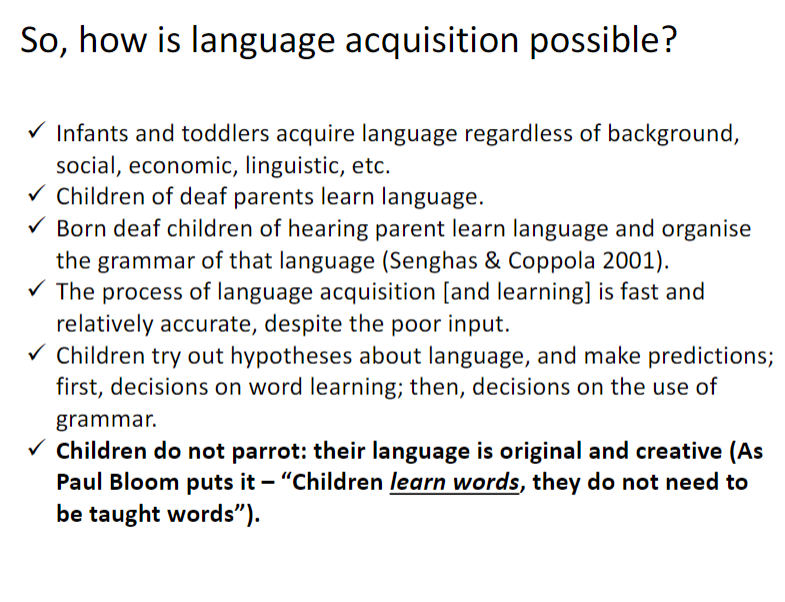
WHY IS LANGAUGE UNIQUE TO HUMANS?
The ape language projects
The most famous of these projects was conducted by psychologist Herbert Terrace in the 1970s with a chimpanzee named Nim Chimpsky. Inspired by the work of psychologist B.F. Skinner, Terrace attempted to teach Nim sign language using a method called "operant conditioning," where desired behaviors were reinforced with rewards.
Koko
Social Relations
Who is a peer?
- Individual with same age or maturity level as you
- Not family members
- Peer relationships tend to be sex segregated in early childhood
WHY ARE PEERS IMPORTANT?
- Children’s peer groups and friendships affect development in children’s lives, including the family, the school, and the community.
- Friendship in childhood aim to: give support, self-esteem enhancement, and positive self-evaluation; give emotional security.
PEER GROUP FUNCTIONS
- Peer groups teach children to engage in cooperative activity rather than individual goals
- Social structures like in-group and out-group
- Learning about skills like leading and following
- Emotion-regulation towards in-group and out-group peers
- Directing aggression towards “outsiders” for the sake of group loyalty.
- Social support and identity development
PEER GROUPS
Typically comprise five or six members, usually of the
same sex
• During childhood, small, intimate groups of friends,
known as cliques are prevalent
• As children move onto adolescence, cliques are replaced
by crowds. These are reputation-based groups that
comprise larger number of individuals
• By late adolescence peer groups become less clearly
defined – emergence of romantic couples
THEORETICAL PERSPECTIVES
Jean Piaget- proposed a theory of the active role of children in constructing their understanding of the world.
- Children typically have a vertical relationship with their parents. Where they are based on dominance and power assertion.
- In peer relationships, there is a horizontal relationship. Where they can question, discuss and argue ideas.
Sullivan (1953)
Introduced the concept of “special relationships”, which encompass chumships (close friends). Where friendships are characterized by mutual respect, equality, and reciprocity. Sullivan highlights the importance of these relationships in contrast to hierarchal relationships based on authority and dominance.
- Early children's relationships with peer's help shape their personality in later adulthood
Harrison (1995)
Challenged view of parental input on development
- Believed that “group socialization”, where children's socialization occur primarily with peer groups rather than parental influence alone.
- Children adapt to and follow the norms in the groups that they spend time with.
TECHNOFERENCE
- Interruptions to Interpersonal interaction or time spent together due to digital media.
- Introduction to technology may disrupt the infant’s ability to self-regulate or co-regulate attention and emotions.
- Early childhood is a particularly vulnerable time.
- This can occur as a result of tv in the background. Where 7% decrease in adult speech per hour, decreased child vocalization, and conversational turn-taking when tv was on.
- Can also occur from phone use.
FRIENDSHIPS
In early childhood: opportunities for enjoyable play help children regulate their behavior
In middle childhood: opportunities to learn about behavioral and emotional norms.
In adolescence: successful identity development
Parten's categories of play behavior, as described in Gillibrand et al. (2016), provide a framework for understanding the different types of play that children engage in during preschool years. Parten identified six categories of play behavior, which reflect the increasing complexity of social interaction and cooperation:
- Unoccupied Play: Children engage in random movements or activities without a specific purpose or goal.
- Solitary Play: Children play alone, focusing on their own activities and interests without interacting with others.
- Onlooker Play: Children observe and watch others play but do not actively participate in the play themselves.
- Parallel Play: Children play alongside each other, engaging in similar activities or using similar materials, but do not actively interact or collaborate with one another.
- Associative Play: Children engage in loosely structured play together, sharing materials and interacting with one another, but without a clear organizational structure or common goal.
- Cooperative Play: Children engage in organized, structured play activities with others, working together towards a common goal, sharing ideas, and cooperating to achieve mutual objectives.
EARLY INFANCY AND PRESCHOOL YEARS
- Children begin to show positive interests in other infants as early as 6 months of age.
- By 14 to 18 months of age, two or more children can play together
with toys –occasionally cooperating but more often simply playing
side by side with different toys –parallel play (Parten, 1932) - By age 3 or 4, children prefer playing with peers to playing alone –
their play is much more cooperative. They tend to have at least one
mutual friendship. - They are more likely to prefer a same-sex peer
ADOLESCENCE
- Many of the friendships patterns change in adolescence
- Mixed sex groups begin to appear
- Conformity to peer-groups values increases
- More intimate firenships- inner feelings and emotions are shared more
Attachment
Attachment is a deep and enduring emotional bond that connects one person to another across time and space. Focus on mother-infant dyad, but attachment includes biological, foster or adopted parents.
JOHN BOWLBY
Studied psychology and pre-clinical sciences at Cambridge, then medicine at UCL.
He suggested that human babies have an innate drive to form an attachment to their primary caregiver (usually mother)
Affectional bond- deep emotional connection between individuals. Individuals in the bond see each other as irreplaceable.
Attachment-specific type of affectional bond that typically forms between infants and their primary caregivers. The central figure is experienced as a safe base.
Attachment behaviors- actions or expressions that individuals, especially infants exhibit to maintain proximity to their attachment figure. These behaviors are believed to be innate.
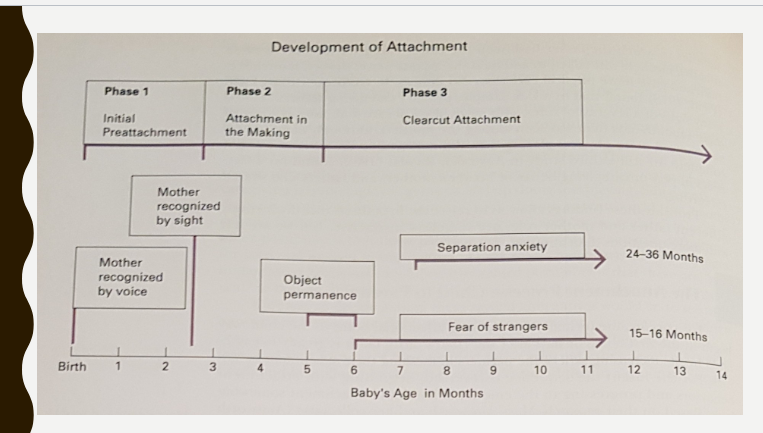
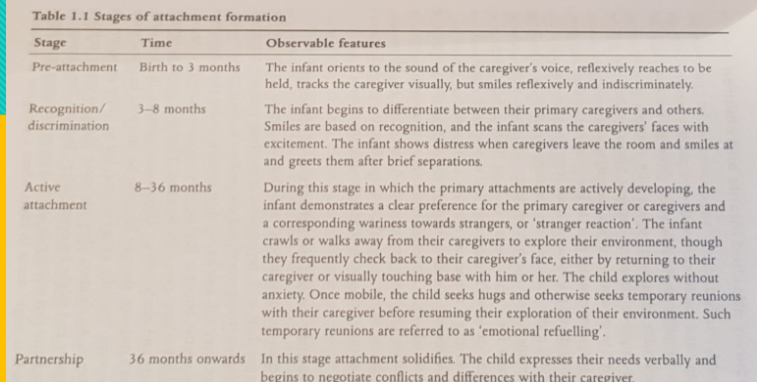
- The infant’s goal is to maintain proximity to the attachment figure, using attachment behaviors like clinging.
- Certain situations or contexts such as moments of fear, can intensify the activation of attachment behaviors in individuals. This is where they will instinctively seek proximity to their attachment figure for comfort and protection. This ten deactivates the distress.
- By early childhood, the child will formulate an internal working model (IWM). Which refers to a mental representation that individuals develop based on their early experiences with caregivers. If a child consistently experiences love, support, and responsiveness from their caregivers, they are likely to develop a positive internal working model.
ANIMAL RESEARCH
Konrad Lorenz
- “imprinting” refers to a form of learning in which young animals have a strong attachment to a particular individual or object early in their life.
- This critical period is typically brief and occurs shortly after birth.
- Lorenz conducted an experiment comparing naturally hatched gray leg geese with those that were artificially incubator- hatcher and had no contact with their mother. In Lorenz's experiment, he himself became the first moving stimulus that the incubator-hatched geese encountered, leading them to imprint on him as their caregiver.
Harry Harlow
Rhesus Monkeys were presented with two “attachment figures”- one provided them with food and the other gave them comfort with their soft skin. Rhesus monkeys felt attached to the cloth mother even when they were fed by the wire mother.
Marry Ainsworth
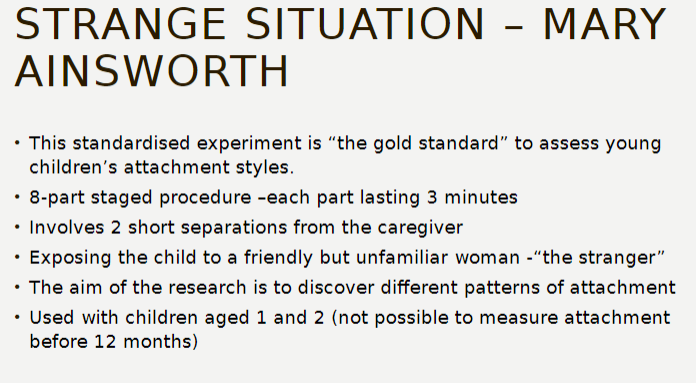
- Conducted observations of mothers and babies in Uganda and Baltimore
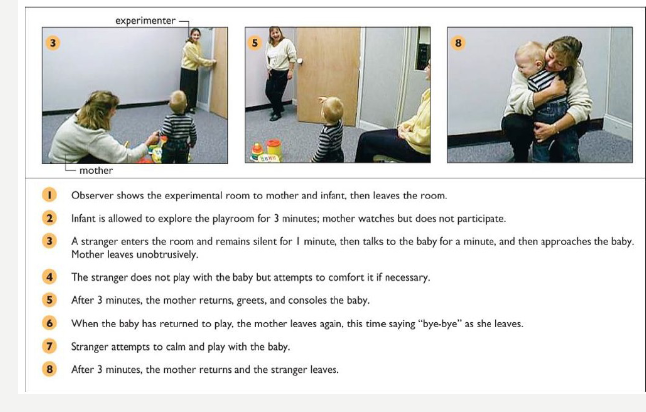
- Noticed how differently babies reacted to being reunited to thier mothers after a period of separation.
Secure Attachment
- Baby may or may not become distressed when separated from caregiver.
- Reacts quickly and positively to the caregiver on reunion
- Distress during separation is assuaged by contact with caregiver.
Insecure Avoidant
- Baby does not become stressed when separated from the caregiver.
- On reunion, baby fails to greet or respond to the caregiver, may actively avoid caregiver. Treats stranger and caregiver similarly.
Insecure Resistant
- Baby becomes super distressed when separated from caregiver.
- Baby reacts positively to the caregiver on reunion
- Contact with caregiver is not effective, baby shows sign of resisting contact (kicking, squirming)
INSECURE-DISORGANISED (MAIN AND SOLOMON)
- In this attachment style, infants exhibit no coherent strategy for dealing with separation from reunion with their caregiver. Unlike securely attached infants.
- Infants react to the caregiver with disorientation or even fear
- While insecure-disorganized attachment is recognized as a distinct category, Main and Solomon also noted that these infants may exhibit characteristics of one of the other attachment styles (secure, insecure-avoidant, or insecure-resistant) in addition to their disorganized behaviors.
Goal-corrected partnership- when children are cognitvely advanced enough to understand if mom says shes going away and will be back, their separation anxiety wanes. Thus attachment figure do not only depend on physical proximity.
PREDICTORS OF ATTACHMENT SECURITY
- Higher levels of maternal sensitivity are seen in mothers of securely attached babies compared to insecurely attached babies.
- Difficult social- environmental conditions were found to determine insecure-disorganized attachment style (maltreatment, poverty, parental drug problem)
TRAITS OF SECURELY ATTATCHED CHILD
- Emotional distress is addressed effectively
- Show greater interests in social partners
- Better liked by peers
- Are likely themselves as worthy of other’s affection
- Hold positive but realistic self- views, higher self esteem
- Show greater cognitive competence in middle school
- Experience lower levels of internalizing (depression) and externalizing problem (inattention)
ATTATCHMENT DISORDERS
- Reactive attachment disorder (assosiated with depression)
- Absence of focused attachment behavior toward a caregiver
- Failure to seek and respond to comforting when distressed
- Insufficient care from caregivers is the key condition
- Disinhibited social engagement disorder (associated with impulsivity)
- Inappropriate approach to unfamiliar adults
- Lack of wariness of strangers
- Lack of boundaries
- Actively seeking close physical contact
MEASURING ATTACHMENT
- Child attachment interview
Developed by Target et al. in 2003, is a structured interview designed to assess various aspects of attachment in children aged 7 to 12 years. It aims to provide insights into the child's emotional experiences, perceptions of attachment figures, and their ability to regulate emotions and resolve conflicts within attachment relationships. Asses things like: 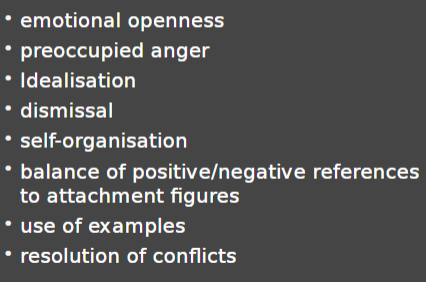
- Adult attachment interview (AAI)
It aims to explore adults' internal working models of attachment by examining their responses to semi-structured interview questions about their childhood experiences and relationships with attachment figures
Similar to the Strange Situation procedure used in assessing infant attachment, the AAI categorizes adults into five attachment classifications:
- Autonomous: Individuals who demonstrate coherence, reflection, and a balanced evaluation of their childhood experiences.
- Dismissing: Adults who downplay the importance of attachment relationships or dismiss the impact of their early experiences.
- Preoccupied: Individuals who are overly preoccupied with attachment-related issues and may have difficulty maintaining coherence in their narratives.
- Unresolved/Disorganized: Adults who show unresolved issues or unresolved trauma in relation to their attachment experiences, often characterized by lapses in coherence or emotional distress.
- Cannot Classify: Cases where the interview cannot be reliably classified into any of the above categories due to various factors such as extreme defensiveness, refusal to discuss attachment topics, or inconsistency in responses.
IMPACT OF CAREGIVING ON ATTATCHMENT
Importance of being present and available physically and emotionally. Responsiveness means that caregivers addresses the needs of the child sensitively, accurately and directly.
Affective attunement- the process in which the caregiver recognizes the emotional expression of their infant and reflects them back to the infant. Through repeated attunment experiences the child’s emotions are validated and regulated through the responsiveness of the caregiver.
Attachment Theory: The WEIRDest Theory in the World”
WEIRD: Western Educated Industrialised Rich and Democratic countries
The paper criticizes the Western-centrality of the Attachment Theory
Keller suggests that diversity should be taken into account as well as cultural beliefs and
practices
Cultural differences in Socialisation strategies,
1. Japan – insecure group consisted of only resistant children, with no avoidant ones
2. Israel - revealed a high frequency of the ambivalent pattern
Comparative Cognition and Principles of Evolutionary Theory
The study of the origins human mind
- Evolutionary theory (Darwin, Wallace and followers): humans share certain cognitive abilities with other species.
- Cognitive science and cognitive psychology: Using concepts such as representation, information processing, learning, memory and decision making to draw on these ideas to interept data, develop theories about cognitive abilities in different species.
- Philosophy of mind: explores and question about the nature of consiciousness, mental states and the relationship between the mind and the brain.
CHARLES DARWIN AND ALFRED WALLACE
- Both proposed theory of evolution by natural selection, which revolutionized our understanding of the origins of species.
Darwin- “On the origins of Species”
Wallace- “On the tendency of varieties to depart indefinitely from the original type”
Both discussed...
- Adaption: species evolve through natural selection, whereby traits that enhance an organism’s survival and reproduction in a particular environment become more common over time.
- Natural selection- Advantageous traits are passed on to future generations, leading to the gradual change and diversification of species over time.
Cognitive differences reflect variation rather than kind.
Romanes (1881)- published “Animal Intelligence” which presented a series of studies on the cognitive abilites of various animal species. Critised for lacking good methodology.
BEHAVIORISM (focus on observable behavior and rejected introspection)
- Anthropocentric
- Emphasized importance of studying observable behavior tather than intropective methods of structuralism and functionalism.
- Analyzed the relationship between environmental stimuli and behavioral responses. Behavior direct result of the stimuli present in the environment and the organism’s repose to those stimuli.
- Rejected the use of mentalists explanations for behaviors, like feelings and internal states. More focus on external and observable behavior.
- “Black box” analogy focuses on the inputs (stimuli) and outputs (responses) of the box, where , behaviorists were primarily concerned with describing the relationship between environmental stimuli and behavioral responses, without speculating about the internal processes within the mind or brain.
HAECKEL- ONTOGENY RECAPITULATES PHLOGENY (1866)
Proposed that during the process of ontogeny (individual development), an organism passes through stages that resemble the evolutionary history of its species or phylogeny.
- Modern biology rejected is ideas as being too simplistic. Since biologists have not been able to identify precise developmental stages in humans. For example, human embryonic development does not neatly recapitulate the stages of fish or reptile embryogenesis, despite humans sharing a common ancestry with these groups.
- Biology acknowledges a related phenomenon: organisms within the same evolutionary lineage often share similar early developmental stages before diverging into distinct adult forms. While ontogeny may not exactly recapitulate phylogeny, closely related species tend to exhibit similar patterns of embryonic development early in ontogeny before diverging into different adult morphologies.
- The most precise way to describe this phenomenon is that related organisms begin with a shared general embryonic form, reflecting their common evolutionary ancestry. As development progresses, they diverge into distinct adult morphological characteristics.
COMPARITIVE COGNITION
Representation plays a crucial role in understanding how organisms process information from their environment.
Representation- refers to the mental constructs or internal models that organisms use to encode, store, and manipulate information about their environment, themselves, and their past experiences
Gallistel’ computer analogy- analogy between cognitive processes and the operations of computers. In this view, the human mind is likened to an information processing device, much like a computer, that receives input from the environment, processes it, and generates output in the form of behavior or responses.
STUDIES OF ANIMAL INTELLIGENCE IN LIGHT OF DEVELOPMENTAL SCIENCE
Tinklepaugh's experiments in 1928 and 1932 focused on studying the capacity of nonhuman primates, specifically rhesus monkeys and cynomolgus monkeys, to remember and represent hidden objects in delayed response tasks.
Monkey shows a piece of lettuce and placed it underneath one of the cup behind the screen. Then Tinklepaugh changes the procedure slightly. Where the monkey is shown a banana, places it underneath the cup behind the screen. However, he changes the banana for a piece of lettuce. This switch was intended to test whether the monkeys could maintain a representation of the hidden object (lettuce) despite the introduction of a distracting stimulus (banana). After a delay, Tinklepaugh removed the screen, allowing the monkeys to choose one of the cups. The monkeys' ability to remember the original location of the lettuce and select the correct cup indicated their memory capacity and ability to represent hidden objects.
Uller’s (2020) cognitive abilities of monkey regarding objecthood and number.
- Study explores whether monkeys possess the cognitive ability to represent individual objects that are hidden from view. understanding whether monkeys can form mental representations of specific objects and retain these representations over time, even when the objects are no longer visible.
ETHOLOGY
- Ethology is the scientific study of behavioral mechanisms, observing animals in their natural environment to understand how they behave, interact and adapt in their environment.
- Focused on understanding the driving behavior, development and survival value of naturally occurring behaviors.
- Lorenz and Tinbergen showed that there are innate mechanisms in animals that guide behaviors.
- Fathers of ethology- Lorenz, Tinbergen, Frisch
- Sign stimulus or releasing stimulus refers to a specific stimulus that triggers a particular behavioral pattern in an animal.
Releaser: a specific stimulus that elicits a particular response in an organism.
Role of releaser: Bridge the gap between environmental stimuli and behavioral responses, providing a mechanism thorugh which organisms respond adaptively to their surroundings.
Releasers are often simple and specific, yet they can elicit complex sequences of behavior in specifics (members of the same species). For example, in the case of gulls, a red dot placed on the beak of an adult gull serves as a releaser for feeding behavior in other gulls. This simple visual cue triggers a complex behavioral response related to feeding.
- Smiling in babies operate as a releaser, with the configuration of the eyes serving as minimal stimuli that trigger social responses in caregivers.
TINBERGEN’S (1963) 4 LEVELS OF ANALYSIS FRAMEWORK
Published foundational manuscript identifying the 4 questions we ask in animal behavior:
- How does the behavior emerge across the lifespan (development)
- How does it work (mechanism)
- How and why did it evolve (evolution)
- Why is it adaptive (function)
INSIGHT AND PROBLEM SOLVING
Teuber and Kohler measured chimpanzee's reaction to various problems presented to them daily. Exploration of insight in chimpanzees refers to sudden realization or understanding of a problem’s solution without the need for trial-and-error learning.
“sultan”- demonstrated strong problem-solving abilities by using a series of sticks to retrieve a banana placed out of reach
Instinct- an innate propensity in organized being, varying with the species, and manifesting itself in acts which appear to be rational. Performed without conscious design or intentional adaptation of means to ends.
GALLUP (1971)
“Mark test”- used to investigate self-awareness in chimpanzees.
The test involves placing a visible mark, such as a colored dot or sticker, on an animal's body in a location that can only be seen in a mirror reflection. The animal is then given access to a mirror and observed to see if it shows signs of recognizing the mark as being on its own body. Research revealed that chimpanzees, unlike many other animals, demonstrate self-awareness by using mirrors to investigate their own bodies. When presented with a mirror, chimpanzees have been observed to engage in behaviors such as touching or examining the marked area on their bodies, indicating that they recognize themselves in the mirror and understand that the mark is on their own body.
In contrast to chimpanzees, monkeys typically do not demonstrate self-recognition in mirrors. When presented with a mirror, monkeys often exhibit behaviors suggesting that they perceive the reflection as another individual, rather than recognizing themselves.
BOYSEN (1993)
ocus on their understanding of symbolic language and their capacity for abstract thinking.
One of Boysen's notable contributions in 1993 was her study involving a chimpanzee named "Sally." In this study, Boysen taught Sally to communicate using lexigram symbols—a set of abstract symbols representing words or concepts. Through training and reinforcement, Sally learned to associate these symbols with specific objects, actions, or ideas and was able to use them to communicate her desires and thoughts to researchers.
CLEVER HANS PERFORMS IN PUBLIC (1907)
Clever Hans could solve mathematical problems, read, spell, and understand German language.
Through careful observation and experimentation, Pfungst discovered that Clever Hans was not actually performing intellectual tasks based on understanding, but rather was responding to subtle cues from his human handlers. Clever Hans was highly attuned to unintentional cues, such as changes in facial expressions, body language, or posture, which inadvertently signaled to him when to stop tapping his hoof.
THE SPONTANEOUS REPRESENTAION OF NUMBER IN COTTON-TOP TAMARINS
- Researchers aimed to investigate whether cotton-top tamarins possess an innate understanding or representation of numerical quantities.
- They used a preferential looking paradigm, where tamarins were presented with two arrays of dots containing different numbers of dots, and their visual preferences were observed.
- The results of the study revealed that cotton-top tamarins showed a spontaneous preference for the larger of two numerical quantities. This preference was consistent across various numerical contrasts, suggesting that the tamarins could discriminate between different numerical quantities based on visual cues alone.
DITZ AND NIEDER (2015)
Ditz and Nieder conducted a significant study that investigated the neural mechanisms underlying numerical cognition in corvid songbirds, such as crows. Their research focused on identifying specific neurons in the corvid brain that are selectively responsive to the number of visual items.
- Researchers identified neurons that exhibit selectivity to the number of visual items presented to the birds. These neurons respond preferentially to specific numerical quantities, such as one, two, or three items, indicating a specialized role in numerical processing.
- Importantly, Ditz and Nieder's findings demonstrated that individual neurons in the corvid brain can encode abstract numerical concepts, such as the quantity of items in a visual display. When a crow is presented with a set of visual stimuli, such as dots, grains, or potential threats (e.g., hunters), single neurons in the corvid brain respond selectively to the numerical value of the group, such as "threeness."
SALAMNADERS; RUDIMENTS OF NUMBER IN A SPECIES OF BASAL VERTEBRATE
- The study aimed to investigate whether salamanders, specifically the species Plethodon cinereus, possess rudimentary numerical abilities
- They used a food choice paradigm, where salamanders were presented with two options containing different numbers of prey items (fruit fly larvae). The researchers then observed the salamanders' choices to determine if they showed a preference for larger numerical quantities.
- The study's results revealed that salamanders showed a preference for larger numerical quantities of prey items.
Theory Of Mind
WHAT IS THEORY OF MIND
Refers to the ability to attribute mental states, beliefs, intents, desires, emotions to oneself and others. It is the ability to understand that others have beliefs, desires, intentions different from our own. It enables individuals to comprehend and predict the behavior of others, understand social interactions, engage in empathy, and navigate complex social situations. Theory of mind is believed to be essential for effective communication, social interaction, and the development of complex social relationships
FALSE BELIEF
- Understanding that others have a different (false) belief to your own. This concept is often used as a measure of theory of mind.
Example:
Change of location task: Wimmer and Perner (1983): Sally-Anne test: In this scenario, a child is shown a story where Sally puts a marble in a basket and leaves the room. While she is away, Anne moves the marble from the basket to a box. The child is then asked where Sally will look for the marble when she returns. If the child understands false belief, they will recognize that Sally will falsely believe the marble is still in the basket, even though the child knows it's in the box.
Different from the Maxi test, real toys were used. They tested 27 TD children, 20children with ASD and14 children with Down Syndrome. 80% of children with ASD failed the task (age 10-15)
Unexpected contents task: Perner (1987): In this task, In the task, Maxi puts his chocolate in the cupboard, but when he's away, his mum moves it to the fridge. Children are asked where Maxi will look for his chocolate when he returns. After the object has been moved, the children are asked a critical question, such as "What does Maxi think is in the chocolate?" Children who understand false belief will recognize that Maxi will mistakenly believe that the object is still in the original location (the cupboard), even though the child knows it has been moved.
3-9 yo children
0% of 3- to 4-year-olds,
57% of 4- to 6-year-olds,
86% of 6- to 9-year-olds passed the test
The main difference between is that unexpected task is testing the child’s false belief in terms of its content not location. These variations can influence the cognitive demands placed on the child and may yield different insights into their understanding of false belief.
Unexpected identity task:
The "Appearance-Reality task" is an experimental paradigm used to assess children's understanding of appearance versus reality and their ability to distinguish between first-person and third-person false beliefs.
In this task, children are typically presented with an object that looks different from its identity. For example, they might be shown a sponge that looks like a rock. Children are then allowed to touch the object to discover its real identity, which contradicts its initial appearance.
The task can be used to measure both first-person and third-person false belief understanding:
- First-Person False Belief: Children are asked to indicate what they initially believed the object to be based on its appearance and then how their belief changed after discovering its real identity. This aspect of the task assesses children's ability to recognize and reconcile their own false beliefs with reality.
- Third-Person False Belief: Additionally, children may be asked to predict what another person (e.g., a puppet or story character) would believe about the object's identity based on its appearance. This aspect of the task evaluates children's understanding of how someone else's beliefs might differ from their own, even when presented with the same information.
The results of studies using the Appearance-Reality task have shown age-related improvements in understanding. For example, fewer than 50% of 3-year-olds typically demonstrate an understanding of the real versus unexpected identity of the object, whereas more than 65% of 5-year-olds exhibit this understanding. This developmental progression suggests that children become increasingly adept at recognizing and distinguishing between appearances and reality, as well as understanding differing beliefs between themselves and others, as they grow older.
Control questions are asked to ensure that their responses are based on understanding of the task:
- Reality Question: "Where is the marble really/now?" This question confirms whether the child understands the current or true location of the marble, demonstrating their grasp of reality.
- Memory Question: "Where was the marble in the beginning?" This question evaluates the child's memory of the initial location of the marble, ensuring that they can recall the original setup of the scenario.
The Change of Location task primarily measures children's understanding of third-person (other) false belief, rather than first-person (self) false belief. In this task, children are asked to predict where a character (e.g., Maxi) will look for an object when they return to the scene, based on that character's false belief about the object's location. The task assesses the child's ability to attribute false beliefs to another person, rather than considering their own beliefs.
According to the findings of the Language ability and false belief understanding study (2007), there is a significant correlation between children's language proficiency and their understanding of false beliefs. The study revealed that language skills play a crucial role in children's ability to comprehend and navigate the complexities of others' beliefs and perspectives. As children develop language abilities, they gain access to the vocabulary and syntactical structures necessary for discussing and understanding mental states, which lays the foundation for theory of mind development.
“Reading the Mind in the Eyes (RMET)” Baron (2001), the ability to recognize facial expressions of emotions Soley from the eyes. RMET used as a measure to assess emotion recognition abilities. Particularly in research related to autism. However, individual with ASD may also experience alexithymia (inability to recognize or describe ones own emotions) thus other factors influence their emotional processing difficulties.
FACTORS INFLUENCING CHILDREN’S PERFORMANCE
- Executive Functions
- Essential cognitive processes that enable complex goal- directed behavior
- An umbrella term that encompasses higher order processes that support adaptive responses to novel or complex situations.
Lecce et al. (2017) demonstrated a link between children's performance on false belief tasks and their performance on tasks measuring executive functions.
Inhibition (the ability to suppress irrelevant or inappropriate responses), working memory (the capacity to temporarily store and manipulate information), cognitive flexibility (the ability to switch between different tasks or mental sets).
- Language skills (look at meta analysis example)
- Family and social environment
Children from larger families performed better
(Perner et al., 1994)
- Children with older (but not younger) siblings
performed better (Ruffman et al., 1998) - Children who spoke about their mental states
to their friends and siblings performed better
(Brown et al., 1996)
DECEPTION IN 3-YEAR OLDS
Children from larger families performed better
(Perner et al., 1994)
o Children with older (but not younger) siblings performed better (Ruffman et al., 1998)
o Children who spoke about their mental states to their friends and siblings performed better (Brown et al., 1996)
o The number of days spent with playmates predicted ToM performance (Shahaeian, 2015)
PRO-SOCIAL BEHAVIOR
Meta analysis of ToM and prosocial
behaviours across 76 studies including
~6500 children aged between 2-12
(Imuta et al., 2017)
• Helping, comforting, sharing, and
cooperation
• ToM measures of cognitive and
affective perspective taking (CPT and
APT)
• Overall positive correlation (but small
magnitude) (r = .19)
• APT had stronger correlations than CPT
This suggests that children with stronger ToM abilities tend to exhibit higher levels of prosocial behavior, such as helping, comforting, sharing, and cooperation. Interestingly, the analysis also indicated that affective perspective taking (APT) tasks had stronger correlations with prosocial behaviors compared to cognitive perspective taking (CPT) tasks. This suggests that understanding and empathizing with others' emotions may be particularly important for engaging in prosocial behaviors.
Prosocial behavior and ToM are closely related in that both involve an understanding of others' internal states and the ability to respond appropriately to those states. Specifically, ToM enables individuals to recognize when others are in need, to empathize with their feelings, and to understand the impact of one's actions on others. This understanding allows individuals to engage in prosocial behaviors by responding to the needs and emotions of others in a compassionate and helpful manner. This ability to take others' perspectives enhances empathy and promotes prosocial behavior by enabling individuals to anticipate the needs and feelings of others and adjust their behavior accordingly. In this way, ToM acts as a cognitive foundation that supports the development and expression of prosocial behavior