Chemical+Kinetics
Kinetic
We are talking about reaction rates..
A rate is measured by a change that occurs per unit of time.
The rate of a chemical reaction, or reaction rate, is measured as a change in amount of a reactant or product over a certain timescale.
We are talking about Reaction Rates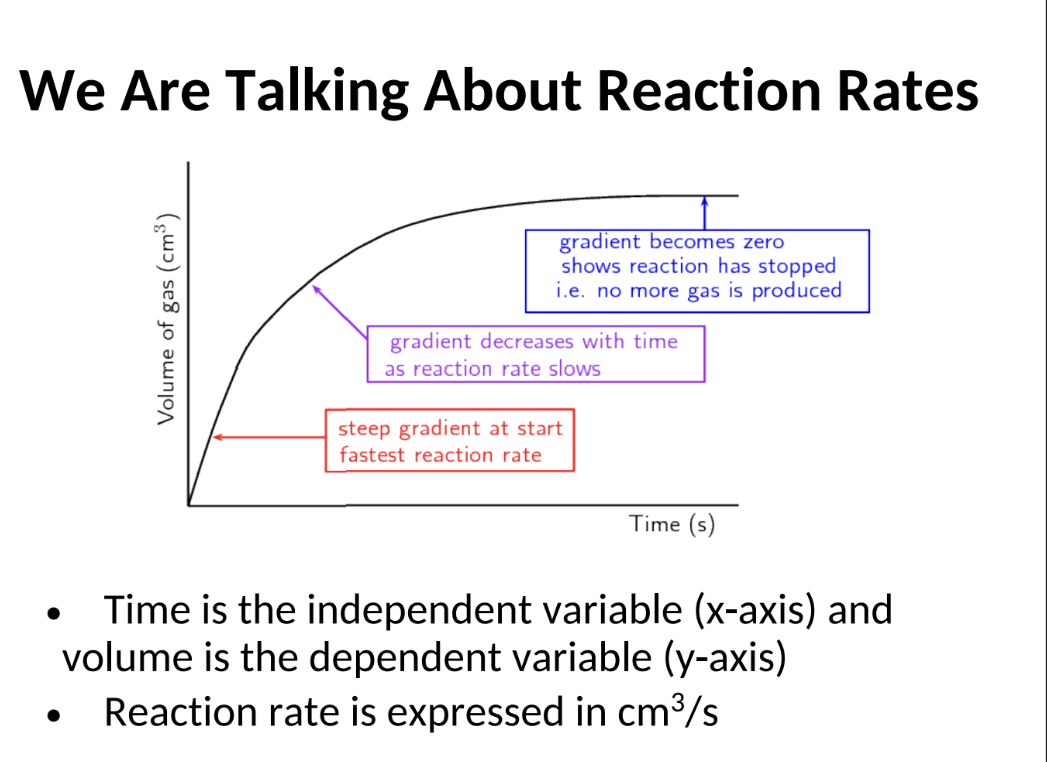
Time is the independent variable (x-axis) and volume is the dependent variable (y-axis).
Reaction rate is expressed in cm³/s
The 3 Fundamental Questions of Chemical Reactions
What happens?
→Answer given by balanced chemical equation and stoichiometry
To what extent does it happen?
→ Answer deals with chemical equilibrium which we will study in a later unit.
How fast and by what mechanism:
→ Chemical Kinetics.
Why? Important Examples
Biological: Large proteins (enzymes) increase the rates of numerous reactions essential to life.
Environmental: The maintenance or depletion of the ozone layer depends on the relative rates of reactions that produce or destroy ozone.
Economic: The synthesis of ammonia (NH3) from N2 and H2 depends on the rates of reaction. Fertilizer industries use catalysts to speed up these rates for economic reason.
Exothermic Reaction Coordinate Diagram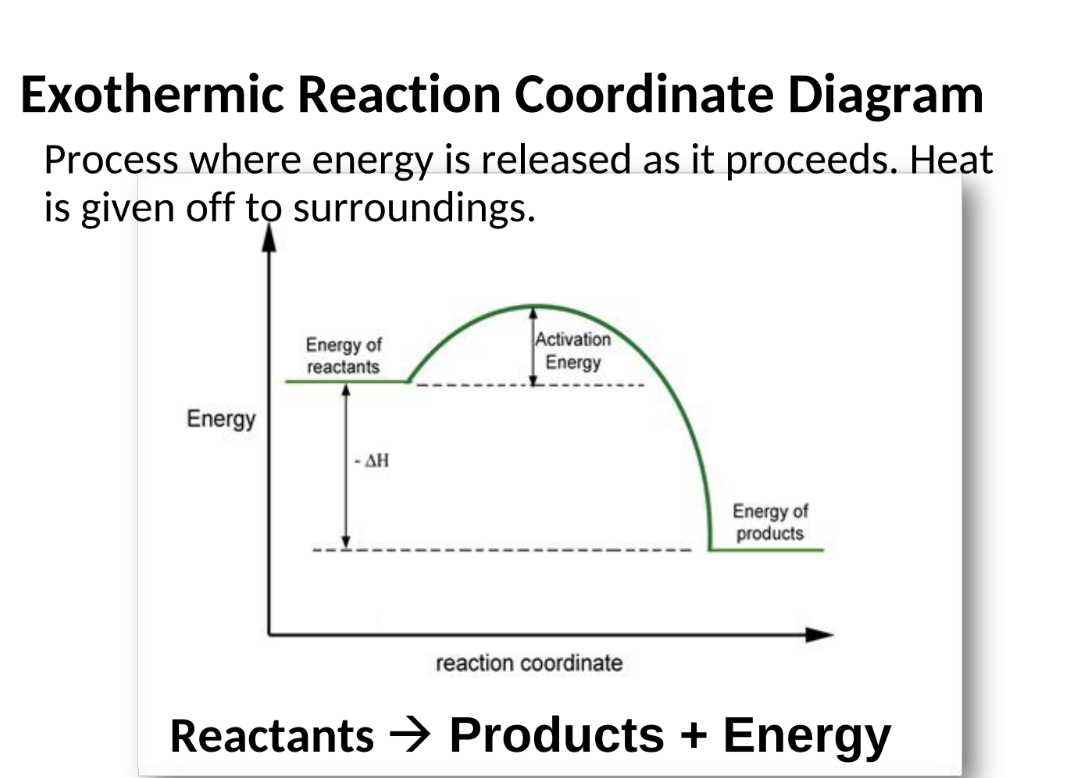
Exothermic Reaction Diagram: Process where energy is RELEASED as it proceeds. Heat is given off to surroundings.
Reactants → Products + Energy
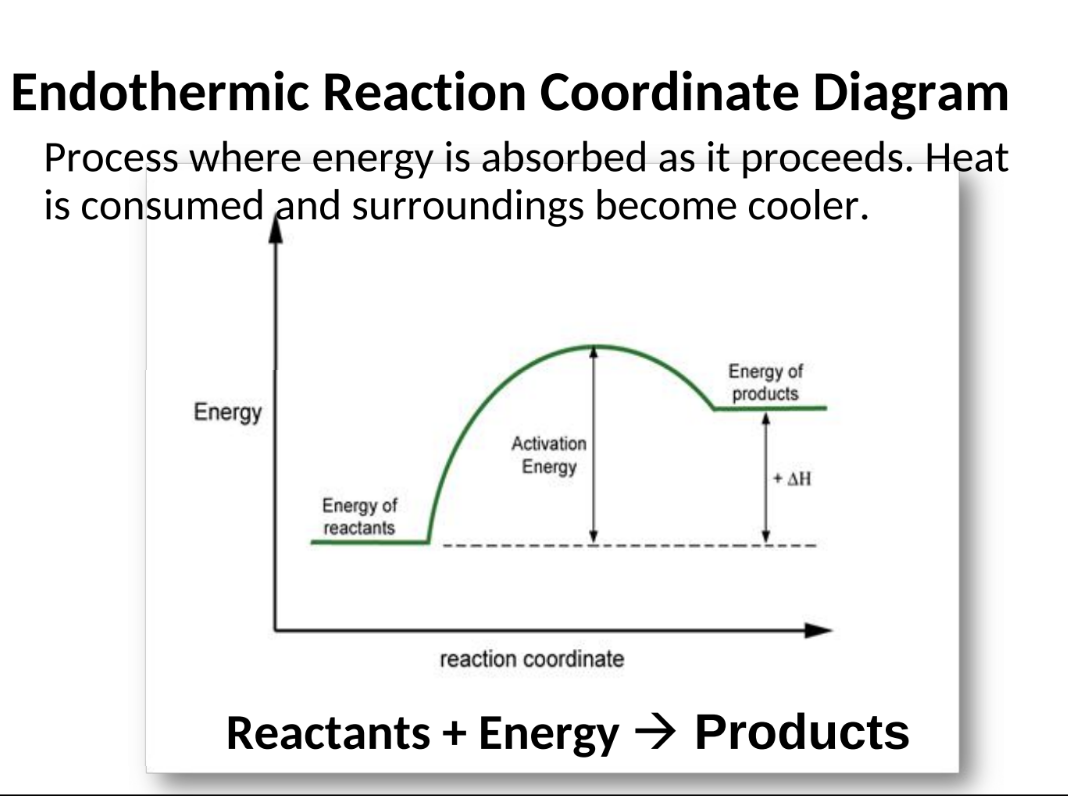
Endothermic Reaction Diagram: Process where energy is absorbed as it proceeds. Heat is consumed and surroundings become cooler.
Reactants + Energy → Products
Factors that affect Kinetics
(BASED ON COLLISION THEORY)
Collision theory: For a reaction to OCCUR, the atoms or molecules must collide with one another enough energy (activation energy) and must collide in the right orientation.
→ Enough particles have to collide with enough activation energy and in the right orientation, or they will not react. The particles will just bounce off each other.
Factors that AFFECT KINETICS!
→ Concentration
→ Temperature
→ Presence of a catalyst
→ Surface area
→ Agitation
→ Nature of reactants
Factor 1: Concentration
→ Concentration of reactants
If you increase concentration (molarity), the rate if reaction increases.
Why?
There are more molecules which increases the number of collisions altogether; However, there are better chances that molecules will collide in the right orientation.
Factor 2: Temperature
→ Temperature
Temperature is an averaged kinetic energy of molecules so if you increase temperature, you increase kinetic energy. This means you increase the number of collisions.
Heat supplies the energy to allow the reaction to proceed (i.e. overcoming the activation energy barrier)
Factor 3: Presence of Catalyst
→ Presence of a catalyst
Catalysts increase the reaction rate without being consumed in the reaction.
Adding a catalyst decreases the activation energy, which means more molecules will have enough energy to react.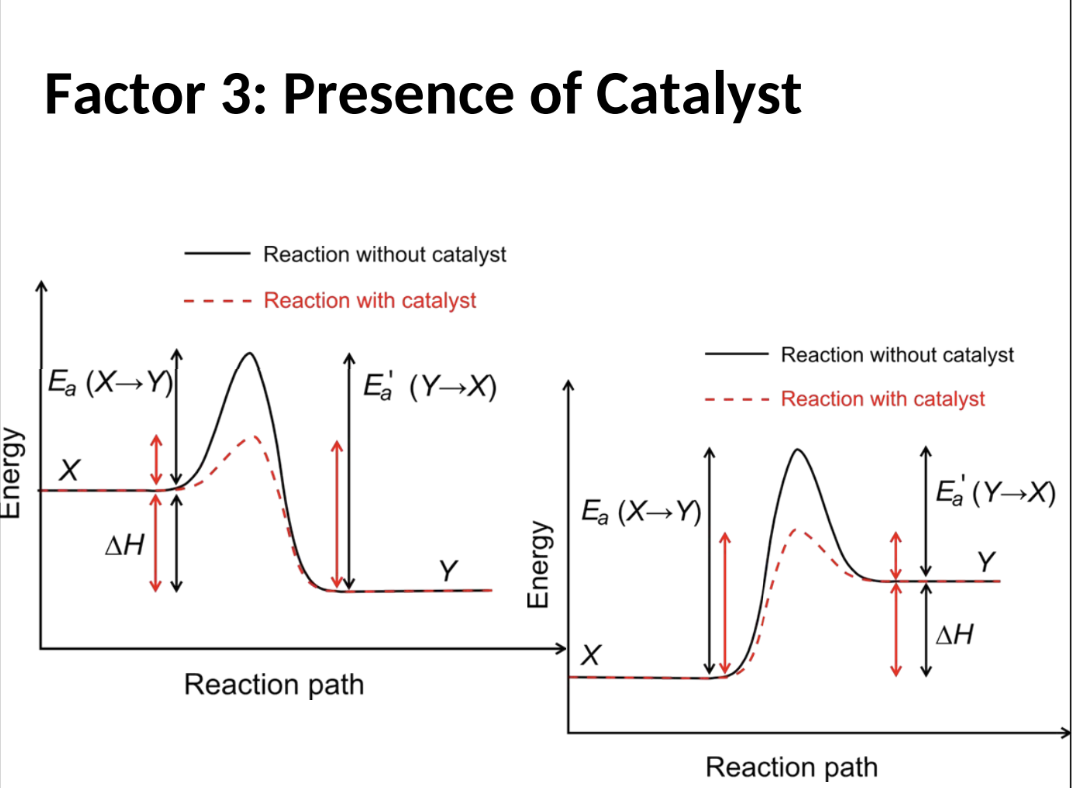
Factor 4: Surface Area
Increased surface areas of molecules / particles will increase the rate of reaction. This means to break into smaller particle sizes by grinding or crushing a mixture of reactants.
More places to give better chances for collisions in the right orientation.
Factor 5: Agitation
Stirring or shaking a reaction will increase the reaction rate.
When agitating, you are introducing energy into the reaction and thus giving molecules/particles more energy to react (overcome activation energy barrier). your mechanical energy is converted to kinetic energy.
Factor 6: Nature of Reactants
Reactants whose bonds are weaker have lower activation energy and thus a higher rate of reaction. All chemical reactions involve bond breaking and bond making. Bond breaking occurs on reactant side. Collisions between reactabts that require less kinetic energy are needed to break weaker bonds (ie smaller activation energy)