3.2.1 & 3.3 Orthogonal Trajectories and Applications of Seperable Differential Equations
3.2.1 Orthogonal Trajectories
Finding parallel and perpendicular vector in terms of another vector
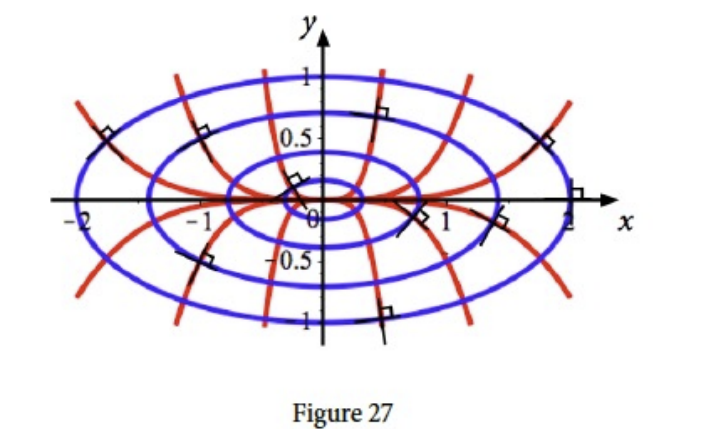
Example 14. Find the family of orthogonal trajectories corresponding to the family of curves and sketch several members of each family
Step 1) Differentiate the equation for the family of curves to get the differential equation that gives the slope of its tangent lines
Step 2) Substitute
Step 3) Find the negative reciprocal to find the differential equation for the corresponding family of orthogonal trajectories
This result is a family of ellipses (centers at the origin, major axes on the x-axis.)