econ u7 test review
Unit 4 Study Guide: The Global Economy, Chapter 17
- Why do individuals, businesses, and governments trade goods/services?
“We trade because we want things we cannot have”
Why do countries trade with each other?
- Because of scarcity.
- We only have so many resources.
- Our resources determine what and how much we can produce.
- By specializing and trading, nations can save valuable resources and still get what they need.
- To obtain goods that they cannot produce themselves; increase choices
- To make more revenues and profits. It is an extra place in which to sell their goods
- Countries specialize in the production of goods and services at which they are better (save time, resources)
Benefits when nations specialize:
- Creates a bigger variety of goods/services.
- Increases global output of goods/services.
- Creates better quality goods/services.
- Allows for an efficient use of resources.
- Lowers the costs of items.
Benefits of International Trade | Costs of International Trade |
|---|---|
|
|
- What is the difference between Absolute Advantage and Comparative Advantage?
Ex. The US can produce more bananas than Costa Rica (absolute advantage). Costa Rica can produce bananas more efficiently (comparative advantage) → US trades for bananas
ABSOLUTE ADVANTAGE: Where one producer is better at producing a product than another producer. (ability of one country, using the same amount of resources as another country, to produce a particular product at less cost)
COMPARATIVE ADVANTAGE: Where one country can produce a good at a relatively lower opportunity cost in terms of other goods than another producer. (ability of a country to produce a product at a lower opportunity cost than another country.)
- A country has an absolute advantage whenever it is able to produce more of a given product than another. Even when one country enjoys an absolute advantage, trade between it and another country is still beneficial because of comparative advantage.
- A country has a comparative advantage when it produces a product relatively more efficiently. Relative efficiency is determined by the opportunity cost of producing one product over another. Comparative advantage is based on the assumption that a country should produce a product that has a low opportunity cost. Each country must produce more of the good in which it has a comparative advantage and then exchange the extra output for the extra output of its trading partners
- Using the chart below, answer the following questions.
Corn | Soybeans | |
|---|---|---|
U.S. | 75 | 100 |
Russia | 60 | 40 |
Williams’ tactic: cross multiplication (rather than fractions)
So:
75 x 40 → US 3,000 corn
75 x 40 → Russia 3,000 soybeans
60 x 100 → Russia 6,000 soybeans
60 x 100 → US 6,000 corn
US should produce corn, Russia should produce soybeans
- Who has an absolute advantage in corn production?
Who has an absolute advantage in soybean production?
- What is the United States’ opportunity cost of producing corn instead of soybeans?
What is the United States’ opportunity cost of producing soybeans instead of corn?
- What is Russia's opportunity cost of producing corn instead of soybeans?
What is the Russia’s opportunity cost of producing soybeans instead of corn
- Who has the comparative advantage in corn?
Who has the comparative advantage in soybeans?
- What is the difference between an import and an export?
- Imports: goods that a country buys from another country
- Exports: goods that a country sells to another.
- Why is a nation with abundant resources better off trading than being self-sufficient?
Trade allows that nation to specialize and produce the most goods at the lowest opportunity cost.
- What is a trade agreement?
A wide-ranging taxes, tariff and trade treaty that often includes investment guarantees. It exists when two or more countries agree on terms that help them trade with each other. The most common trade agreements are of the preferential and free trade types, which are concluded in order to reduce (or eliminate) tariffs, quotas and other trade restrictions on items traded between the signatories.
- What is a trade deficit?
Bring in more than you export (imports > exports) ← balance of trade
- Define balance of trade and payments. Why is it important to maintain both?
- Balance of trade: difference between the value of a nation’s imports and its exports
- When countries trade with one another, two terms—balance of trade and balance of payments—are often used to summarize the activity. A balance of trade records the values of all goods and services exported from a country minus the value of all goods and services imported from outside the country. This is often referred to as the "trade surplus" (if exports exceed imports) or the "trade deficit."
- Balance of payments (money) → Do the profits from our exports cover the cost of what we’re importing?
- The balance of payments covers all the economic transactions of a country; this includes the trade balance, but it also includes other items such as the transfer of capital goods and changes in a country's official reserves.
- What is a trade barrier?
#13
A trade barrier is a means of preventing a foreign product or service from freely entering a nation’s territory.
- Each country of the world possesses different types and quantities of land, labor, and capital resources.
- By specializing in the production of certain goods and services, nations can use their resources more efficiently.
- Specialization and trade can benefit all nations.
- Why would a nation erect a trade barrier?
- Protect domestic jobs [protectionist policies]
- The two governments do not agree politically
- What are the costs/benefits of trade barriers over time?
Depends. Can protect domestic industries (good) but can lead to more political struggles (bad).
BENEFITS:
- Preservation of jobs
- Ensuring national security
- Ensuring health of citizens
- Government earns revenue (from tariffs)
- Putting pressure on another country to get what you desire
COSTS
- Raises prices of goods
- Reduces economic efficiency
- Reduces imports from developing countries
- Reduces consumer choices
- Producer does not efficiently use resources
Increased Prices for Foreign Goods
- Tariffs and other trade barriers increase the cost of imported products, making domestic products more competitive.
- Although manufacturers of many products may benefit from trade barriers, consumers can lose out (decreases supply, increases prices, limits choice).
Trade Wars
- When one country restricts imports, its trading partner may impose its own retaliatory restrictions.
- What methods are used to restrict free trade? Trade barriers [protectionist policies]
- Define the following methods:
- Tariff
- Define the following methods:
Tax on imported goods. This increases the price of that good, thereby decreasing the quantity demanded. A tariff might help a domestic producer stay in business, even though an imported good would (without the tax) be cheaper for domestic consumers.
- Quota
Limit on the number of goods that can be imported. That way, while a foreign good may be cheaper, domestic consumers can only buy so much of it before they have to buy comparable domestic goods instead.
- Standards
Regulations and rules that must be met for a product to enter the country. Governments employ standards to ensure the safety of imported goods and to make sure that these goods comply with local laws. For example, the use of lead in paint is severely curtailed in the United States due to the toxic effects associated with ingestion of this lead-based paint. However, other nations have no such law or prohibition. Therefore, the U.S. government has various agencies to ensure that imported goods adhere to the national standard, which prohibits use of lead in paint. In order to comply with this standard, foreign firms may have to incur higher production costs in order to use paint with no lead.
- Embargos
Prohibition of trading with another country. Can be broad or specific. While there are embargoes on particular goods and services, governments also place trade embargoes on nations that they disagree with, politically or otherwise. These embargoes prohibit trade in goods or services with businesses from the embargoed nation.
- Done because two countries don’t agree politically. We have an embargo with North Korea, with China, etc.
- Subsidies
Government makes payments to local manufacturers in order to reduce the production costs of the supplier. Lowered production costs should allow the local supplier to charge less for his/her goods and services, thereby making the local supplier more competitive in comparison to foreign firms offering the same goods or service.
- Government payments to producers → lowers cost of production → greater production
- What are the effects of trade barriers on manufacturers, consumers, and workers?
- Trade barriers protect domestic manufacturers
- Trade barriers make products more expensive (bad for consumers) BUT a consumer may decide that it's okay that they’re expensive as it will keep American money in America
- Workers of a domestic industry like trade barriers because they protect jobs
- What are the arguments for the following sides in terms of the respective topics?
Free Trade | Protectionism | |
|---|---|---|
Argue: because of our interconnectedness with China (especially with trade + money) → keeps us from throwing missiles at each other (increases safety for the time being) | National Defense | Argue: not necessarily true. China buys farmland in the US → do we want this? Do they have our best interest in mind? Protectionist view: NO. Some states have laws that foreign governments cannot own land in their states to protect us |
Make regulations on a global scale | Infant Industries ex. AI | Develop AI first (esp for national defense) before giving these secrets to bad actors like North Korea. Do we really want them to have the ability to use AI for their missiles? |
Lower goods being imported keeps money in the pockets of Americans | Money at Home | I would rather pay higher prices for American goods to give my money to the American worker |
OK that jobs have gone elsewhere because those goods are now cheaper. Those workers can change sectors to something we do better | Domestic Jobs ex. The steel industry (Rust Belt → manufacturing jobs have moved overseas) | We lost those jobs. People lost their careers. This is NOT OK |
Arguments for Protectionism
Protectionism is the use of trade barriers to protect a nation’s industries from foreign competition.
- Protecting Jobs–Protectionism shelters workers in industries that would be hurt by specialization and trade.
- Protecting Infant Industries–Protectionist policies protect new industries in the early stages of development.
- Safeguarding National Security—Certain industries may require protection from foreign competition because their products are essential to the defense of the United States
- Imagine you work for a newspaper. You have received the following answers from five people to a question about whether or not the government should protect American industry and workers by erecting trade barriers. On the line following each opinion, label the point of view as either favoring free trade or favoring protectionism and explain your answer.
- Debbie, homemaker: “I just bought back-to-school clothing for my children. Most of the items were made in Hong Kong or Taiwan. I like the quality and you can’t beat the prices. → Free trader
- Gary, farmer: “Much of my income comes from selling wheat to other countries. I think a restrictive trade policy would hurt our sales abroad.” → Free trader
- Marla, steelworker: “Cheap foreign labor is destroying the American steel industry. Two guys on my shift were laid off last week, and I don’t think I’ll have a job by the end of the year.” → Protectionist
- Major Henry Mecom, U.S. Army: “If the American computer industry is swamped by foreign competition, our national security will be threatened. We can’t afford to depend on foreign sources for computer technology.” → Protectionist
- Francis Rosen, recent college graduate: “I’ve been looking for a car. I sure would like to support American industries, but the Koreans and Japanese make the least expensive cars. I hope the government doesn’t raise the import duties.” → Free trader
Identify each of the following trade organizations. Indicate the regions served and the purpose of the organization.
Region | Purpose | |
|---|---|---|
ASEAN | Southeast Asia | Established to accelerate economic growth, social progress, and cultural development and to promote peace and security in Southeast Asia.
|
EU | Europe | Established to achieve economic, environmental, political, and defense goals that would not be possible working alone.
|
NAFTA | North America (USA, Canada, Mexico) | Established to eliminate all tariff and non-tariff barriers of trade and investment between the United States, Canada and Mexico.
|
- What is a Foreign Exchange rate? How do people benefit and lose from changes in the exchange rate?
The foreign exchange rate is the price of one country’s currency in terms of another country’s currency. The value of the $ changes daily against other currencies. It could become stronger or it could become weaker.
- Appreciation of currency: Appreciation refers to an increase in the value of a currency relative to another currency. When a currency appreciates, it gains strength compared to other currencies, meaning it can buy more of another currency. This can happen due to various factors such as strong economic performance, high interest rates, or increased demand for the currency.
- Depreciation of currency: Depreciation occurs when a currency loses value relative to another currency. When a currency depreciates, it becomes weaker compared to other currencies, meaning it can buy less of another currency. Factors leading to depreciation may include weak economic indicators, low interest rates, or decreased demand for the currency.
WHY DO EXCHANGE RATES MATTER?
- They influence the price of imports
- They influence the price of exports
- They affect tourism. Changes in exchange rates influence how much money you receive when you change your currency
- They can affect firms profits
- They can have an effect upon unemployment, inflation, economic growth and the balance of payments.
- What is meant by a strong or a weak dollar?
A stronger U.S. dollar means that:
- Americans can buy foreign goods, services, and resources more cheaply and U.S. imports will increase. This will benefit foreign producers.
- Americans can travel abroad less expensively.
- Foreigners find U.S. goods, services, and resources more expensive and U.S. exports will decrease. This impact could mean lost production and jobs in affected industries.
A weaker U.S. dollar implies that:
- Foreigners can buy American goods more cheaply and U.S. exports will increase. This could mean more production and employment in exporting industries.
- Foreigners can travel to the U.S. less expensively.
- Foreign goods become more expensive for U.S. residents and demand for imports will fall. This will harm foreign producers.
- What is a flexible exchange rate system? What determines the exchange rate?
Exchange rates are fixed or flexible. Flexible exchange rates, commonly used today, establish the value of each currency through the forces of supply and demand.
- What type of currency did the European Union establish? Euro
- Using the following exchange rate chart to answer the questions.
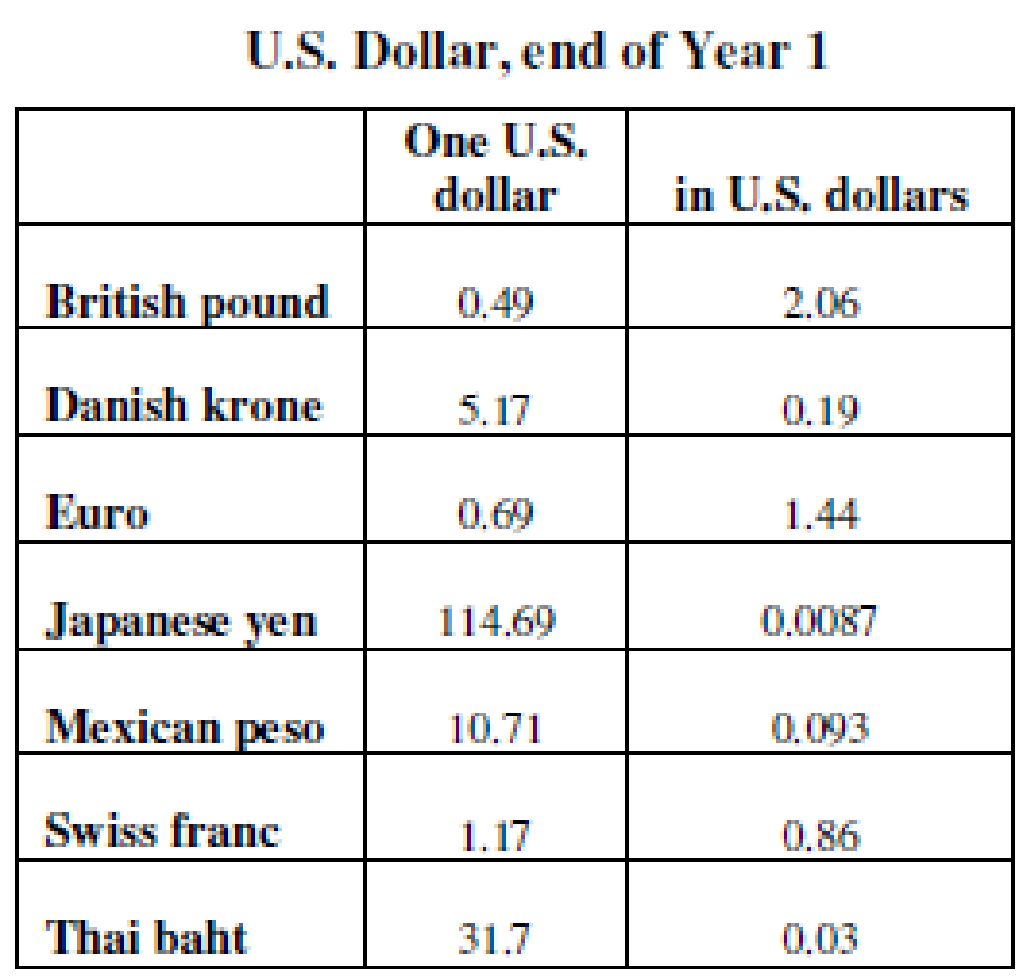
About how many U.S. dollars do you need to purchase one British pound? $2.06
About how many Mexican pesos do you need to purchase two U.S. dollars? $21.42
How many Swiss francs are needed to purchase a U.S. dollar? 0.86
----------------------------
IN CLASS REVIEW (past questions)
- Which economic system is best at providing incentives to produce? → market system (profit motive)
- To fix a US trade deficit → devalue the dollar (US products become more expensive, imports fall, exports increase)
- Fundamental beliefs of command economies: equality of resources distribution, central planning = stabilizing force, individual property rights are not important to economic development.
- Does NOT have most favored trade status with US → North Korea
- NOT an argument by those seeking protectionism → specialization increases efficiency
- Most favored nation status (US trading partner) = US will not give a better offer of tariff or quota rates to a third party nation [comparable to credit rates → prime rates offered to those with good credit]
- Most likely to support free trade → Coca Cola Corporation
- Tariffs make imported goods more expensive than domestic goods
- in UK, gov owns some industries (derense, contractors, etc) but private businesses own others. → mixed
- nafta = multilateral trade agreement
- remove tariffs on sugar → US sugar growers upset
- 1 Ruble to 2.2 Serbian dinars changes to 1 Ruble to 2.75 Serbian dinars. Ruble has appreciated; buy items in Serbia to get more for your money