psych
Prospective Memory - Remembering to perform a task at the original time you intended to do that task. Ex. Taking a pill daily.
Social Loafing - When an individual puts forth less effort while working in a group, than when working alone (where they would be judged individually for doing that task) Ex. Group projects.
Cocktail Party Effect - “Our ability to tune into a single voice from many conversations going on in a noisy room.”
Neurotransmitter - signaling molecule that carries a message
Dopamine - neurotransmitter, pleasure
Acetylcholine (ACh)- Neurotransmitter, muscle activation/activation
Serotonin - Regulates our MOODS(Happiness/Sadness)
Epinephrine/Norepinephrine - Fight/Flight Response
Gamma-aminobutyric acid (GABA) - Inhibits neurons from firing, Helps regulate daily sleep-wake cycles
Endorphins - Reduces pain
Glutamate - Used in MEMORY, learning, movement.
Display Rules - Cultural rules/norms that distinguish how one should express emotions. Ex. Burial.
Groupthink - When members of a group “tend to accept a viewpoint or conclusion that represents a perceived group consensus, whether or not the group members believe it to be valid, correct, or optimal.” When individuals in a group sensors beliefs in order to serve the harmony of the group.
Cognitive Dissonance - “Mental [strain] that results from holding two conflicting beliefs, values, or attitudes.” This strain/dissonance needs to be reduced. Ex: The man believes it's important to help the environment, but he drives a car that causes a lot of pollution.
Schema - The different categories that we organize information into our brains. Ex. Different classes. Also different types of vehicles.
Self-fulfilling Prophecy - An expectation about a situation that impacts an individual’s behavior in such a way that leads to those expectations becoming a reality. Ex: “Bad” student.
Big Five Personality Traits - Openness, Conscientiousness, Extraversion, Agreeableness, and Neuroticism. Current sectional study on stress - Stress levels 2022 ( Current 6th graders, Current 7th graders, and current 8th graders.) Longitudinal study on stress- (2022 stress levels students in 6th grade - 2023 stress levels same students in 7th grade - 2024 stress levels same students in 8th grade.)
The Development Stage Theorists
Kohlberg’s Theory - Moral Development
Piaget - Cognitive Development
Erikson - Psychosocial Development
Freud - Psychosexual stages.
Context Dependent Memories - The tendency to retrieve memories that correspond to the physical setting that we’re in.
Mood Congruent Memories - The tendency to retrieve memories that correspond to the mood that we’re in.
State Dependent Memories - The tendency to retrieve memories that correspond to the state (e.g. wide awake/sleepy, drunk, high, MOOD, etc.) that we’re in.
Encoding Failure - Long Term Memory (not remembering oddly specific details)Three Stage Processing Model (Atkinson-Shiffrin), Inputs - Sensory Memory - Working Memory —---Encoding—-----
Procedural Memory, Long Term Memory -
Explicit (Declarative) With conscious recall - Episodic Events , Semantic Facts
Implicit (Non-declarative) With conscious recall - Procedural Muscle Memory , Conditioning , and Priming.
Mass VS. Distributed Practice
Mass Practice - Cramming
Distributed Practice - Spacing out studying for short intervals over a period of time.
Convergent VS. Divergent Thinking -
Convergent Thinking - Finding ONE best solution. Ex: MC Test
Divergent Thinking - Finding creative or multiple solutions. Ex: 1. How many uses can you come up with a quarter? What are some different ways that you could earn some money to buy a car?
Parasympathetic vs. Sympathetic Nervous System -
Know Everything About Vision -
Parts of the Brain -
Social Facilitation vs. Social Inhibition -
Social facilitation - The tendency for one to perform easy or well learned tasks better in the presence of others.
Social Inhibition - The tendency for one to perform more difficult or less practiced tasks more poorly in the presence of others.
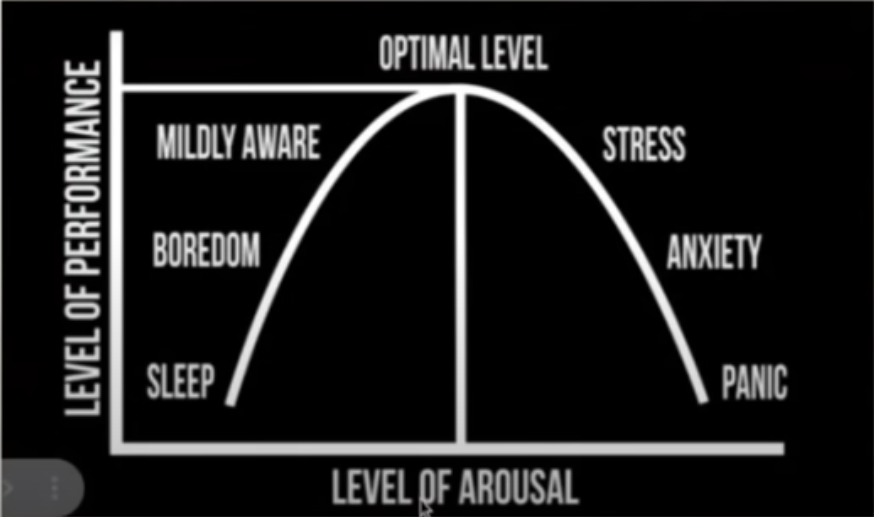
Yerkes - Dodson Law
26. Operant Conditioning - Attempt to stop a behavior/Get a behavior to occur again (Positive/Negative, Addition/Removal, Reinforcement/Punishment)
Positive Negative |
Reinforcement Rewards are given in order to get a behavior to occur again. The removal of an aversive stimulus. |
Punishment The ADDITION of something unpleasant in order to stop a behavior. The REMOVAL of something pleasant in order to stop a behavior. |
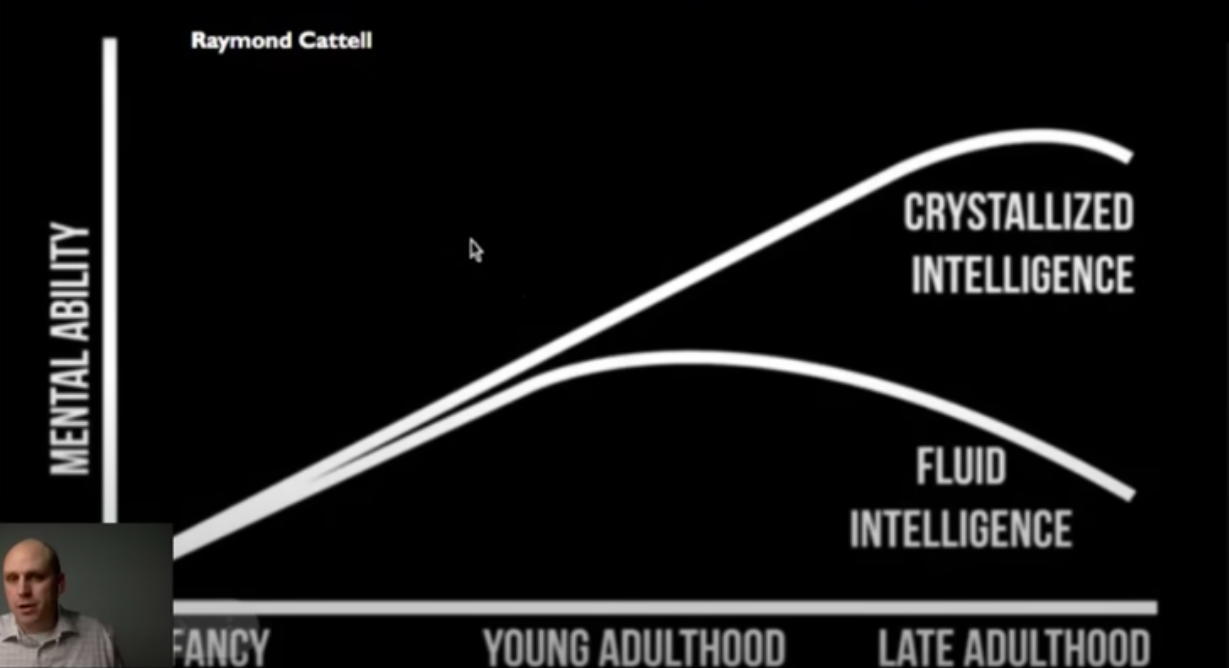
Fluid vs. Crystallized Intelligence
Fluid intelligence - The ability to solve new problems & reason abstractly. Decline with age.
Crystallized Intelligence - The accumulation of facts, knowledge, and skills over a lifetime. Increases with rage.
Deindividuation - When a group setting causes one to lose their self-awareness and abandon their normal straints.
Self-efficacy - How capable or confident a person feels in their ability to complete a task.
Heuristics - Bias - A rule thumb strategy for making quick gut decisions.
Availability Heuristic - A rule of thumb strategy used to make quick decisions based off information that comes to mind easily.
Intrinsic vs. Extrinsic Motivation
Intrinsic Motivation - The desire to perform a task comes from WITHIN the individual.
Extrinsic Motivation - The desire to perform a task comes from an EXTERNAL reward.
Overjustification Effect - A phenomenon in which a person becomes less internally motivated to pursue an activity after they are rewarded(extrinsic motivation) for something that they ALREADY love to do (instinct motivation).
Conformity - Where someone changes their beliefs or behaviors to align with a group.
Asch’s Line Experiment - Conformity (following the group on which answer was correct)
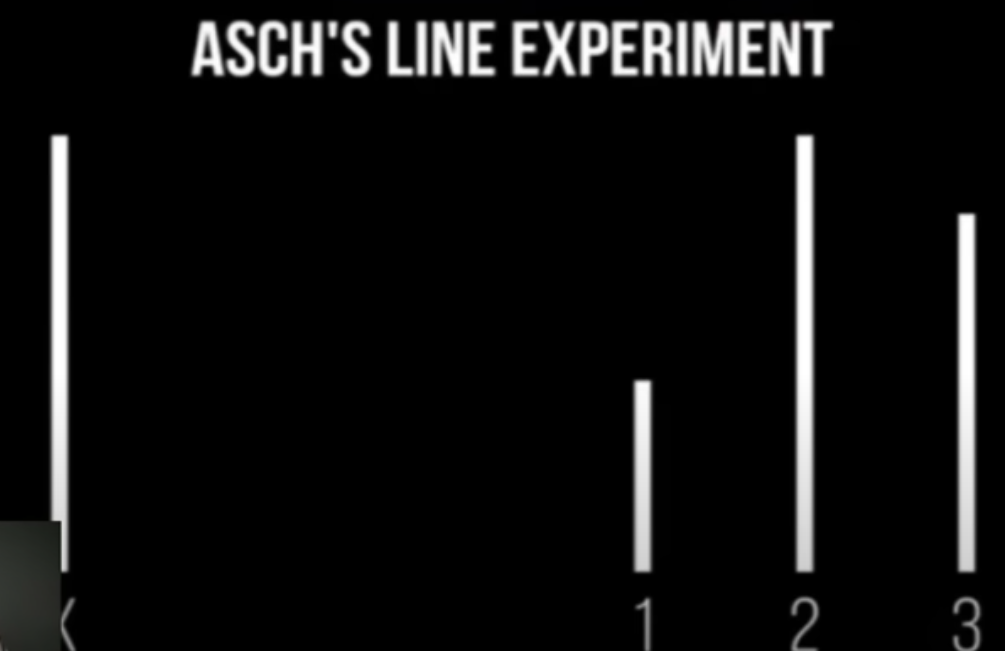
Normative Social Influence - When someone conforms because they want to FIT in with the group, even though they may not agree.
Informational Social Influence - When someone conforms because they think the group is actually RIGHT.
Proactive vs. Retroactive Interference
Proactive - Old info interfering with new
Retroactive - New info interfering with old
Observational Learning, Social Learning Theory, Modeling (Bandura) - Where an individual learns how to behave or act by watching others.
16. The different types of Research Methods - Case Study, Survey, Naturalistic Observation, Correlation, Experiment
KEY: Correlation does NOT imply causation
Only EXPERIMENTS can prove cause and effect!
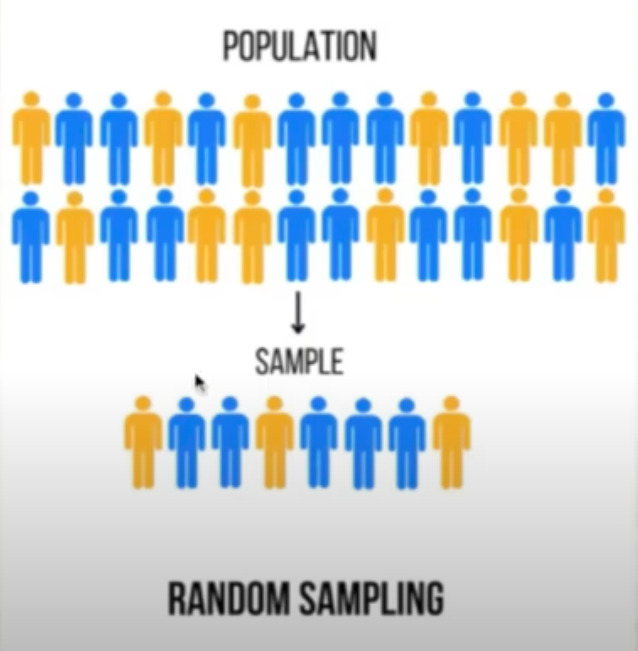
15. A researcher should seek to obtain a random sample when selecting participants.
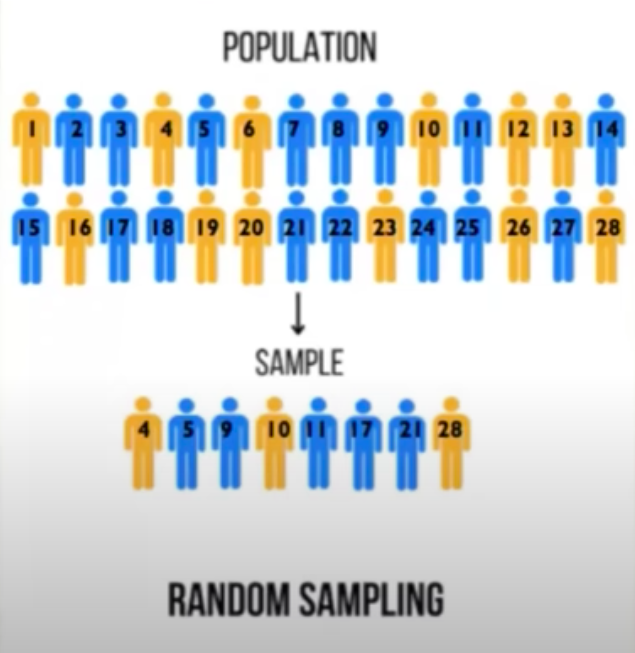
14. Using a random sample allows a researcher to make generalizations (Inferences) from the data.
Experiments - A research method in which an experimenter can determine cause and effect through the manipulation of a(n) independent variable(s).
Hypothesis - A prediction. - Ex: IF students drink caffeine before a test, THEN their scores will improve.
Independent variable - The variable which is manipulated by the researcher. Ex: The amount of caffeine before a test.
Dependent variable - What’s being measured. Ex: Test scores.
Confounding/Third/ Lurking Variables - A confronting variable “is an extraneous variable whose presence affects the variables being studied so that the results you get do not reflect the actually relationship between the “independent & dependent variables _ Alleydog,com
Operational Definitions - A detailed description of the steps, variables, and procedures. 1. Amount 2. Time/Duration 3. Change
Reliability vs. Validity
Reliability - can it be repeated
Validity - accuracy (for ex with length/weight)
Random Assignment
Experimental - yk this t
Control Group - yk this
Single-Blind Experiments - Only the participant is clueless
Double-blind Experiment - Both researcher and participant don’t know who got the real treatment
Placebo - self explanitory
Reminder: Don't confuse Random Sampling & Random Assignment.
Statistical Significance - The result of a study did not likely occur by chance.“There is a high probability that the independent variable causes changes in the dependent variable.”