Uranus (Part 4)
Uranus's Rings
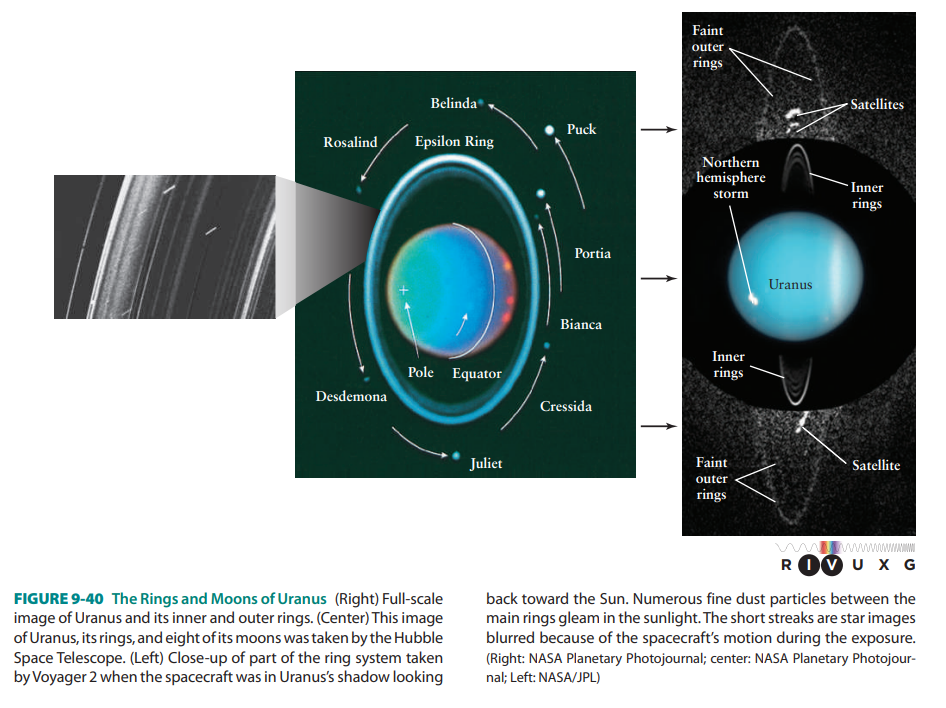
Uranus has 13 known rings, each divided into ringlets.
The first nine thin, dark rings were accidentally discovered in 1977 when Uranus occulted a star, blocking its light.
Occultation is the blocking of light from a distant object by an intervening body.
Other rings were detected by the Voyager mission and the Hubble Space Telescope.
The rings are maintained in orbit by shepherd moons, such as Cordelia and Ophelia.
Uranus's Moons
Uranus has 27 known moons.
Most moons, like the rings, orbit in the plane of the planet's equator, almost perpendicular to the plane of the ecliptic.
These unusual orbits resulted from tides created on Uranus by the moons, which altered their orbital direction.
Five satellites, with diameters ranging from 480 to nearly 1600 km, were known before the Voyager mission.
Voyager's cameras discovered an additional 10 satellites, each smaller than 50 km across.
More moons have since been observed from Earth, including several tiny, irregularly shaped ones that act as shepherd satellites.
Orbital Dynamics and Ring-Moon Interaction
Observations over 30 years (1970s to 2000s) show that moons near the rings are continuously changing orbits due to mutual gravitational influences and the rings' gravitational tugs.
Ring debris is consistently lost and replaced by material blasted off the moons, likely from meteorite impacts.
The moon Mab, discovered in 2003, is believed to be supplying dust for Uranus's outermost ring.
Miranda
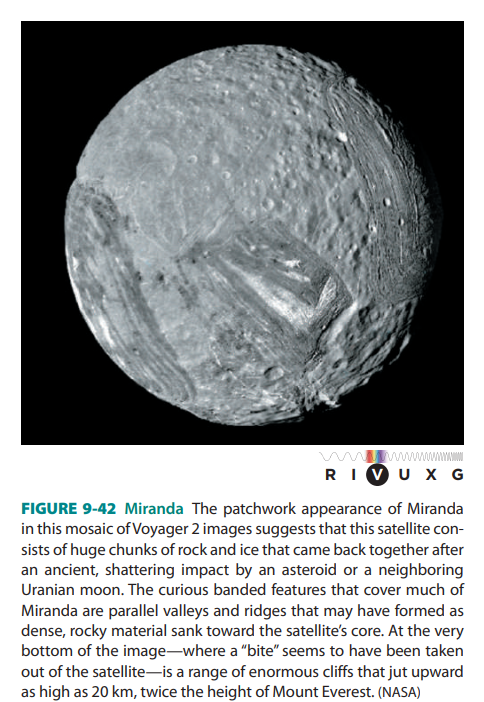
Miranda is considered the most fascinating and bizarre of Uranus's moons.
Its surface is covered with unusual wrinkled and banded features.
The highly varied terrain suggests it was once severely disturbed, possibly by:
A shattering impact that temporarily broke it into pieces, which then reassembled.
Intense tidal heating, similar to what is seen on Io, causing large sections of its surface to move.
Miranda's original structure likely included a dense rock core and outer layers composed mostly of ice.
Under the impact scenario, debris blocks broke off and then recoalesced due to mutual gravity, forming a chaotic mix of rock and ice.
The moon's current landscape is thought to be the result of dense rocks settling toward its center, pushing less dense ice blocks upward toward the surface.