Biology Module 3 + 4 - Biological Diversity and Ecosystem Dynamics
Selection Pressures
Abiotic factors such as:
Temperature
Soil type
Light intensity
Water availability
Gas concentration in water
Biotic factors such as:
Competition for resources
Predators
Availability of prey
Number of mates
Number of disease-causing organisms
availability and abundance of food
Abiotic Selection Pressures
In terrestrial → temperature range, light and water availability most commonly affect the abundance and distribution of a species
In aquatic → salinity is a key selective pressure
Environment Pressures
In Australia → rainfall, temperature and landform patterns significantly affect the distribution and abundance of vegetation and ecosystems
Changes in Population
Cane Toads
Native to South and central America
Deliberately introduced to Australia in 1953 to control the Greyback Cane Beetle, in sugar cane plantations
They quickly spread from their original release site in northern QLD to NT and northern NSW
Population travels approx. 60km a year and has increased from 102 to 200 million
Feed mainly at night
Ground dwellers
Eat insects, snails, frogs, birds and small mammals/reptiles
Absorb water through their skin
No known predators
Toxins
Cane toads contain toxins that kill any animals that try to kill them
Glands on their shoulders produce bufotoxin, which acts on the heart and central nervous system, causing rapid heartbeat, hyper-salivation, convulsions and paralysis
Toxin can be absorbed through membranes around the eyes, mouth and nose
Selection Pressures
e.g. Cane toads → predators with characteristics such as vulnerability to bufotoxin and increased preference to eat cane toads are removed from the population.
Predators that have increased resistance to bufotoxin and those that are reluctant to eat cane toads are the ones that survive and reproduce
Prickly Pear
Introduced in the 1800’s in Australia from the USA to start a cochineal dye industry
The growing conditions enabled the plant to propagate and cover 24 million hectares by 1920
It became a pest and a lot of money and time was invested into reducing its numbers
Controlling the spread
Early control methods → burning, crushing and the use of herbicides
By 1912, the prickly pear travelling commission was established → researched control agents
Cochineal beetle and Cactoblastis moth (showed the best results and was primarily used) were imported
Energy and the Food Chain
Food chain → shows the flow of energy through the community
Typical food chain: Producer → herbivore → carnivore → another carnivore
→ = is eaten by and the flow of energy
Food webs → complex set of interacting food chains within an ecosystem. They show all the interacting and interconnecting food relationships
Biomass Pyramid
At every step of the food chain energy is lost as heat and wastes
Biomass is lost as undigested material and wastes
Predation
Predator-prey relationship → feeding relationship where the predator obtains its food by killing and eating another animal
e.g. venus flytrap eats insects
Consequences of Predation
Predators affect the abundance and distribution of their prey
If the prey species can replenish itself as fast as it is predated, its population will remain stable
Factors that affect Predator and Prey Populations
Number of predators competing for the same prey
Availability of the prey’s food
Reproduction rates
Death rate
Ratio of males to females
Size of the ecosystem for supporting predator and prey numbers
Movement between ecosystems
Number of shelter sites available
Competition
When 2 or more organisms use 1 or more resources in common such as:
Food
Shelter
Mates
Types of competition
Intraspecific → compete with members of the same species
Interspecific → compete with members of another species
Plant Competition
Plants can complete for soil nutrients, water, space and sunlight
Allelopathy
The production of specific biomolecules by one plant, that can be beneficial or detrimental to another plant
Allelochemicals → produced by a plant to keep another plant from growing in its space
They may also release a chemical to change the amount of chlorophyll in another plant
E.g. eucalyptus leaf litter is allelopathic for certain soil microbes and plant species
Animal competition
Animals possess many defence mechanisms that may be used in intraspecific and interspecific competition
E.g. attack predators with teeth, claws, stingers, chemicals
E.g. camouflage, mimicry
Consequences of Competition
Affects reproduction and survival rates
Commonly, one species is more successful meaning the others population will drop in numbers
If one species is dominant for a long period of time the other will have decreased reproduction rates and increased deaths therefore leading to possible extinction

Decomposers
Organisms that cause decay
E.g. fungi, bacteria
They make the materials produced by the decomposition available to plants
By breaking down dead material, they provide the nutrients that other organisms need to survive
As decomposers feed on dead material, they leave behind nutrients which sinks into the soil
Adaptations
Is a characteristic that an organism has inherited and that makes it suited to its environment
An organisms chance of survival increases when adaptations work together
3 types of adaptations:
Structural -> how an organism is built e.g. physical features
Physiological → how an organism functions e.g. variations in the metabolism
Behavioural → how an organism acts or behaves e.g. response to a stimulus
Symbiotic Relationships
Symbiosis → interactions in which 2 organisms live together in a close relationship
Symbiosis usually involves providing protection, food, cleaning or transportation
Mutualism
Bothe species in the relationship benefit
E.g. The clown fish is protected from predators and cleans the anenome
Commensalism
One species benefits and the other is unaffected
E.g. Barnacles adhere to whales/turtles allowing them to be transported to diverse areas rich in food
Parasitism
One species is benefited and the other is harmed
E.g. Parasite obtains shelter from the host while it feeds upon its tissues/ fluid
Ectoparasite → live on the host
Endoparasite → live in the host
Macroparasite → visible to the naked eye
Microparasite → can only be seen with a microscope
Consequences of Symbiosis
Increased evolutionary diversification (biodiversity)
Development of new species from the integration of their genetic material (symbiogenesis)
Sources of new capabilities for organisms which enhances evolutionary ‘fitness’
Biological Diversity
Refers to the variety of all forms of life on earth, the diversity of the characteristics that living organisms have and the variety of ecosystems of which they are components
Diversity → what allows for evolution and adaptations
Genetic Diversity
Populations with reduced genetic biodiversity risk extinction in the long term
If there is biodiversity within a population → chance some may have pre-existing ability to survive and go on to reproduce
Theory of evolution
Living organisms arose from their common ancestors or a common life form and have changed over time
Differences that occur among groups of living organisms imply that living things change over time
Similarities occur in living things and suggest a common ancestry: basic chemistry has remained relatively unchanged
Darwin Wallace Theory of Evolution
Proposes that natural selection and isolation could account for how organisms adapt/evolve
Natural selection depends on:
Variability
Heritability
Over-reproduction
Competition between organisms/survival of the fittest
Neo-Darwinism
The explanation of Darwinian evolution based on modern genetics
Variation → applies to differences in the characteristics of individuals within a population
Heredity and variation are essential for this evolution to occur
Types of Speciation
Occurs if 2 populations become so different that they can no longer interbreed
Allopatric speciation → occurs when populations become isolated
Process:
In a parent population that has a large range with common gene pool, there is a regular flow of genes due to mating events between individuals
Part of the population becomes separated due to physical barriers, This prevents the flow of genes between the parent populations and the isolated populations
The 2 populations experience different selection pressures that favour some individuals with specific characteristics. This alters the frequency of specific genes
If the population are separated long enough, the gene pool of each population will change in isolation
Natural Selection
Variation within a population
Change in conditions (selective pressure introduced)
Individuals without favourable characteristics die
The individuals that survive, reproduce
Individuals pass on the favourable characteristics to the offspring
Life on Earth
The environment on early earth provided conditions for inorganic molecules to form organic molecules
Organic molecules then reacted with each other to form more complex organic compounds
Membranes formed around organic molecules to produce the first primitive cell called prokaryotic cells
Cells developed specialised compartments to carry out different chemical reactions
Larger cells ingested smaller cells, resulting in membrane-bound organelles such as chloroplast and mitochondria. These new cells are called eukaryotic cells
Diversification of life on earth
Cells clustered together and some cooperation between those cells occurred, colonial organism will result
When these cells began to specialise to carry out particular functions, it led to higher organisation and the selection of multicellular organisms
Urey-Miller Experiment
Modelled early water cycle
Discovered biomolecules such as amino acids and proteins can form from basic chemical compounds
These results created the field of prebiotic chemistry
Measuring Populations
Abundance → the number of individuals in a population
Distribution → where the population of a species is spread within an ecosystem
Quadrat Method
Used to estimate the abundance of plants
Quadrats are used to cover randomly selected representative areas for estimating the percentage cover of an area

Capture-Release-Recapture Technique
Used to calculate the abundance of animals. Animals are:
Captured
Sample animals are tagged
Animals are released
Animals are given time to mix back into the population
Another sample captured
Number of tagged animals in the second sample are counted


Transects
Provide an accurate and easy method of representing an area simply
Commonly used to give an idea of the variation that may occur
Changing Australian Ecosystems
Evolution of Australian Biota
Scientists analyse evidence of organisms from the past to determine how organisms in the present day have evolved
Monotremes → lay eggs
Marsupials → a mammal of an order whose members are born incompletely developed and are typically carried and suckled in a pouch on the mother's belly
Mammals → an animal that breathes air, has a backbone, and grows hair at some point during its life
Climate Change
Distribution and abundance of present day plants in Australia origins:
Those already on the continent when it split from Gondwana
Those that dispensed from South East Asia to Australia
Introduced species
Origins of animals that led to present day fauna:
‘Original residents’ → those that were on the continent when it split from Gondwana
Asian ‘Immigrants’ that arrived when sea levels were low
Those introduced by immigrant traders or late arrival aboriginals
Those introduced by European immigrants
Changing Flora and Fauna
Linked with the movement of continents and the effects on climate
Microevolutionary Changes and Speciation
Environmental Change
Resources may be limited
Living organisms will begin to compete for light, soil nutrients, and water in plants. or food, shelter, mates and breeding territory
Natural Selection
Some individuals have variations in their features that make them better suited to the change in environment
A diverse range of individuals allows the population to be better able to survive a sudden change
Diversity allows some organisms to compete more successfully for available resources and survive to breed and pass on their genes
Macroevolution
Takes place over millions of years, measured as geological time and results in a new species
Microevolution
Takes place over shorter periods of time and results in changes within populations, but it generally doesn’t produce new species
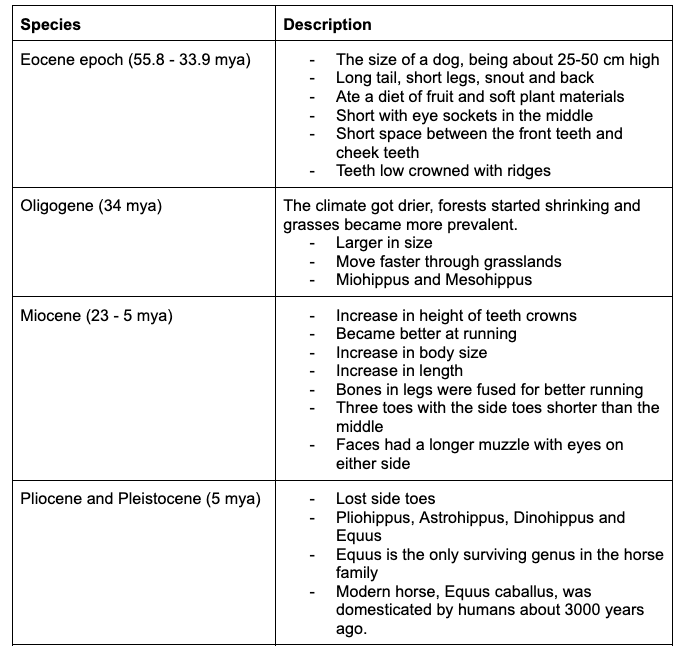
Evolution of the Horse
Convergent and Divergent Evolution
Darwin and Wallace
Studied and observed similarities in structure
Darwin-Wallace theory of evolution by natural selection and location therefore can account for both, certain traits in variants to better survive
Divergent Evolution
In closely related species, the basic similarities between organisms could be a result of their relatively recent divergence
Natural selection account for differences as they moved into different habitats, exposed to new selective pressures, result in evolution by natural selection to become different
Convergent Evolution
More distantly related species show similarities, result of similar environment, exposed to similar selective pressures and so natural selection could account for similarities
Adaptive Radiation
Describes evolutionary variation in species that evolved from common ancestor
Because of the migration of organisms into new environments, organisms begin to occupy new niches
Punctuated Equilibrium VS Gradualism
Two types of evolution that can occur in a species. A species can exhibit one or both of these evolutionary patterns
Gradualism
Suggests that populations slowly diverge by accumulating changes in characteristics due to different selection pressures
Suggests transitional forms should exist

Punctuated Equilibrium
The rapid speciation which occurs after extinction events to realise vacated niches
If there is no environmental change there is no evolution
Evolution occurs in short bursts of rapid changes, followed by long periods of stability within populations
Gould and Eldridge used fossil evidence showing ongoing changes

A population living in stasis. There is no change in its environment and little change is observed in the fossil record
Part of the population is isolated by a change in the environment
The small, isolated population experiences strong selection pressure from the sudden change in conditions
Due to small size of the population, there are no fossils representing any transitional forms
If environmental conditions change and populations reunite, there may be competition between the populations
A larger population and a stable environment make evolutionary changes less likely
Evidence of the Theory of Evolution
Biochemical Analysis
Biochemistry → study of chemicals found in cells
Amino Acid Sequencing
A protein that is found in a wide range of organisms is usually studied to examine amino acid sequences and evolutionary relatedness
The sequence of amino acids in the protein is analysed and similarities and differences between organisms are identified
Similarities imply that the organisms may have shared a common ancestor
Differences imply that organisms have evolved
Phylogenetic Trees
Branching diagrams showing inferred evolutionary relationships
Number of differences is proportional to the length of time since the organisms are separated

DNA-DNA Hybridisation
Based on the assumption that DNA molecules of closely related species have a similar nucleotide base order
DNA double strand is split lengthwise by applying heat (disassociation)
Separated strands from the 2 species are mixed
The 2 strands from the different species combine (reassociation) and form a ‘hybrid’ DNA molecule
The more closely matched the base pairs are, the stronger the binding of the strands
The higher the temperatures are required to separate hybrid strands the more strongly combined and therefore the more closely related
Comparative Anatomy
The study of similarities and differences in the structure (anatomy) of living organisms
More similarities in the structure of organisms implies that they must have separated from a common ancestor more recently
DNA Sequencing
The exact order of nucleotide bases in the DNA of one species is compared with the sequence in a similar DNA fragment of a second species
The more closely related the species, the closer the order of nucleotides bases in the DNA

Biochemical Evidence
Suggests that organisms that share a common ancestor have fewer differences in the DNA base sequences
Limitations → techniques complex, rely on highly specialised computer technology, expensive
Homologonous Structures
Organs that have the same basic plan to their structure, but show modifications because they are used in different ways, are termed Homologonous - they have the same evolutionary origins
Pentadactyl Limb
The 5 digit limb of all vertebraes have the same basic bone plan
As all vertebraes share this common basic structure, it suggests that they share a common evolutionary origin

Vestigial Structures
Evolutionary remnants of body parts that no longer serve a useful function within the population
Presence of vesitgial structures provides evidence of common ancestry e.g. coccyx
Comparative Embryology
The comparison of the developmental stages of different species
Similarities can be used to infer relationships between organisms

Biogeography
The study of geographical distribution of organisms, both living and extinct
Flightless Birds
Example of where biogeographical evidence supports macroevolution

Fossil Evidence
Palaeontology is the study of fossils
Fossils provide direct evidence of the existence of an organism in the past
Relative Dating
Relies on the assumption that fossils found higher up in rock strata are younger than lower fossils, so fossils are dated relative to one another
Actual age of fossils cannot be determined however they can be put into chronological order
Stratigraphy
Relies on sedimentary rocks being formed in layers with the oldest rocks being at the bottom and youngest on top
Palaeomagnetism
The study of the record of Earth’s changing magnetic field in rocks, sediments or other materials
Some magnetic minerals in rocks lock in a record of the direction and intensity of Earth’s magnetic field when the rock was formed
Approx. dates can be determined from previous magnetic reversals

Absolute Dating
Or Radiometric dating
Enables the actual age of a specimen to be determined using the radioactive elements that are present in the specimen
Fission-tracking-data → a technique used to establish the age of a mineral sample from its uranium content
The age of the specimen can be determined by measuring the amount of uranium remaining and the density of fission tracks
Potassium-argon dating → a technique used to determine the age of a rock by measuring the ratio of radioactive argon to radioactive potassium in the sample
Transitional Forms
Represent successive change in organisms over a long period

Limitations of Palaeontology
Fossil record is incomplete and so it is not a random sample or past life
There is a lack of fossils representing the majority of early or soft-bodied organisms and there is an unequal representation of transitional organisms
There is some doubt about the correct age sequence of some fossils, since radiocarbon dating can be used to date fossils only as recent as up to 50 000 years ago
Australian Megafauna
During the Pleistocene Epoch, Australia was home to a group of giant animals known as the Australian Megafauna
Theory 1: Changes in Climate
The continent dried out due to the ice age
Rainforests were contracting due to a drying climate
As the climate became hotter and drier, fires broke out
Arguments
For → large animals would have died out when water became scarce, may have died out because they could not manage the sudden change in temperature
Against → the last ice age did not have this effect, earlier extinctions seems to have occurred before the peak of the last ice age
Theory 2: The arrival of humans
Evidence suggests that humans hunted the megafauna and as the larger animals were slower, they were the ones that were killed
Arguments
For → the smaller species of megafauna that became extinct has short limbs, which would have made them slow
Against → there is no fossil evidence of kill sites and little evidence of humans and megafauna coexisting
Theory 3: Level of nutrients
The low level of nutrients in the soils of Australia may have caused a nutrient depletion throughout the food web, resulting in smaller animals'
Humans and Megafauna Coexisting
The bones of megafauna and tools suggest coexisting at Cuddie Springs Fossil Site
Paleontological and Geological Evidence
Palaeontology
In 1669, Nicolas Steno published his work on the principles of stratigraphy
Law of Superposition → in any sequence of rocks that is undisturbed, the oldest layers will be at the bottom and the youngest layers at the top
Law or original horizontally → all sedimentary strata are deposited horizontally to start with and only tilt or bend due to subsequent forces
Law of lateral continuity → stratum of rock will be continuous until something disturbs it
Law of cross-cutting relationships → in any rock sequence, the layer that crosses or intrudes another is the younger rock layer

Radioactivity
The discovery of radioactivity enabled the establishment of absolute dating methods whereby materials could be given an age in years
Proxy data → the evidence that scientists use to reconstruct past ecosystems
Paleontological evidence
Fossils are generally found in sedimentary rocks
Classify fossils in → mineralised remains such as moulds and casts, organic remains, impressions, track fossils
Molecular Biomarkers
Trace evidence of the existence of a living thing found in rocks and soils
E.g. pigments in sedimentary rocks, evidence of nucleic acids, carbohydrates, lipids, and amino acids
Evolutionary acids between organisms may be inferred by these biomarkers and help to build a more accurate geological timescale biomarkers are also useful for identifying past human activity
Ice core drilling
Global carbon dioxide levels are steadily increasing and have been linked to climate change
Scientists are interested in changing climates of the past and how they affected life on earth to help them predict future effects of current climate change
Claude Lorius
French glaciologist
Discovered and developed paleo-atmospherics → the interpretation of past environments from the study of gases and other materials trapped in ice
Ice Cores
Special equipment made to receive cylinder shaped samples
A core sample reveals the changes in properties of the snow
Radiometric dating of certain isotopes allows absolute dating of layers
Aboriginal and Torres Strait Islander History
Artworks that act as primary evidence for scientists who wish to understand the change in ecosystem in Australia
Technology
Radiometric Dating or Geochronology
The process whereby scientists determine age in years of a fossil, rock or mineral
Based on the content of radioactive isotopes, igneous and metamorphic rocks can be dated this way
The parent isotope undergoes radioactive decay and releases energy and/or particles to become a more stable daughter atom
Measuring Radioactivity
Measured using nuclear reactors, mass spectrometers, laser beams, special microscopes
Sensitive High Resolution Ion Microprobe (SHRIMP) → dates very resilient grains of minerals
Fission track dating → decaying uranium atoms leave marks in the surface of grains as they release particles and energy (electron microscopes are used to see the tracks)
Gas Analysis
Levels of carbon dioxide effect the air temperature
Carbon dioxide is a greenhouse gas that traps solar radiation to keep the earth warm enough to sustain life
An increase in greenhouse gases → an increase in temperature of earths atmosphere and oceans
Carbon dioxide levels are used to infer past climates
Human Induced Changes
Accurate data on human population growth → allows the designing of mathematical models that can assess the impact of human activity on ecosystem health
Increasing population
Increased efficiency of food production → selective breeding, the use of fertilisers, pesticides and herbicides, a better understanding of the needs of plants
Reduced human mortality rate → antibiotics, better hygiene practices, vaccination programs, screening for common diseases
Use of biotechnology to produce disease-resistant, water efficient plants and animals has reduced the impact of extreme climate conditions on food production
Water availability → main factor limiting crop growth
More people → higher demand for space and resources → food, materials for construction of infrastructure, freshwater, increases in the need for waste disposal
Agriculture
Neolithic Revolution → increased human populations → humans transitioned from hunters and started to cultivate crops and domesticate animals
Irrigation → developed alongside domestication of plants as a means of producing a surplus and so water was diverted away from its natural courses
Selective breeding of crops and livestock → altered features in favour to large yields
Human access to reliable food and water sources improved → agricultural practices began to alter critical processes in ecosystems
Soil Erosion
Refers to the removal of topsoil to distant areas by wind and water
Main causes:
Removal of vegetation
Soil cultivation practices that break up soil structure
Increased stocking rates of hard-hooved animals grazing on land, leading to the breakup of the soil
Compaction of the soil of heavy machinery with loss of rain infiltrations and increased water pooling on the surface
Salinisations of soils
Pollution
Refers to the presence in the environment of any unwanted substances that causes harm
Main concern is the effect of agricultural chemicals
Comes in the form of → fertilisers, pesticides
Eutrophication
Refers to the overgrowth of cyanobacteria in waterways due to an increase in the availability of phosphorous-containing compounds such as those in fertilisers and detergents
Algal bloom poses a threat to native plants and animals in water ways through both loss of light and the presence of cyanide-containing toxins in many species of cyanobacteria

Introduced species
Animals and plants were brought in from overseas
E.g. European rabbit, European red fox
Many European species out-compete native species for water, light, habitats and nutrients
Ballast Water
Ballast water is used by ships to improve their stability on long ocean voyages
When the water is picked up → marine species are also picked up and transported across the oceans to distant sites

Land Clearing
Refers to the removal of native vegetation for urban or agricultural development
Trees need to be removed → sustain growing populations, create space to grow food
Contributes to → soil salinisation and erosion, removal of nesting sites and habitats
Mining
Contributes to land degradation by:
Extraction and refining of ores leaves behind chemical pollutants which accumulate in soil and waterways
Acid wastes are produced, which change the acidity of waterways
Topography of the land is altered by the removal of topsoil and vegetation, leading to soil erosion and siltation of local waterways
Air pollution with oxides of sulfur and nitrogen may lead to the production of acid rain which destroys vegetations and soil invertebraes
Extinction
Leading cause →habitat loss
Mass Extinction
Special category of extinction where not just a species disappears, but entire families and orders of organisms are wiped out at the same time
Two mass extinctions
Permian-Triassic extinction: 245mya marine based organisms were affected
Cretaceous-Tertiary extinction: loss of the dinosaurs 65mya
Biodiversity
Habitat loss can affect biodiversity
The Environment Protection and Biodiversity Conservation Act 1999 (EPBC) was created to meet Australia’s obligations as a signatory to the Convention on Biological Diversity
3 levels:
Genetic Diversity
Species Diversity
Ecosystem Diversity
Impacts on Biodiversity
Models to Predict Future Population Changes
Historical information is critical in explaining the present and predict the future of the environment
Recognition of different rates and types of change in the past is crucial in understanding change in the present and to manage human activity in the future
Scientists use models of biological communities to predict the effects of human impacts on their populations
Trends in populations mapped along with trends in abiotic factors can help scientists make mathematical links between a steady rise in atmospheric temperature and the features of a species
Environmental management involves 2 aspects:
Baseline information known as equilibrium model
Measurements of change known as the non-equilibrium model. Disturbances such as storm, fore, flood, drought, overgrazing, land clearing are factored in
Models to Manage Human Impacts
Palaeontology
Provides data for building models to help guide uture ecosystem management
Fossils provide information about what past environments were like
Models can be constructed on the environmental requirements of organisms in the past and predict changes to those present species that are closely related to them
Can use the fossil record to:
Determine how the organisms have changed over time
Understand how the organisms may be related
Understand why the organisms have become extinct
See the effects of species extinction on other organisms
Recognise changes in the past distribution of organisms in order to provide information about how the distribution may be currently changing
Restoring Ecosystems
Mining Sites
The Mining Act 1992 establishes definitions of harm and the subsequent management of mine sites to minimise harm
The effects include → physical disruption to the earth and the potential harm from the processing of the ores
All mining companies must complete an environmental impact statement as a part of their mining license application
Sustainable Development
Conservation of biodiversity and environmental integrity
Precautionary principle → the burden of proof needs to be on the company to convince that their plan is ecologically sustainable
Limits should apply according to the ability of the environment to supply what is required
Human efficiency and ecological resilience are important factors
Control and Rehabilitation
Strategies for environmental control and rehabilitation of mine sites include:
Removal of any infrastructure, including machinery and buildings
Making sure that mine entrances and shafts are sealed and secure
Removal of contaminated soil
Revegetation and landscaping of the environment
Regular testing of local waterways for signs of chemical contamination
Control of gas emissions
Control of dust generated
Scheduling of truck movement to limit noise pollution
Stabilising all underground tunnels
treatment of tailings and other chemical waste
Fencing the site to protect it while it re-establishes
Control of weeds and feral pests such as rabbits while vegetation re-establishes