12.3 - Principles 4 & 5 - Linear Motion
Principles Related to Linear Motion
Two biomechanical principles are related to linear (or translational) motion:
Principle 4 “The Impulse-Momentum Relationship”
Principle 5 “The Direction in Which Movement Usually Occurs”
Principle 4
THE IMPULSE-MOMENTUM RELATIONSHIP
“The greater the applied impulse, the greater the increase in velocity.”
Interpreting Principle 4
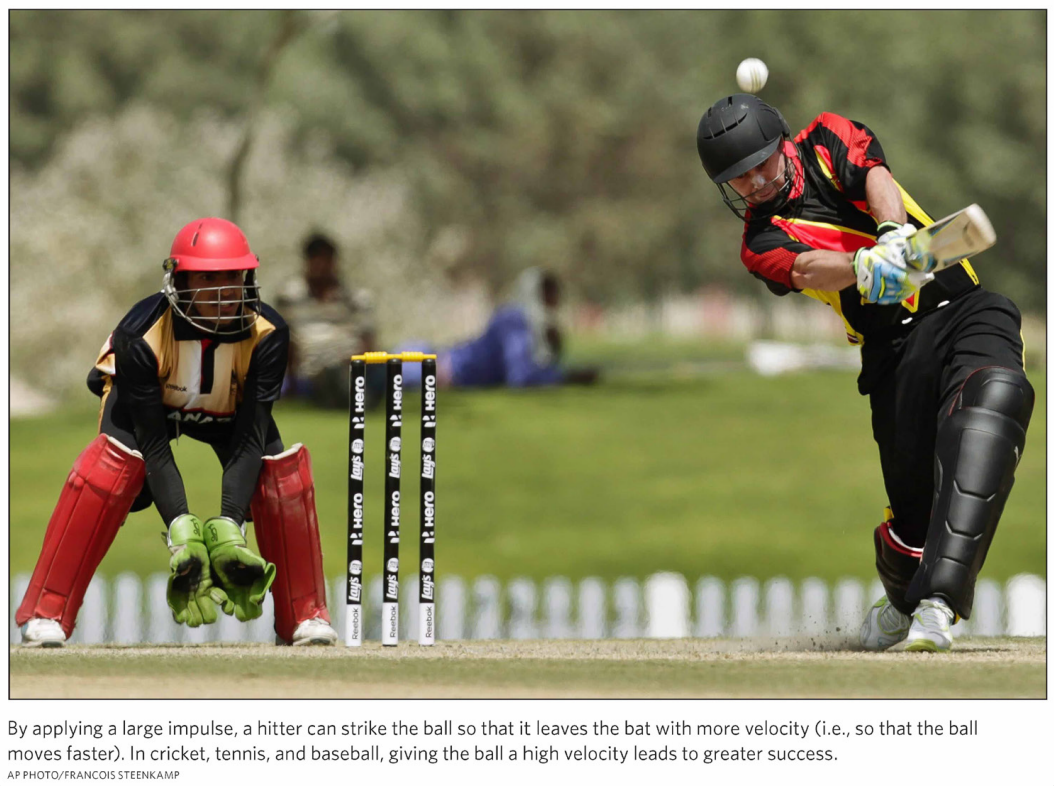
When an object such as a cricket ball, field hockey ball, or tennis ball is in motion, it is said to have momentum.
The momentum of the ball or any other object in motion is equal to its mass multiplied by its velocity.
To get a ball moving, a cricket, field hockey, or tennis player will use a striking implement to apply a pushing force to the ball over a period of time.
The greater the pushing force, and the greater the amount of time over which it is applied to the ball, the greater the impulse.
This is a restatement of biomechanical principle 4.
Imparting High Velocity to a Cricket Ball
Example of Principle 4 in Action
Elite athletes and their coaches often rely on biomechanical principle 4 to improve their techniques and performance.
For example, today’s high jumpers commonly use a technique called the Fosbury Flop.
As jumpers near the bar, they arch their neck and back and push against the ground to create a powerful impulse force.
An equal and opposite ground reaction force is generated, which propels the high jumper into the air.
Example of Principle 4 in Action
The “jump serve” in volleyball provides another good example of biomechanical principle 4.
Players begin well back behind the service line, lob the ball forward, and run and jump into the air in order to “spike” the ball to the opposing team.
The forward running motion of the server’s body transfers momentum to the ball, making it move through the air at a high velocity.
This increase in velocity, combined with a high flight path, makes it difficult for the ball to be returned by the opposing team.
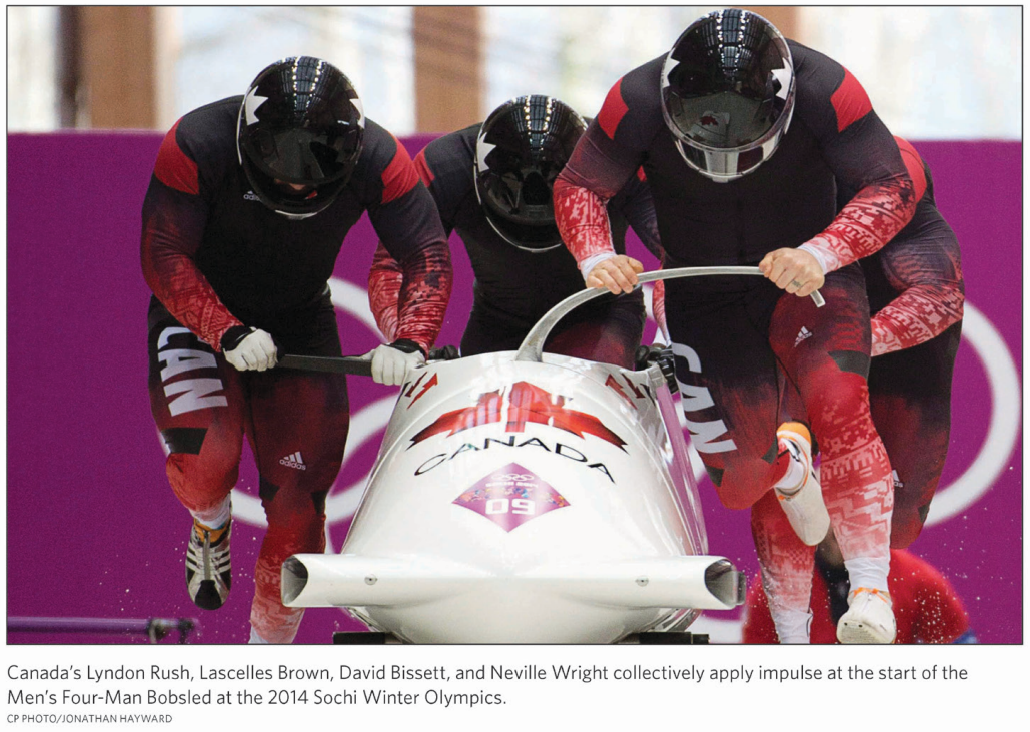
Applying Impulse in a Bobsled Race
Principle 5
THE DIRECTION OF APPLICATION OF THE APPLIED FORCE
“Movement usually occurs in the direction opposite that of the applied force.”
Interpreting Principle 5
The fifth biomechanical principle is closely related to Newton’s third law of motion, which states that for every action there is an equal and opposite reaction.
People at work and at play rely on this principle constantly.
For example, when a person sitting in an armchair stands up, the individual will place his or her hands on the armrests and push down.
A reaction force that is equal in magnitude but opposite in direction will be generated by the chair arms.
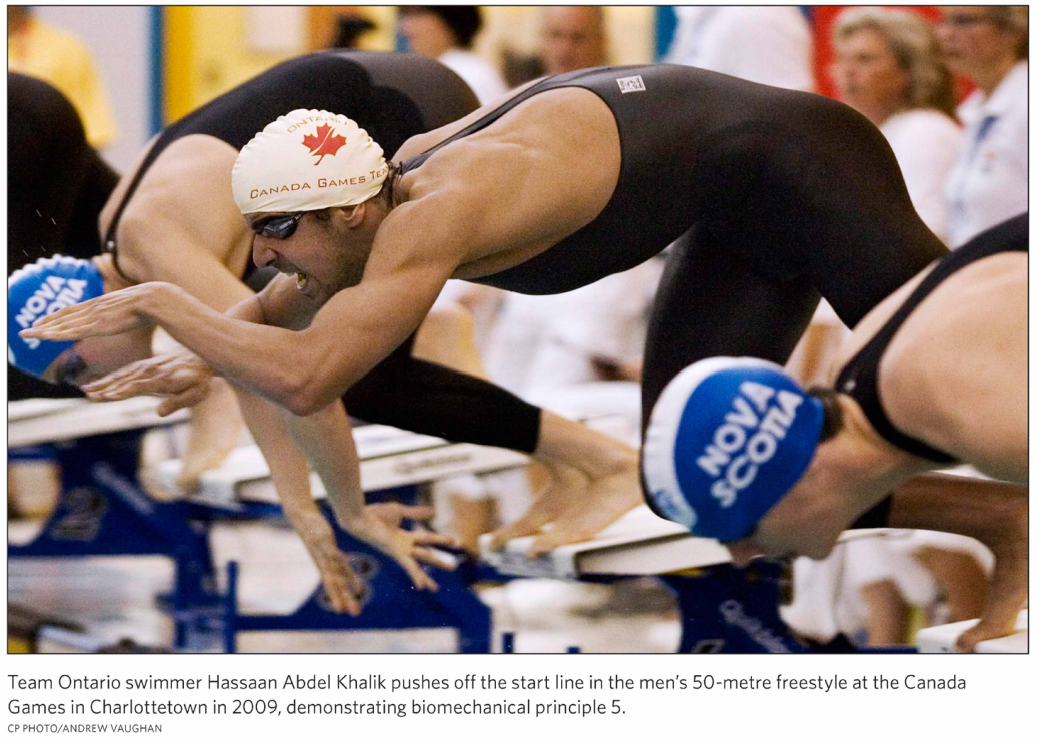
Principle 5 and Aquatic Events
Biomechanical principle 5 is evident in many aquatic events.
When completing a length of a pool, for example, free-style swimmers turn and push against the wall of the pool with their legs.
The swimmers’ bodies are propelled forward—in the direction opposite that of the applied force.
Example of Principle 5 in Action
Example of Principle 5 in Action
Biomechanical principle 5 can be seen in action in many team sports.
In making a cut, for example, an ultimate player or a soccer player will push his or her foot against the ground to make a change in direction away from an opponent.
Similarly, an ice hockey player will push off using the edge of the skate blade to make the same type of movement to either avoid a hit or make one.