Scientists that contributed
Robert Koch- German, 1843-1910
- Made the discoveries that led to the discovery of the germ theory
- Attempted in answering the world wide problem of identifying the microscopic creature that was causing disease.
- Disapproved the miasma theory
- Miasma theory was the predominant theory of disease transmission from the early 1700’s to the late 1800’s.
- It was believed that diseases were transmitted by a poisonous vapour containing suspended particles of miasma
- Demonstrated that Bacillus anthracis was causative pathogen of anthrax, Mycobacterium tuberculosis was causative pathogen of tuberculosis and confirmed that vibrio cholera was causative pathogen of cholera
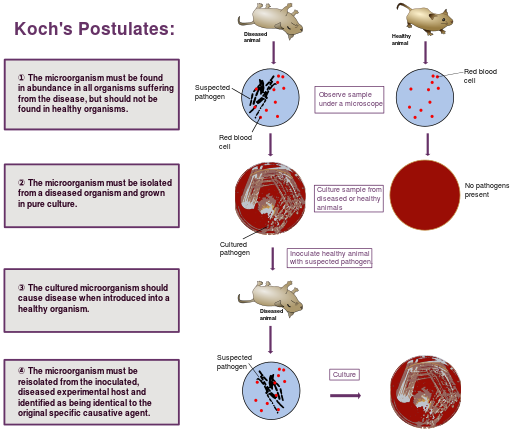
- Demonstrated that infectious diseases are caused by specific microscopic pathogens, thus formulated postulates
- Pathogen must be found in all animal suffering from the disease but not in healthy animals
- The pathogen must be isolated from a deceased animal and grown in pure culture
- The culture of pathogens should cause disease when introduced into healthy animal
- The pathogen must be re-isolated from the experimental insect animal
Louis Pasteur- French, 1822-1895
- Louis Pasteur is known as the father of germ theory
- The germ theory states that microorganisms known as pathogens or "germs" can affect disease.
- Robert Koch’s discoveries led to Louis Pasteur to describe how small organisms called germs could invade the body and cause disease. Thus introducing the widely accepted idea of the germ theory.
- Louis pasteur’s contribution
- ^^Louis pasteur disproved the idea spontaneous generation^^
- Until mid 19th century people thought that living things were produced due to Spontaneous generation
- Spontaneous generation is a hypothetical process by which living organisms develop from nonliving matter.
- For example, dust creates fleas, maggots arise from rotting meat, and bread or wheat left in a dark corner produces mice
- The steps of Pasteur's experiment are outlined below:
1. First, Pasteur prepared a nutrient broth similar to the broth one would use in soup. 2. Next, he placed equal amounts of the broth into two long-necked flasks. He left one flask with a straight neck. The other he bent to form an "S" shape. 3. Then he boiled the broth in each flask to kill any living matter in the liquid. The sterile broths were then left to sit, at room temperature and exposed to the air, in their open-mouthed flasks. 4. The broth in both flasks is boiled. 5. After several weeks, Pasteur observed that the broth in the straight-neck flask was discolored and cloudy, while the broth in the curved-neck flask had not changed. 6. The broth in the straight-neck flask becomes discolored. 7. He concluded that germs in the air were able to fall unobstructed down the straight-necked flask and contaminate the broth. The other flask, however, trapped germs in its curved neck, preventing them from reaching the broth, which never changed color or became cloudy. 8. Conclusion: germs come from other germs and do not spontaneously generate. * If spontaneous generation had been a real phenomenon, Pasteur argued, the broth in the curved-neck flask would have eventually become reinfected because the germs would have spontaneously generated. But the curved-neck flask never became infected, indicating that the germs could only come from other germs.
- ^^Developed world’s first attenuated vaccine^^
- Pasteur artificially generated vaccines for anthrax, chicken cholera and rabies
- Revolutionised work in the prevention of infectious diseases
- Pasteur’s strategy to fight diseases was to “attenuate” (weaken) the pathogen by various methods then use this “vaccine” to provoke the immune system to make antibodies which would prevent later infections by the pathogen.
- ^^Demonstrated that fermentation was caused by living organisms^^
- In 1858, Pasteur demonstrated that fermentation was caused by living yeast
- ^^Invented pasteurisation^^
- Pasteurization is a heat-treatment process that destroys pathogenic microorganisms in certain foods and beverages
John Snow
- John Snow discovered that contaminated water was the source of cholera infection
- In 1854 during the third cholera pandemic a British Dr John Snow considered the father of modern epidemiology carefully mapped cholera cases in the Soho region of London
- Dr snow isolated the cause of the outbreak to contaminated water from a public well. the pump was removed and the number of new infections infections dropped immediately