Class 7: Tableau
Tableau file types
Tableau workbook (twb) - data visualizations, no data
Tableau data extract (tde) - data only, not presented via visuals
Tableau packaged workbook (twbx) - data and visuals in one file
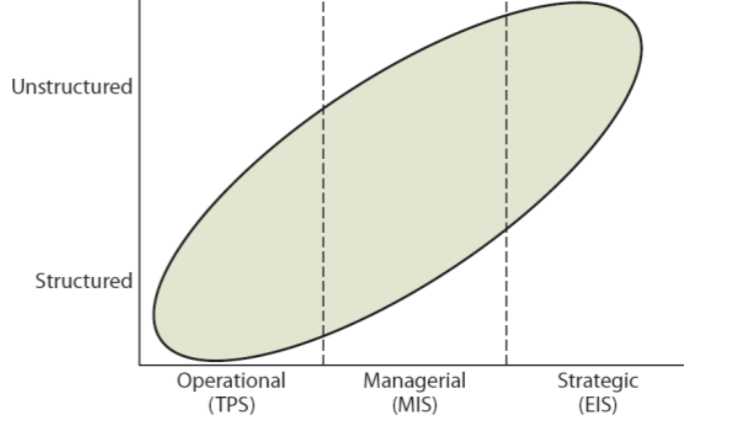
Review: decision types
Operational decisions
Supported by transaction processing systems
Managerial decisions
Allocation and utilisation of resources
Supported by MIS
Strategic decisions
Organizational issues, broader-scope
Supported by executive information systems - calls made by execs
Unstructured vs structured decisions
Structured: methodical
Unstructured: ex. Who you should marry
Refers to the decision method, not about the underlying problems
OLTP vs OLAP
Online Transaction Processing (OLTP) systems collect data electronically and process the transactions
Online OLTP systems support decision making by providing the raw information about transactions and status for an organization
Payroll, inventory
Online Analytic Processing (OLAP) systems focus on making OLTP-collected data useful for decision making
Provides the ability to sum, count, average, and perform other simple arithmetic operations on groups of data
Stats, reports, data mining
Business intelligence (BI)
Transforms data into actionable intelligence
Bi tools present analytical findings in reports, summaries, graphs, etc
Provide them to the right decision maker at the right time with the right information (data relevancy)
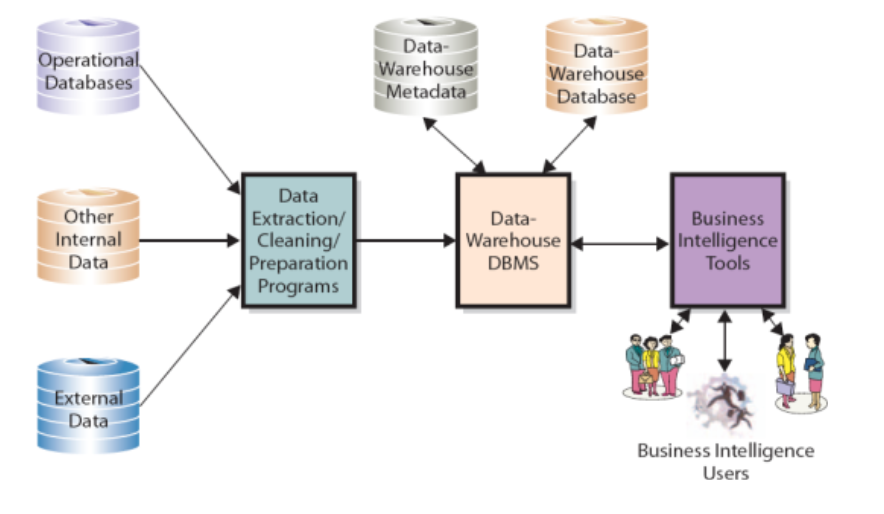
Data warehouse
Used to extract and clean data from operational systems
Prepares data for BI processing
Data mart
Data collection, subset of data warehouse
Addresses a specific function of the business
Ex. Web sales data mart, store sales data mart, inventory data mart
Data mining
Discovering trends in datasets to extract relevant insights for decision making
Combines stats, maths, AI, machine learning
Descriptive: explaining what is in the data
Prescriptive: forecasting future outcomes
Data mining examples: Customer segmentation, recommendation engines, fraud detection, credit scoring, medical research
Techniques
Supervised: Start with hypothesis and gather data to prove it, use of labeled data to predict outcome
Unsupervised: No model prior to running analysis, uses unlabeled data, hypothesis is created after as an explanation for the results
Clustering - ex. Political affiliation demographics
Market basket analysis ex. Amazon ‘others also purchased’
Anomaly detection ex. Credit card fraud detection
Midterm material Review
Iclicker practice test
Practice exam
Short answer questions: ERD, data normalization, tableau data visualisation