Chapter 8: Puberty
Celebrating Puberty
Puberty is the hormonal and physical changes that lead children to become sexually mature human beings and reach their adult height
person-environment fit: when our body is prepared for things our environment is not
ex: one may be physically ready to have sex after reaching menstruation at age 11, but society is encouraging them to say no to sex
Throughout history, and in some impoverished agrarian nations, puberty is considered a person’s sign to get married and give birth
Today, society believes that sexuality and parenthood are not supposed to happen for years after puberty
Celebrated blossoming bodies through puberty rites, emotional coming of age ceremonies where children were removed from their families and forced to perform a stressful task, resulting in anxiety, awe, and a new sense of self efficacy (a person’s belief in their ability to perform the actions needed to achieve specific goals)
Ex: In one Amazonian tribe, boys would “prove their manhood“ by killing a large animal, then metaphorically “die“ by drinking a hallucinogen to be “born again“ as men
Menarche, or first menstruation, is a classic signal to celebrate a girls’ entrance into womanhood
Ex: In a traditional Navajo ceremony, girls in their first or second menstrual cycle, guided by a female mentor, perform a running ritual in which they sprint for miles, guided by a female role model. At the end of the ceremony, they build a corn cake, a symbol of fertility, and get a new adult name for their “new life“
Declining Age of Puberty
In the past, we reached puberty at a much older age, therefore making us seem more ready for adult life. Today, many girls reach menarche at age 9 or 10, so they aren’t truly ready.
1/5 european american girls begin breast development as young as age 8
2/5 african american girls
Secular trend in puberty: centuries long decline in the average age at which children reach puberty
got older because of better nutrition
overabundant access to calorie-rich food, average girl menstruates slightly before 12
in less developed nations, where starvation is common, menarche starts at roughly 18
Hormones
Puberty is commanded by 2 command centers
Adrenal glands: release hormones at 6 or 8, several years before children show signs of puberty
adrenal androgens: produce pubic hair, skin changes, body odor, and sexual desires, reach a peak in the early 20s
HPG Axis: involves hypothalamus, pituitary gland, gonads and produces major body changes
Puberty is set off by 3-Pronged Reaction
1. hypothalamus and hormones stimulate pituitary gland at 9 or 10, steps up production of hormones
- hypothalamic hormones are triggered by genetics, light exposure, environmental stress, and a hormone called leptin, which is tied to body fat. A certain threshold of fat must be reached to start puberty, factors like obesity and malnutrition can impact puberty
2. Causes ovaries and testes to secrete estrogens and testosterone
3. Concentrations of estrogens and testosterone unleash a physical transformation
- Estrogen causes hips to widen, uterus and breasts enlarge, stimulate ovaries to produce eggs
- Testosterone causes penis to lengthen, facial and body hair, dramatic increase in muscle mass
At about age 9 or 10, the hypothalamic hormones stimulate the pituitary gland to step up production of hormones, causing the ovaries and testes to secrete estrogens and testosterone
influences on timing:
life stress
body weight
climate
light
nutrition level and body fat
growth
genetics
pituitary hormones: stimulate gonads to increase production of hormones
these hormones produce bodily changes:
growth spurt
primary and secondary sexual characteristics
Physical Changes
Puberty causes psychological and physical transformation
Primary sexual characteristics: body changes directly involved in reproduction (growth of penis, menstruation, etc)
Secondary sexual characteristics: other changes that characterize puberty (breast development, pubic hair, voice change, sweat glands
Growth Spurt: dramatic increase in height and weight
Girls!
Growth accelerates, peaks at 11, and then begins to decrease
6 months after growth spurt, breasts and pubic hair become visible
On average, breasts take about 4 years to grow to adult form
Menarche occurs in the middle to final stages of breast and pubic hair development when growth is winding down
after menarche, breasts continue to develop while height does not develop much
after menarche, girls can get pregnant, but there is often a window of infertility until puberty is fully complete
Puberty is diff for every girl because pubic hair development is sometimes underway before breasts enlarge or a girl grows taller after menarche
some children are developmental tortoises and have slow paced progression through puberty, while some are hares who speed through body changes
ex: breast development can range anywhere from less than 2 to 9 years with an average of 4
Internal changes:
uterus grows, vagina lengthens, hips develop fat, vocal chords get longer, heart gets bigger, red blood cells carry more oxygen
girls become much stronger after puberty
Tanner’s 5 Pubertal Stages: classifications of a girl’s breast development
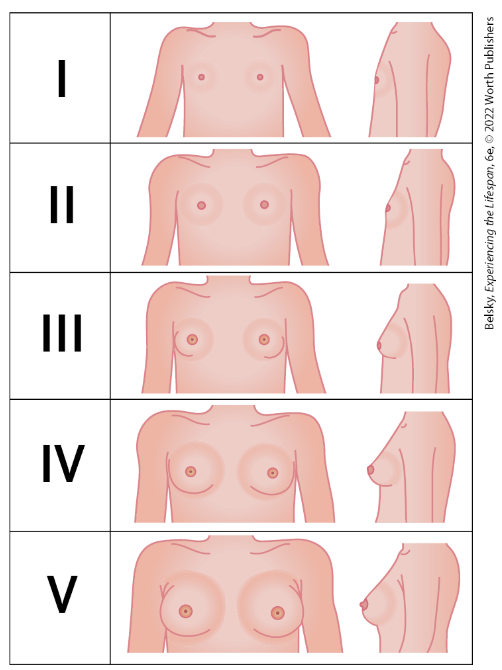
Boys!
tanner stages for boys: track growth of penis, testicles, and pubic hair
though reproductive organs begin developing first, boys still look like children on the outside for 1-2 years after puberty begins
primary characteristics for men: growth of penis, testes, and pubic hair
secondary characteristics for men: voice deepening, facial hair, body hair
grow average of 8 inches in growth spurt compared to 4 for girls, and become far stronger than girls
caused by increase in muscle mass, cardiovascular changes (heart increases in weight by more than one third, males have more red blood cells and a greater capacity for carrying oxygen in their blood, signs are shown through wide shoulders, big chest, muscular frame)
real world outcome: boost in gross motor skills
spermarche: first ejaculation, typically at 13 (later than avg menarche)
hands, feet, and legs grow first rather than cephalocaudal (from the head downward) or proximodistal (middle to outward) which is especially obvious in boys
Differences!
for boys, the hidden differences (growth of testes etc) occurs first, while for girls, the external differences (height and breast growth) take place toward the beginning of the sequence
for girls, having a high BMI during elementary school predicts earlier puberty
family stress, according to evolutionary perspective can create a physiological mechanism that accelerates puberty
unhappy childhood signals the body to expect a short life and pushes adult fertility to a younger age
genetics (age when parents developed) is most important, but family life can impact temperamentally vulnerable girls
for a girl who was sexually abused, breast development began 8 months earlier than the norm
Main chances of girl reaching puberty early: parents reaching puberty early, girl being hispanic or african american, girl being overweight or rapid weight gain as an infant, stressful family life
Body Image Issues
Susan Harter 1999
5 self worth dimensions: scholastic abilities, conduct, athletic skills, peer likeability, appearance
being happy about looks seemed to outweight anything else
beginning in elementary school, girls get increasingly distressed by how they look, due to the thin ideal, the media driven pressure to be very thin
impacts during early adolescence because social sensitivities reach a peak
gay and trans males also vulnerable
epigenetic roots: mothers exposed to intense stress during pregnancy are more likely to have daughters with eating issues
Albert Bandura: latina and african american girls are less succeptible to thin ideal because their culture celebrates bodies of larger sizes (thick thighs, big butt etc)
children of color who want to fit in with mainstream western culture are just as likely to be impacted by thin ideal
Eating Disorders
Eating disorders: pathological eating behaviors that threaten well being
Anorexia nervosa:
most serious eating disorder
self starvation to the point of reaching 85% or less of ones ideal body weight
girl who should weigh 110 weighs 95, etc
8/1000
Bulimia nervosa: frequent (biweekly) cycles of binging and purging in an attempt to lose weight
not as life threatening b/c weight stays in a normal range
second most prevalent (2.6/100)
Binge eating disorder: recurrent out of control eating
tied to obesity and presents a serious threat to health
most prevalent (3/100)
could be caused by hereditary component, genetic propensities or parents with eating issues who broadcast messages to their children
internalizing issues: worrying escesively or experiencing intense ups and downs in mood, could cause eating disorders to flare up
insecure attachment
extreme need for approval
low self-efficacy, feeling out of control about their lives
Preventing EDS:
dialectic behavior therapy: ED treatment that teaches meditation and strategies to promote self-efficacy
encourage teens to not deny their imperfectioins but focus on their physical pluses
Sexuality
over half a century (1950 to 2000), the number of seniors who think its okay for teenagers to have sex shot up from a minority to over 70%
first sexual feelings at age 10
gay and lesbian individuals first realized they were physically attracted to a person of the same se at around age 10
first sexual feelings occur before visible puberty, around 4th grade
average age of first intercourse is between ages 17 and 18, though 1 in 8 children have it at age 15
variety of forces predict earlier transition to intercourse
teens who are more impulsive are apt to make transition earlier
those with externalizing tendencies
being religious, not having found the right person, being afraid of pregnancy are reasons to stay a virgin
african americans and low income males are more apt to become sexually active at younger ages
abortions, adolescent pregnancies, and births have dramatically declined for the past 30 years
w/ teens who admitted to nonromantic sexual encounter, ¾ said it was with a person they knew well
one boy lost his virginity w/ his best friend who he wouldnt date but felt very comfortable with
also often happens with ex boyfriends/girlfriends
in order to encourage good sexual education, it is important to encourage healthy relationships