plate tectonics
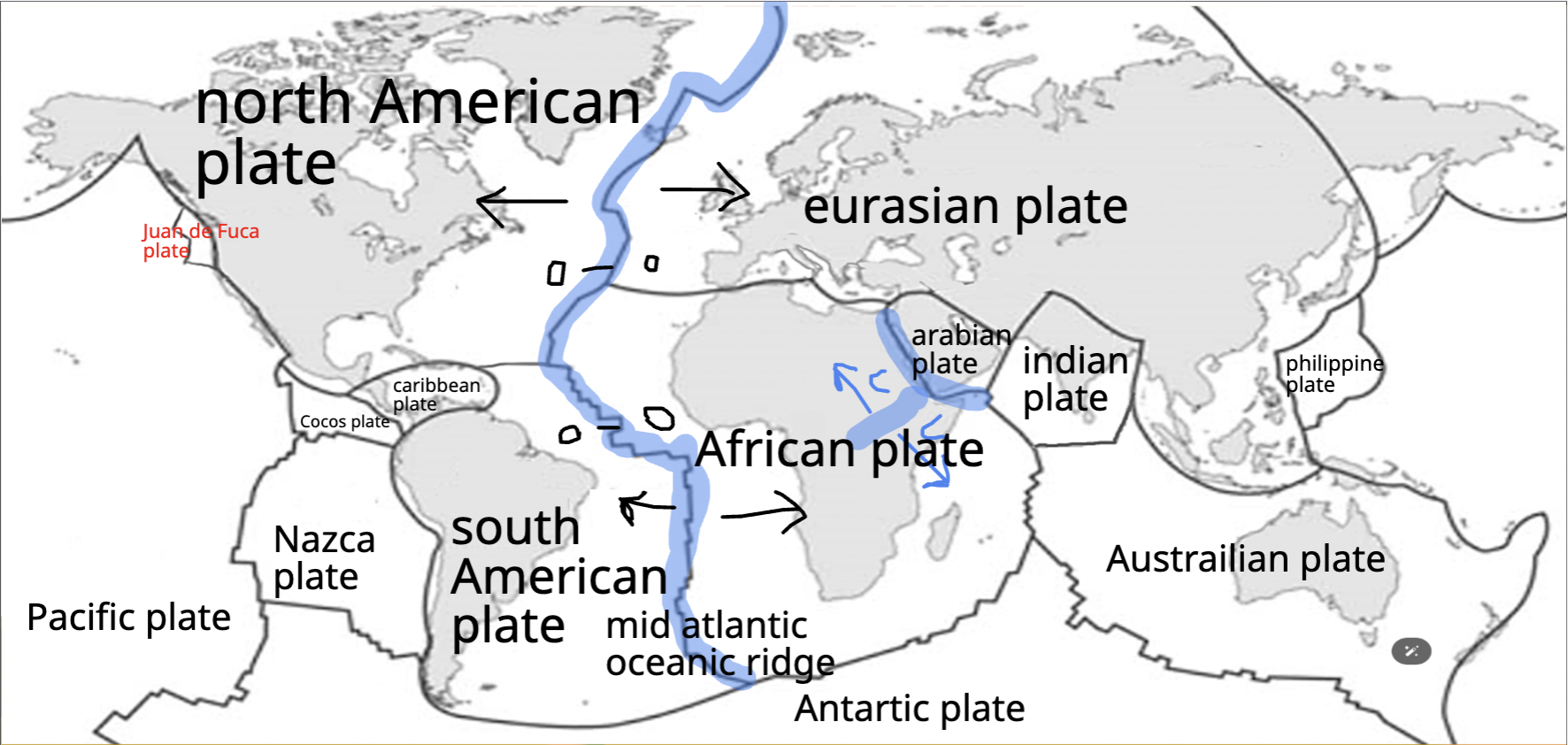
what is plate tectonic theory
Continents on earth were once connected as a supercontinent Pangea, over time Pangea began to break apart to eventually be what we recognise in our present day world map - seven continents 5 oceans
plate tectonics is a scientific theory that explains how major landforms are created as a result of Earth’s subterranean movements.
Plate tectonic theory explains that
earth has 3-layered structure
the earth’s lithosphere is broken up into tectonic plates
tectonic plates are constantly moving
plate movements result in the formation of major landforms we find on the earth’s surface, such as volcanoes, fold mountain ranges and oceanic trenches. It also explains the occurrence of certain phenomena - earthquakes and tsunamis.

earth’s internal structure
core
the core is the innermost layer. it is the hottest layer, with temperatures ranging from 4400 to 6000ºC. It is also the thickest layer of about 3300km in thickness
mantle
the mantle lies above the core. Temperatures hence range from 1000 to 3700ºC. This layer is about 2900km thick
crust
the outermost layer, it is also the thinnest layer at about 6 to 70km in thickness
The upper most parts of the mantle and the crust above it are the solid parts of the earth. Together they are known as the lithosphere
Continental lithosphere is found on land, making up the continents
Oceanic lithosphere makes up the seafloor
Oceanic crust is denser than continental crust as they consist of different materials
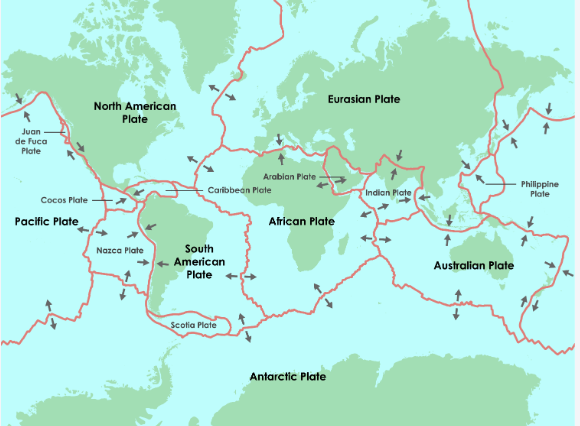
The lithosphere is divided into huge piece called tectonic plates
Below the solid lithosphere is the semi solid asthenosphere. Heat from the core causes the rocks in the asthenosphere to melt
plate boundaries
divergent plate boundaries - plates move away from each other
convergent plate boundaries - plates move towards each other
transform plate boundaries - plates sliding past each other
convection currents
hotter, less dense material rises while colder, denser material sinks.
heat from the earth’s core causes the material in the mantle to become less dense and rise towards the surface
rising material in the mantle spreads under the more rigid crust
driving force exerted on the overlying plates - causing them to move
material in the mantle then loses heat - becoming denser - sinks towards the core
material gets heated up again
process repeats
rising and sinking of the mantle material form a current known as convection currents
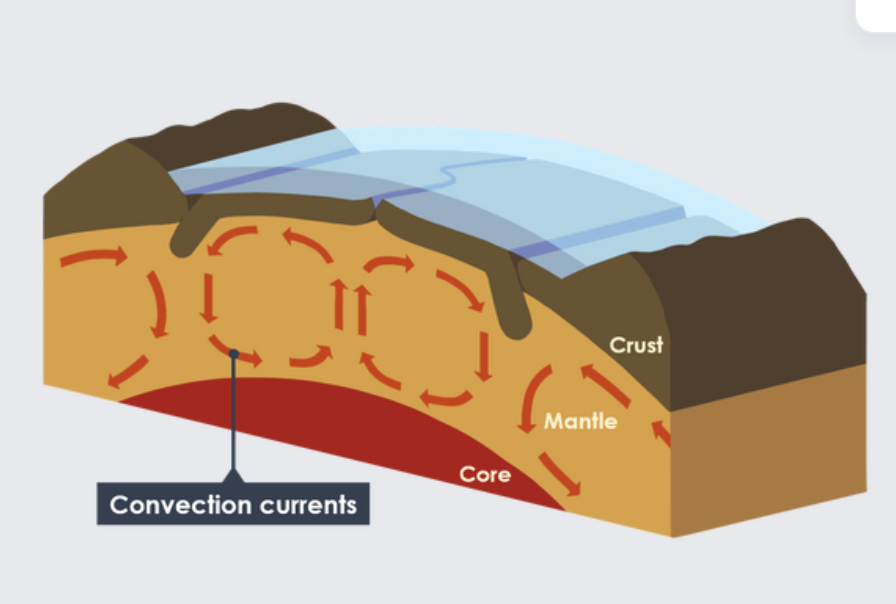
rising convection currents spread beneath the plates, they drag the plates away from each other
creates divergent plate boundary
convergent boundaries are found where the convection currents are sinking
steps
heat is generated in the core
heat causes mantle material to become less dense and rise
mantle material spreads beneath the plates
rising convection currents spread beneath the plates and drag them apart, causing divergent plate movement
mantle material loses heat and sinks
convergent plate movement occurs where the convection currents collide
mantle material heats up again and process repeats
Continent - Continent divergents
uneven heating of the mantle by the core creates convection currents in the mantle
tensional forces develop as a resultant of plates diverging from each other
the tensional forces result in parts of the crust being fractured
this process is called faulting
a fault is a fracture in the rocks along which the rocks are displaced. Along these faults, sections of the crust can extend along fault lines, forming parallel faults
Tensional forces result in crustal material being displaced relative to adjacent blocks can cause a central block of land to subside between a pair of parallel faults, forming a rift valley such as the East African Rift Valley system.
A rift valley is a valley with steep sides formed along parallel fault lines formed from the sinking of the central block along fault lines
A block mountain is formed when the block of land with steep slopes is left standing higher than the surrounding land that has subsided.
these may occur in isolation or cause multiple rift valleys and block mountains to be found in the same area. Each may be 30 to 60km long. A number of active volcanoes and earthquakes fractures can also be found here
Oceanic - Oceanic Divergents
uneven heating of the mantle by the core creates convection currents in the mantle
the rising portion of the convection current pulls 2 oceanic plates apart
a gap/fracture is formed at the divergent boundary
magma rises from the mantle to fill the gam between the plates as they diverge
new seafloor is formed when the magma cools and solidifies
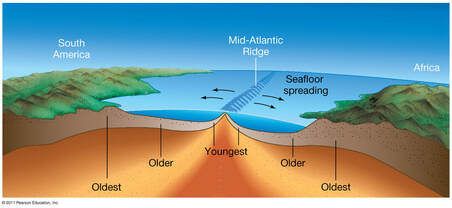
process is called seafloor spreading
magma rises at the zone of divergence/spreading zone to form a ridge of new ocean floor called mid oceanic ridge
the newly formed rocks are closest to the middle of the ridge/plate boundaries
at various points along the ridge, magma builds up above the ocean to form volcanic islands
e.g. the mid-atlantic ridge is found in the middle of the Atlantic Ocean cutting across Iceland, a volcanic island
notes from sls qns
convection currents result in the movement of tectonic plates - convection currents within the Earth’s interior is one of the major drivers of tectonic plate movements
process in which convection currents cause tectonic movements
Describe that the mantle material gets heated, becomes less dense and rises
heat from the core causes materials in the mantle to become less dense and rise towards the surface, spreading beneath the more rigid crust
results in the mantle material dragging the tectonic plates away from each other, creating a divergent boundary
the mantle material loses heat and sinks towards the core
sinking of the cold mantle drags the plates together, creating a convergent plate boundary
the mantle material gets heated up again and process repeats
The rising convection current account for the movement of plates at the divergent boundaries
The sinking convection currents account for the subduction of denser
slab-pull force
how does slab-pull force lead to the movement of tectonic plates?
besides convection currents, slab-pull force also contributes to tectonic plate movement
tectonic plates differ in density depending on the material of the crust - e.g. oceanic crust is denser than continental crust
when 2 plates converge, the denser oceanic crust is pulled down by gravity as it subducts beneath the less dense crust
the denser oceanic crust sinks deeper into the mantle under its own weight, pulling the rest of the plate with it
results in further convergence
steps of slap-pull forces
plates move towards each other
gravity acts upon the subducting plate, causing it to sink under its own weight
on the other end of the palte, slab-pull force causes divergent plate movement
qns ntoes
slab-pull force is only observed at convergent plate boundaries where subduction occurs
gravity acts upon the subducting plate, causing the plate to sink deeper into the mantle under its own weight
slab-pull force describes how gravitational force pulls a sinking tectonic plate down, causing it to sink under its own weight at convergent boundaries
convection currents result in the movement of tectonic plates
During subduction, slab-pull force cases one end of the plate to sink into the mantle, contributing to plate convergence
as the entire plate is pulled into the mantle, the other end of the plate is dragged away from another plate, contributing to plate divergence
seafloor spreading
process that occurs at mid-oceanic ridges
two plates are moving away from each other
magma from deep within the earth then…
rises
cools
solidifies
hence constructs new oceanic crust
this is why divergent boundaries are also known as constructive boundaries
steps to seafloor
two plates move away from each other
magma rises through the cracks and forms new oceanic crust at the spreading centre
the mid-oceanic ridge forms in the centre
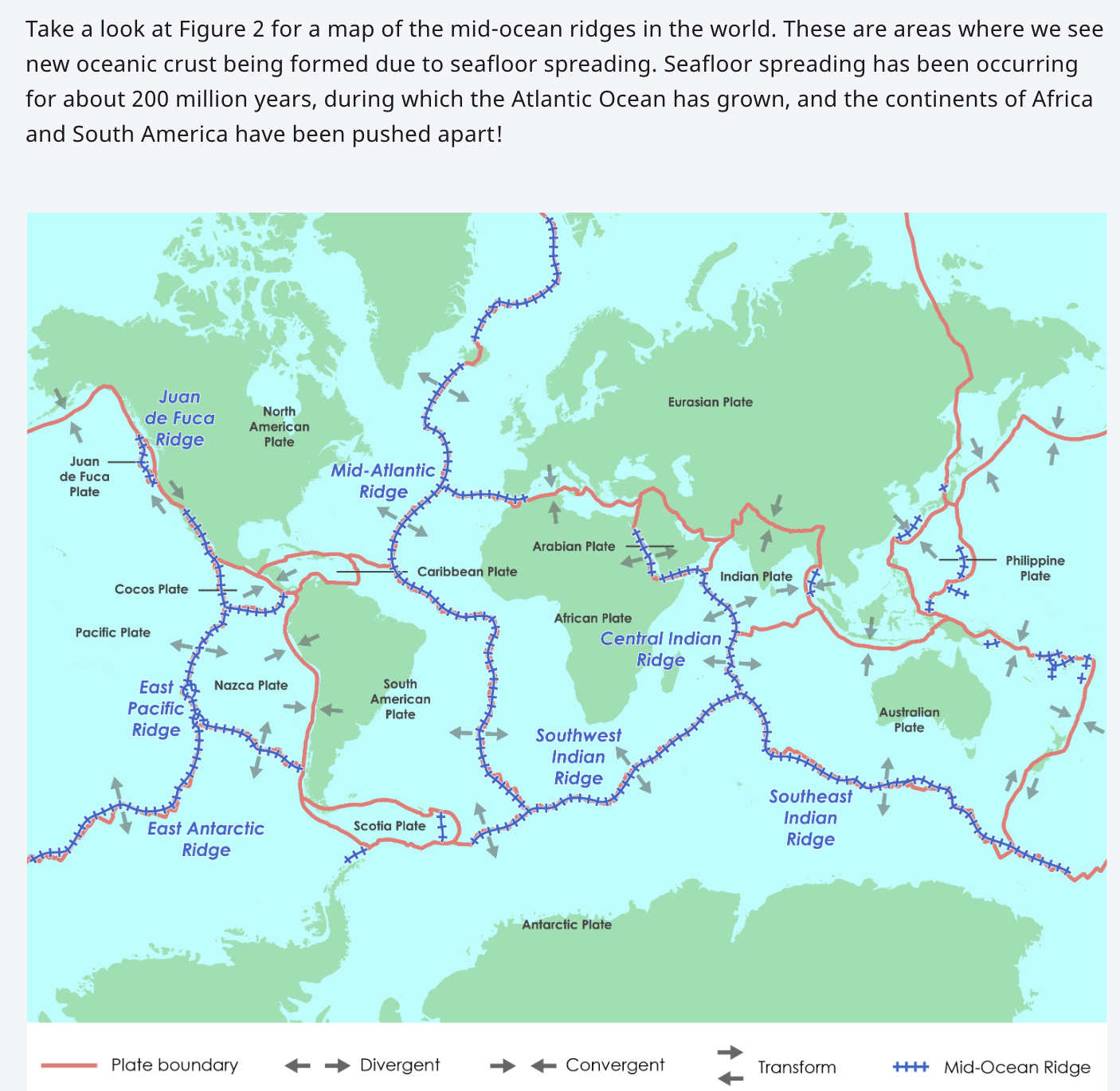
besides occurring at oceanic-oceanic divergent boundaries, seafloor spreading also occurs when two continental plates diverge
Great rift valley in Africa - red sea first began as a narrow lake then expanded to become a sea as the African plate and Arabian plate continue to diverge
qns notes
New oceanic crust is formed at divergent boundaries as magma rises to the surface of Earth, cools and solidifies
When there are plates moving towards each other, no magma rises at the plate boundaries and no new oceanic crust is formed
e.g. indian plate and eurasian plate moving towards each other
age of rocks
there is a pattern to the ages of rocks at the seabed
where the rocks nearer to the crest of the mid-ocean ridge are younger
rocks get progressively older as they spread out from the ridge
crest of the mid-ocean ridge is spreading centre
magma rising from the mantle cools and solidifies, forming new seafloor
continuous formation of new seafloor at the crest of the ridge pushes the older seafloor further from the crest of the ridge
resulting in the rocks nearer to the crest to be younger and further to be older
shows how new oceanic crust is created at divergent boundaries and is spread laterally on both sides of the mid-ocean ridge as seafloor spreading continues due to plate movement
pattern shows that seafloor spreading is not a random or isolated occurrence
associated with plate movement at boundaries
limited sediment accumulation
not much sediment accumulates at ocean trenches
due to older oceanic crust getting destroyed and “recycled” back into the mantle at ocean trenches
new oceanic crust form at mid-ocean ridges - younger crust would not have existed long enough for much sediment to accumulate
because sediment accumulation takes place over time
how new crust is created at the mid-oceanic ridge and older crust is recycled as it moves away from the mid-oceanic ridge
new crust is formed at the mid-oceanic ridge
older crust is recycled into the mantle at the oceanic trench
resulting in oceanic crusts being younger than continental crust
earliest dated continental crust was formed about 4.3 billion years ago
oldest seafloor formed only about 180 million years ago
hence evidence of seafloor spreading supports the theory that tectonic plates move
qns
rocks are youngest at the centre of the mid-ocean ridges that is the location where magma rises to form new oceanic crust
as plates move, the rocks then spread laterally on both sides of the mid-ocean ridges - hence these are older rocks
at ocean trenches, the older crust gets destroyed and is '“recycled” back into the mantle
there is limited sediment accumulation at ocean trenches
rocks are youngest at the centre of the mid-ocean ridges and get older as they spread further away
shows that new oceanic crust is continually being created at the mid-ocean ridge, and these rocks are eventually spread laterally
proves that tectonic plates moves, hence providing evidence for the plate tectonic theory
symmetrical pattern regarding the age of rocks absorved at mid-ocean ridges shows how seafloor spreading
magnetic striping
bg knowledge
planet’s magnetic fields also behave in the same way as bar magnets
earth has a geographical north and geographical south (direction towards the fixed point of the earth called the north/south pole)
also has magnetic north and magnetic south (direction that a compass needle points to - the direction of the earth’s magnetic North/South pole due to Earth’s north/south pole)
BUT magnetic North and geographical South can shift - they have reversed multiple times over geological time
rn magnetic North points roughly towards geographical North and same for magnetic and geographical South - known as normal polarity
when magnetic North roughly points towards geographic South and vice versa - known as reverse polarity
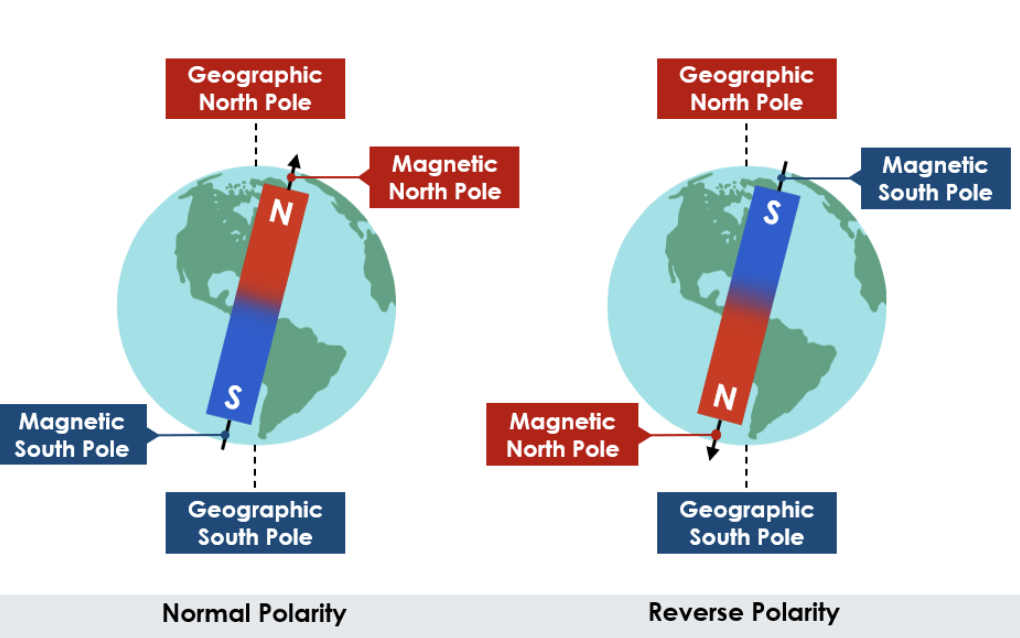
the reversals of Earth’s polarity are evidenced by studying the magnetic properties of rock from the ocean floor
stripes of rocks on the seafloor with alternating magnetic properties can be observed when examining the ocean floor
magnetic striping is the pattern where there are strips of normal polarity rock alternating alongside strips of reversed polarity rock
qns
earth’s geographic North and South Poles are fixed points and do not change
but earth’s magnetic North and South Poles have reversed multiple times over geological time period
magnetic striping is the strips of normal polarity rocks alternating alongside strips of reversed polarity rocks at the seabed - there is a symmetrical zebra like pattern
the minerals will points to the magnetic north at the time when the rock solidified and they keep the same orientation hereafter
basaltic rocks
these rocks at the seabed provide evidence of plate tectonic theory
basaltic rocks are iron-rich volcanic rocks at the oceanic crust
contain magnetic materials
when the iron-rich lava erupts from the centre of the mid-ocean ridge, cools and solidifies
magnetic field of the minerals in lava point towards earth’s magnetic north (evidence of earths polarity at the time)
how symmetrical zebra-like magnetic pattern emerges at the centre of the mid-oceanic ridge
two plates move away from each other (divergent)
iron rich lava erupts, cools and and solidifies to form new oceanic crust that records earth’s polarity at that time
as the plates continue to diverge, the oceanic crust is pushed in both directions away from the centre of the ridge
over time a symmetrical zebra-like magnetic pattern forms
shows how plates are moving apart from each other over time - supporting the theory of seafloor spreading hence supporting plate tectonic theory
qns
rocks found at the ocean floor have a zebra-like magnetic pattern
when volcanic rocks erupts, they are magnetised according to the magnetic field of the earth at the time
due to the reversal of earth’s magnetic North and South over geological time periods - volcanic rocks that are created over time also alternate in polarity
volcanic rocks closest to the centre of the mid-oceanic ridge are magnetised according to Earth’s current magnetic field as they had just recently erupted
how magnetic striping supports plate tectonic theory
as lava erupts from the centre of the mid-oceanic ridge, cools and solidifies, it records the magnetic field of the earth at that time - forms new oceanic crust
when the plates continue to diverge, the older oceanic crust are moved away from the mid-oceanic ridge
produces a symmetrical magnetic pattern
supporting how plates moves, supporting the plate tectonic theory
divergent plate boundaries
results in mid-oceanic ridges, volcanoes, rift systems and earthquakes
oceanic - oceanic
2 oceanic plates move apart
decrease in pressure causes parts of the mantle to melt, forming magma
magma rises through weak areas in crust and fills gaps caused by spreading plates
lava cools and solidifies to make up new oceanic crust, forming a mid-ocean ridge
at the centre of the ridge is a rift valley
magma rises through cracks and forms submarine volcanoes
after many eruptions, the volcanoes may break the ocean surface to form islands
earthquakes also occur here due to stress and tension released when plates move
e.g. north american and eurasian plates divergence - Mid-Atlantic Ridge
continental - continental
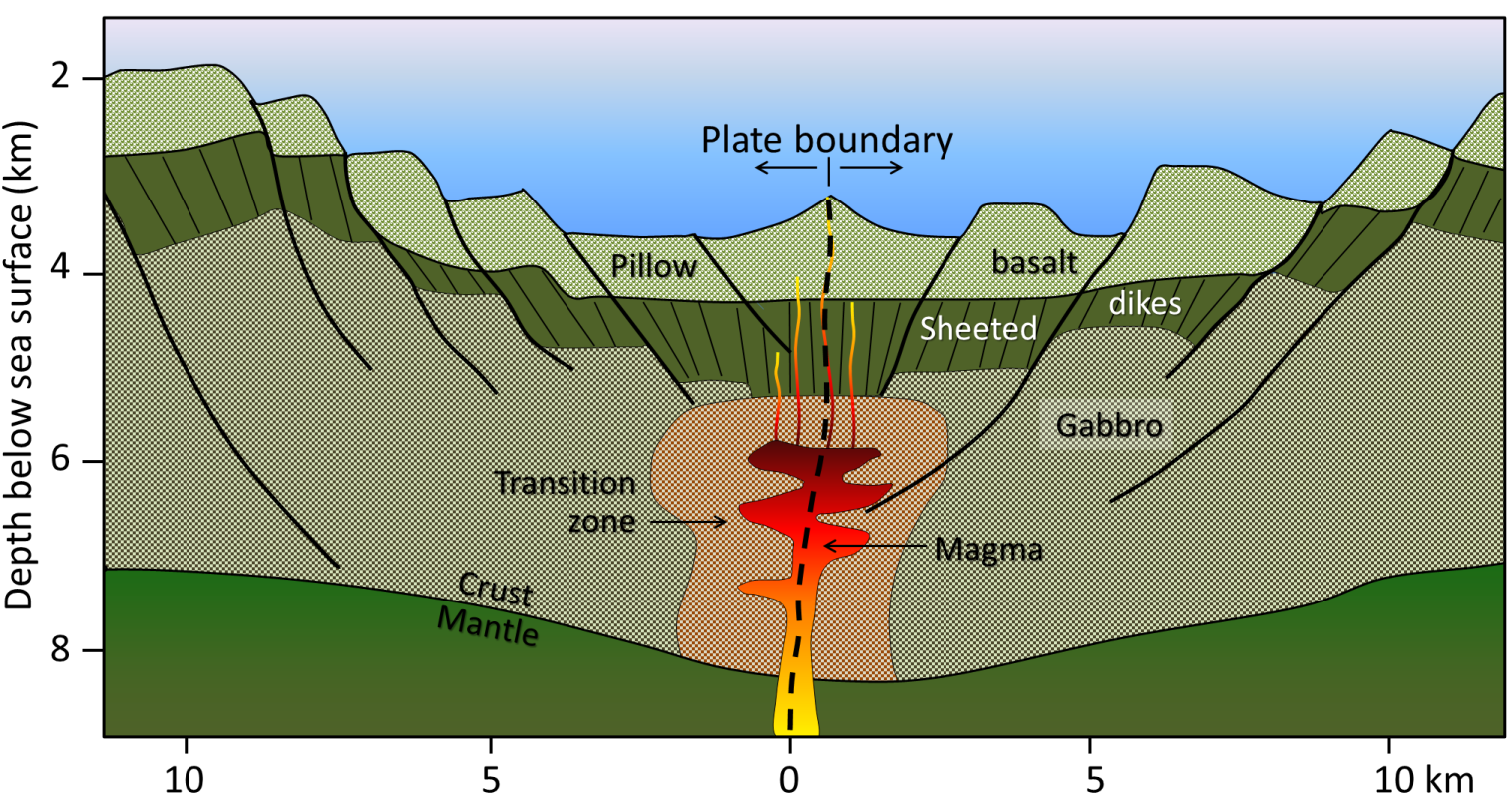
2 continental plates move apart
rocks fracture to form parallel faults
rocks between the faults collapses, forming a deep rift valley with steep sides
as plates move apart, decreasing in pressure causes parts of mantle to melt, forming magma
magma rises through weak points in crust, forming volcanos
earthquakes occur in this area as stress and tension being released when plates move
e.g. Nubian plate and Somalian Plate
qn
explain how different plate boundaries occur
at divergent plate boundaries, heated and less dense rock rises, causing the plates to move away from each other. This results in the formation of mid-ocean ridges, volcanoes including submarine volcanoes and volcanic islands, rift systems and earthquakes
As the semi - molten rock spreads out horizontally beneath the plates, it exerts a driving force pulling the plates above with it
When the semi-molten rock cools, it becomes denser and sinks back towards the core where it is reheated
The direction of plate movement is influenced by the convection currents, with plates moving horizontally, converging, or diverging.
The heat source from radioactive decay in the core drives the convection currents, causing the heated mantle material to rise and the cooler, denser material to sink, creating a circular motion.
rift valleys
the rift valley stretches out for a vast distance, with steep sides formed as the tectonic plates separate and the crust is pulled apart, creating a depression
explain how mid-ocean ridge is formed through the process of seafloor spreading at divergent plate boundaries
• At divergent boundaries, upwelling of hot mantle material from the Earth's interior causes the oceanic crust to bulge upwards, forming an elevated submarine mountain chain known as a mid-ocean ridge.
• Along the crest of the ridge, tensional forces pull the tectonic plates apart further, creating a rift valley where magma rises through the thinned crust.
• The upwelling magma cools and solidifies, forming new oceanic crust that gets pushed away from the ridge crest by the continuous seafloor spreading process.
• The rocks nearest to the ridge crest are the youngest, with the age of the rocks increasing progressively further away from the ridge as new crust is continually formed.
• The Mid-Atlantic Ridge is a prominent example, where the upwelling magma pushes apart the North American and Eurasian plates at a slow rate of 2.5-5cm per year, gradually expanding the Atlantic Ocean.
convergent plate boundaries
results in
fold mountains
volcanoes
submarine volcamoes
oceanic trenches
earthquakes
3 kinds of convergent plate boundaries
o - o
two plates move towards each other
one oceanic crust subducts beneath the other oceanic crust
forms an oceanic trench in the subduction zone
as the subducting plate sinks into the mantle, the high pressure forces water out of its oceanic crust. Water lowers the melting point of the overlying mantle, causing it to melt, forming magma
magma rises through the cracks and forms a volcanic island arc
c - c
two plates move toward each other
subduction does not take place here as continental crust is too buoyant
rocks on the crust are uplifted and buckled forming fold mountains
earthquakes are common here and can be violent due to the enormous build-up of pressure
o - c
2 plates move towards each other
denser oceanic crust subducts beneath the continental crust
forms an oceanic trench in the subduction zone
subducting plate sinks into the mantle, the high pressure forces water out of its oceanic crust. water lowers the melting point of the overlying mantle, causing it to melt, forming magma
magma rises thru the cracks and forms volcanoes
rocks on the continental crust are uplifted and buckled (due to large amount of pressure), forming fold mountains
friction along the subducting plate causes earthquakes to occur
o - o
one oceanic plate sinks below another oceanic plate (they collide), denser plate sinks below other plate - subduction
forms oceanic trench in subduction zone - high pressure forces water out of oceanic crust when subducting plate sinks into mantle
water lowers melting point of overlying mantle - melts to form magma
Magma from asthenosphere rises to the earth’s surface forms crescent chain of volcanoes
some remain underwater (submarine volcanoes)
some rise above sea level as volcanic islands
friction along the subducting oceanic plates causes earthquakes
example: oceanic Pacific Plate subducts beneath oceanic Philippine Plate - world’s deepest Mariana Trench and volcanic island arc Marianas Islands. Guam, an island near the Marianas Trench commonly experiences earthquakes
c - c
2 low density continental plates collide (no subduction)
continental plates are too buoyant to subduct
when 2 plates collide a lot of pressure is created
rocks on the plates to be uplifted and buckled to form fold mountains
earthquakes are very common & violent
magma does not rise to surface - no volcanoes
example: Himalayan Mountain range (Mount Everest) is formed where the Indian Plate converges with the continental Eurasian Plate. Every year Mount Everest is taller by 5mm. This area experiences many earthquakes such as the devastating earthquake that struck Nepal in 2015.
o - c
example: Oceanic Nazca Plate converges with the continental South American Plate. Denser Nazca Plate subducts beneath the South American Plate, forming of the Peru-Chile Trench as well as Andes fold mountains. Volcanoes form here (Nevado del Ruiz volcanoes). Earthquakes are also common here, for instance in 2010 when a severe earthquake hit Chile.
qns
things that cannot be found at o - o convergent plate boundaries
fold mountains
when 2 oceanic plates converge, subduction occurs
rock layers do not get uplifted and bucked
mid-ocean ridges
mid-ocean ridges only form when 2 plates diverge
oceanic trenches, which is a deep depression, only form when a denser oceanic plate subducts under another less dense plate.
transform plate boundaries
what happens at transform plate boundaries
2 plates try to slide past each other
friction causes the 2 plates to get locked and stress builds up
stress caused by the plate movement produces a fault
earthquakes occur here as one block of rocks suddenly slips past another
at transform boundaries, 2 plates slide horizontally alongside each other - no crust is created or destroyed hence there is a lack of landforms.
stress caused by the plate movement produces a fault - a zone of fractures btwn 2 block of rocks
earthquakes occur at transform plate boundaries as one block of rock suddenly slips past another. - as magma does not rise to the earth’s surface, there are no volcanos at transform plate boundaries
example:
San Andreas Fault in California USA
fast-moving Pacific plate is sliding alongside the slower-moving North American plate
in 1989 the Loma Prieta earthquake hit California
qns
at transform plate boundaries, 2 plates slide past each other and there is no subduction
Magma does not rise to the Earth’s surface
hence no volcanos at transform plate boundaries
earthquakes occur at transform plate boundaries as one block of rock suddenly slips past another and seismic waves are generated
when the 2 plates slide past each other, the stress causes faults to form on the earth’s surface
a fault is a zone of fractures between 2 blocks of rocks and can be found at transform plate boundaries
there is no uplifting and buckling of rocks at transform plate boundaries so there are no fold mountains formed
instead fold mountains are formed at oceanic - continental convergent plate boundaries and continental-continantal convergent plate boundaries
no subduction happens at transform plate boundaries and magma does not rise to the earth’s surface
there are no volcanoes formed
earthquakes
shaking of the earth’s ground due to sudden release of energy in the earth’s lithosphere
usually occur along plate boundaries - systems of deep fractures or faults.