REBT
Definition (#f7aeae)
Important (#edcae9)
Extra (#fffe9d)
Difference between REBT and Cognitive Therapy:
REBT: Highly directive and confrontative.
Cognitive therapy: Emphasizes Socratic dialogue, uses guided discovery.
Assumptions:
Emphasis on thinking, judging, deciding and analyzing.
Assumes that cognitions, emotions and behaviors interact and have a reciprocal cause-and-effect relationship.
Is highly didactic, very directive, and concerned as much with thinking as with feeling.
Teaches that emotions stem mainly from our beliefs, evaluations, interpretations, and reactions to life situations.
View of Human Nature:
We are born with a potential for both rational and irrational thinking.
We have the capacity to change our cognitive, emotive, and behavioral processes.
Key Concepts:
Although emotional disturbance is rooted in childhood, people keep telling themselves irrational and illogical sentences.
Irrational ideas lead to self-defeating behavior.
REBT:
Assumes human beings have both rational and irrational tendencies.
Rational Beliefs | Irrational Beliefs |
Lead to goal attainment | Prevents goal attainment |
More inner harmony | Leads to inner conflict |
Reduce conflicts with others and allow for good mental health | Increase conflict with others and lead to poor mental health |
Rational thinking and behaving mean rationally, logically and pragmatically evaluating oneself and life as they really are. | Irrational thinking and behaving leads to the development of emotional difficulties such as jealousy, self-blame, guilt and depression. |
Therapy process:
Clients learnt to:
To identify the interplay of their thoughts, feelings and behaviors.
To identify and dispute irrational beliefs that are maintained by self-indoctrination.
To replace ineffective ways of thinking with effective and rational cognitions.
To stop absolutistic thinking, blaming, and repeating false beliefs.
Techniques and Procedures:
Eclectic: Can use a variety of techniques as needed by the client.
Includes disputing irrational beliefs, cognitive homework, changing one’s language.
REBT provides a variety of methods to help people reformulate dysfunctional beliefs into more rational ones by employing a technique called disputing.
Disputing: Actively questioning and debating negative, self-defeating thoughts to replace them with more rational and helpful ones.
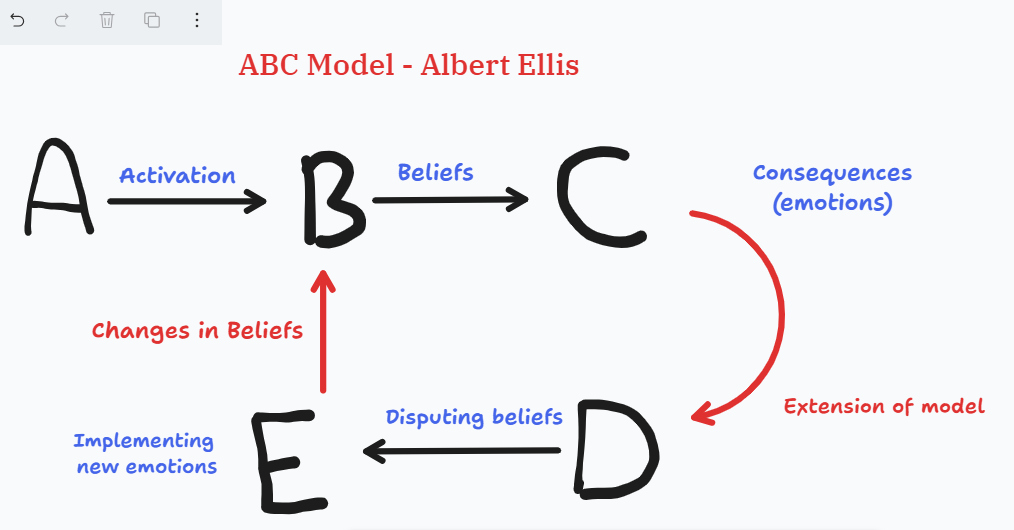
ABC Model:
A: Activating event
Event that happens to you in your environment.
B: Beliefs
Belief or interpretation of the event.
C: Consequences
The belief has consequences related to emotions.
D: Disputation of beliefs
Challenge your beliefs to make new beliefs.
E: Effective new beliefs
Implementation of new beliefs
Application: (Group Counseling)
Tailored for specific diagnoses such as anxiety and phobias.
Treatments are standardized and based on empirical evidence.
Use of homework allows lessons learned in group to generalize to the client’s daily environment.
Help members gain awareness of how their self-defeating thoughts influence what they feel and how they behave.
Heavy emphasis on psychoeducation and prevention of symptoms
Limitations:
Extensive training is required to practice CBT.
Therapist may misuse power by imposing their ideas of what constitutes “rational” thinking on a client.
Therapists must take special care to encourage clients to act rationally within the framework their own value system and cultural context.
The strong confrontational style of Ellis’ REBT may overwhelm some clients.
Some clinicians think CBT interventions overlook the value of exploring a client’s past experiences.