STRATEGIC MANAGEMENT
CHAPTER 1- What is Strategic Management?
1.1 Strategic Management
The analyses, decisions, and actions an organization undertakes in order to create and sustain competitive advantages. The essence of strategic management is the study of why some firms outperform others: strategy is all about being different from everyone else.
The four key attributes of Strategic Management are:
1) It is directed toward overall organizational goals and objectives;
2) It includes multiple stakeholders in decision making;
3) It requires incorporating both short-term and long-term perspectives;
4) It involves the recognition of trade-offs between effectiveness and efficiency.
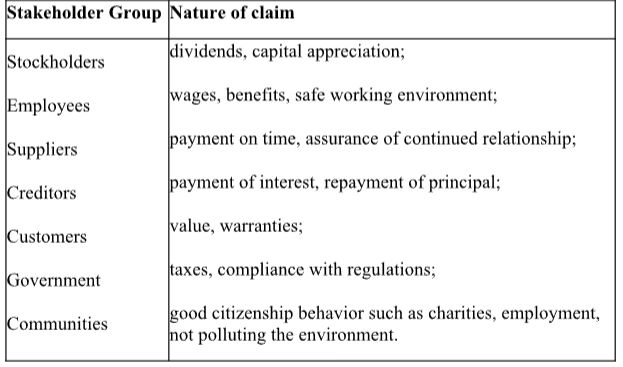
Stakeholders- Individuals, groups, and organizations who have a stake in the success of the organization, including owners (shareholders in a publicly held corporation), employees, customers, suppliers, and the community at large.
Stakeholder Group Nature of claim
Effectiveness- Tailoring actions to the need of an organization rather than wasting effort, or “doing the right thing.”
Efficiency- Performing actions at a low cost relative to a benchmark, or “doing things right.”
Operational Effectiveness- Performing similar activities better than rivals.
Ambidexterity- The challenge mangers face of both aligning resources to take advantage of existing product markets as well as proactively exploring new opportunities.
1.2- THE STRATEGIC MANAGEMENT PROCESS
Three ongoing processes that are central to strategic management are analyses, decisions and actions.
strategy analysis,
formulation and
implementation,
are highly interdependent.
An alternative model of strategy development:
● Intended strategy: strategy in which organizational decisions are determined only by analysis.
● Realized strategy: strategy in which organizational decisions are determined by both analysis and unforeseen environmental developments, unanticipated resource constraints, and/or changes in managerial preferences.
1.3 The Role of Corporate Governance and Stakeholder Management Corporate Governance
The relationship among various participants in determining the direction and performance of corporations.
The primary participants are:
1) the shareholders;
2) the management (led by the chief executive officer);
3) the board of directors. Generating long-term returns for the shareholders is the primary goal of a publicly held corporation.
There are two opposing ways of looking at the role of stakeholder management in the strategic management process:
1) Zero sum: the role of management is to look upon the various stakeholders as competing for the organization’s resources. In essence, the gain of one individual or group is the loss of another individual or group.
2) Stakeholder symbiosis: stakeholders are dependent upon each other for their success and well-being. That is, managers acknowledge the interdependence among employees, suppliers, customers, shareholders and the community at large.
Social responsibility- The expectation that businesses or individuals will strive to improve the overall welfare of society.
Triple Bottom Line- The assessment of a company’s performance in financial, social and environmental dimensions.
1.4 The Strategic Management Perspective: An Imperative throughout the Organization
To develop and mobilize people and other assets, leaders are needed throughout the organization. Everyone must be involved in the stratgic management process.
There is a critical need for three types of leaders:
1) Local line leaders who have significant profit-and-loss responsibility;
2) Executive leaders who champion and guide ideas, create a learning infrastructure and establish a domain for taking action;
3) Internal networkers who, although they have little positional power and formal authority, generate their power through the convinction and clarity of their ideas.
Top-level executives are key in setting the tone for the empowerment of employees.
There are two perspectives of leadership:
1) Romantic view of leadership: situations in which the leader is the key force determining the organization’s success – or lack thereof.
2) External view of leadership: situations in which external forces – where the leader has limited influence - determine the organization’s success.
1.5 Ensuring Coherence in Strategic Direction
Hierarchy of goals- Organizational goals ranging from, at the top, those that are less specific yet able to evoke powerful and compelling mental images, to, at the bottom, those that are more specific and measurable.
Vision- Organizational goal(s) that evoke(s) powerful and compelling mental images.
Mission Statement- A set of organizational goals that include both the purpose of the organization, its scope of operations, and the basis of its competitive advantage.
Strategic Objectives- A set of organizational goals that are used to operationalize the mission statement and that are specific and cover a well-defined time frame. They must be measurable, specific, appropriate, realistic and timely.
CHAPTER 2- EXTERNAL ENVIRONMENT OF THE FIRM
2.1 Three important processes to develop forecasts:
1) Environmental Scanning: surveillance of a firm’s external environment to predict environmental changes and detect changes already under way.
2) Environmental Monitoring: a firm’s analysis of the external environment that tracks the evolution of environmental trends, sequence of events, or streams of activities.
3) Competitive Intelligence: a firm’s activities of collecting and interpreting data on competitors, defining and understanding the industry, and identifying competitors’ strengths and weaknesses.
Environmental Forecasting- The development of plausible projections about the direction, scope, speed, and intensity of environmental change. A danger of forecasting is that managers may view uncertainty as black and white and ignore important grey areas.
Scenario Analysis- An in-depth approach to environmental forecasting that involves experts’ detailed assessments of societal trends, economics, politics, technology, or other dimensions of the external environment.
SWOT Analysis- A framework for analyzing a company’s internal and external environment and that stands for strengths, weaknesses, opportunities and threats.
The strengths and weaknesses portion of SWOT refers to the internal conditions of the firm opportunities and threats are environmental conditions external to the firm.
Limitations of SWOT Analysis
By listing the firm’s attributes, managers have the raw material needed to perform more in-depth strategic analysis. However, SWOT cannot show them how to achieve a competitive advantage, because of the following limitations:
● Strengths may not lead to an advantage;
● SWOT’s focus on the external environment is too narrow;
● SWOT gives a one-shot view of a moving target, because it is primarily a static assessment;
● SWOT overemphasizes a single dimension of strategy.
2.2 The General Environment
Factors external to an industry, and usually beyond a firm’s control, that affect a firm’s strategy.
The general environment is divided into six segments:
1) Demographic: aging population, rising affluence, changes in ethnic composition, geographic distribution of population etc;
2) Sociocultural: more women in the workforce, increase in temporary workers, greater concern for fitness, concern for environment etc;
3) Political/Legal: tort reform, Americans with Disabilities Act, taxation of local, state and federal levels, Sarbanes-Oxley Act of 2002 etc;
4) Technological: genetic engineering, emergence of Internet technology, pollution/global warming, wireless communication etc;
5) Economic: interest rates, unemployment rates, consumer price index, trends in GDP, changes in stock market valuations etc;
6) Global: increasing global trade, currency exchange rates, emergence of the Indian and Chinese economies, creation of WTO etc.
2.3 The Competitive Environment
Factors that pertain to an industry and affect a firm’s strategies. The nature of competition in an industry as well as the profitability of a firm is often more directly influenced by developments in the competitive environment.
Porter’s Five-Forces Model
The “five-forces” model has been the most commonly used analytical tool for examining the competitive environment. It describes the competitive environment in terms of five basic competitive forces.
-is a framework used to analyze the competitive dynamics of an industry. The model considers five key factors that influence the intensity of competition and profitability of a market:
1) Threat of new entrants: possibility that the profits of established firms in the industry may be eroded by new competitors. There are six major sources of entry barriers:
● Economies of Scale; - are cost advantages reaped by companies when production becomes efficient. Companies can achieve economies of scale by increasing production and lowering costs. This happens because costs are spread over a larger number of goods. Costs can be both fixed and variable.
● Product Differentiation;
● Capital Requirements;
● Switching Costs;
● Access to Distribution Channels;
● Cost Disadvantages Independent of Scale.
2) Bargaining Power of Buyers: buyers threaten an industry by forcing down prices, bargaining for higher quality or more services, and playing competitors against each other. A buyer group is powerful under the following circumstances:
● It is concentrated or purchases large volumes relative to seller sales;
● The products it purchases from the industry are standard or undifferentiated;
● The buyer faces few switching costs;
● The buyers pose a credible threat of backward integration;
● The industry’s product is unimportant to the quality of the buyer’s products or services.
SUPPLY CHAIN-is the network of all the individuals, organizations, resources, activities and technology involved in the creation and sale of a product.
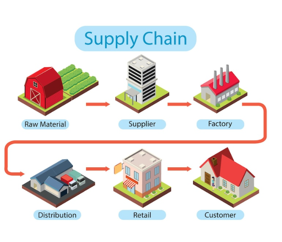 HORIZONTAL INTEGRATION- is the process of a company increasing production of goods or services at the same part of the supply chain. A company may do this via internal expansion, acquisition or merger. The process can lead to monopoly if a company captures the vast majority of the market for that product or service.
is when a business grows by acquiring a similar company in their industry at the same point of the supply chain.
VERTICAL INTEGRATION- is when a business expands by acquiring another company that operates before or after them in the supply chain.
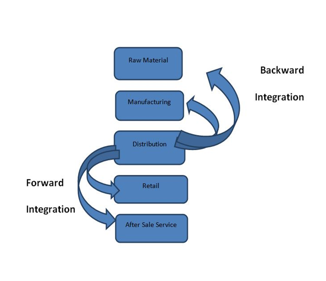 Backward integration is a process in which a company acquires or merges with other businesses that supply raw materials needed in the production of its finished product. Businesses pursue backward integration with the expectation that the process will result in cost savings, increased revenues, and improved efficiency in the production process. Companies also use backward integration as a way of gaining competitive advantage and creating barriers to entry to new industry entrants.
In short, backward integration involves buying part of the supply chain that occurs prior to the company's manufacturing process, while forward integration involves buying part of the process that occurs after the company's manufacturing process.
ADVANTAGE OF BACKWARD INTEGRATION
Better control
cost control
competitive advantage
DISADVANTAGE OF BACKWARD INTEGRATION
Inefficiencies
Substantial investment
3) Bargaining Power of Suppliers:
● The supplier group is dominated by a few companies and is more concentrated (few firms dominate the industry) than the industry it sells to;
● The supplier group is not obliged to contend with substitute products for sale to the industry;
● The industry is not an important customer of the supplier group;
● The supplier group’s products are differentiated or it has built up switching costs for the buyer;
● The supplier group poses a credible threat of forward integration.
4) Threat of Substitute Products and Services: all firms within an industry compete with industries producing substitute products and services. Substitutes limit the potential returns of an industry by placing a ceiling on prices that firms in that industry can profitably charge. The more attractive the price/performance ratio of substitute products, the tighter the lid on an industry’s profits.
5) Intensity of Rivalry among competitors in an Industry: rivalry among existing competitors takes the form of jockeying for position. Firms use tactics like price competition, advertising battles, product introductions, and increased customer service or warranties. Intense rivalry is the result of several interacting factors, including the following:
● Numerous or equally balanced competitors
● Slow industry growth
● High fixed or storage costs
● Lack of differentiation or switching costs
● Capacity augmented in large increments
● High exit barriers
Caveats of using industry analysis:
● Managers must not always avoid low profit industries (or low profit segments in profitable industries). Such industries can still yield high returns;
● the five-forces analysis implicitly assumes a zero-sum game, determining how a firm can enhance its position relative to the forces. Yet, such an approach can often be short- sighted;
● The five-forces analysis also has been criticized for being essentially a static analysis. External forces as well as strategies of individual firms are continually changing the structure of all industries.
Complements- Products or services that have an impact on the value of a firm’s products or services.
Strategic Groups- Clusters of firms that share similar strategies. Competition tends to be more intense among firms within a strategic group than between strategic groups.
One can derive an analytical tool from the strategic groups concept:
● Strategic groupings help a firm to identify barriers to mobility that protect a group from attacks by other groups;
● Strategic groupings help a firm identify groups whose competitive position may be marginal or tenuous;
● Strategic groupings help chart the future directions of firms’ strategies;
● Strategic groups are helpful in thinking through the implications of each industry trend for the strategic group as a whole.
PESTEL ANALYSIS
P-OLITICAL
E-CONOMIC
S-OCIOCULTURAL
T-ECHNOLOGICAL
E-NVIRONMENTAL
L-EGAL