Occupational Therapy: Key Terms from Chapter 1
Stories of OT in Action
Sade Salley, MSOT, Class of 2022 (University of New England) shared that OT works best when therapists respect clients’ cultures and learn their personal stories.
She saw OT practitioners try to speak clients’ languages and connect with their lives. This shows OT is about teamwork between the client and therapist.
Big idea: When therapists understand each client’s personal story, people from all backgrounds can safely take part in activities that matter to them.
Examples of Clients
Kareem – 6 months old, trouble feeding from a bottle.
Macy – 6 years old, struggles with focus, writing, and play at school.
Scout – high school freshman, struggles with identity and isolation.
Trey – 21 years old, college student with a spinal cord injury from a car crash.
Margaret – mother with a degenerative disorder, struggles caring for two kids.
Jaquan – veteran of 3 military tours, struggles with physical and emotional trauma.
Ethel – older adult showing signs of dementia, wants to live independently.
Each person has a unique story and goals. OT looks at how health challenges affect daily life in different environments (home, school, community, work, etc.).
What Is Occupational Therapy (OT)?
Definition: OT is using everyday activities (occupations) in a therapeutic way to help people participate in life.
Examples by setting:
Hospital (adult rehab): OT helps people return to normal routines (work, social life, hobbies).
Mental health (teens): OT helps teens build coping skills, problem-solving, and routines for school and social life.
School (kids): OT helps children develop skills for academics, recess, lunch, and social activities.
Tips for explaining OT: Keep it short, use examples, avoid medical jargon, focus on benefits.
Occupations: The daily activities people do—like self-care, chores, sleep, school, work, play, leisure, and socializing.
The OT Process and Client-Centered Care
The OT process has 3 main steps: Evaluation → Intervention → Outcomes.
Client-centered care: Focuses on what is important to the client, not just the medical condition.
Example: A teen with anxiety might need organization strategies. Staying organized lowers anxiety and helps with schoolwork.
OT happens in homes, schools, clinics, and communities. The process is flexible and may change as new info comes up.
Types of OT Practitioners
OT practitioner = OT + OTA.
Occupational Therapist (OT): Needs a master’s or doctorate, passes NBCOT exam, and gets a state license. They run evaluations, make intervention plans, and supervise OTAs.
Occupational Therapy Assistant (OTA): Needs a 2-year degree, passes NBCOT, and gets licensed. They carry out therapy plans under OT supervision.
Aides: Not licensed; help with setup, paperwork, or cleaning.
Service competency: OTs and OTAs must show they can perform tasks at the same level.
Ongoing learning: Practitioners keep studying, stay updated on research, and focus on ethics and inclusion.
Requirements to Become an OT Practitioner
To be an OT:
Graduate from an accredited master’s or doctorate program.
Complete fieldwork (Level I = short practice; Level II = 6 months full-time). Doctorate students also do a capstone project.
Pass NBCOT exam and get state license.
To be an OTA:
Graduate from an accredited associate program.
Complete Level I and 6 months of Level II fieldwork.
Pass NBCOT exam and get licensed.
OT Education and Courses
Programs are accredited by ACOTE.
Courses include theory, science, human development, and therapy skills.
Students learn critical thinking to analyze activities and design interventions.
Programs stress cultural awareness and self-reflection.
Learning includes group projects, simulations, and hands-on fieldwork
What Do OT Practitioners Do?
Goal: Help clients do daily activities (self-care, school, work, play, sleep, etc.).
Approaches:
Fix or restore skills.
Compensate for lost abilities.
Adapt activities or environments.
Advocate for supports or accessibility.
Examples: Coaching families on feeding infants, using calming routines, helping with play or school participation.
Discharge planning: OT tracks progress and plans for life after therapy.
Relationships: Building trust is key for progress.
The OT Process in Detail
Evaluation: Gather info from interviews, observation, and assessments.
Intervention Plan: OT + OTA create a plan based on evidence, client goals, and environment.
Implementation: OT applies science + communication skills to deliver therapy.
Outcomes: Measure progress, reflect on sessions, and decide next steps.
Occupations, Activities, and Tasks
Occupation: Big life role (e.g., being a student, a gardener).
Activity: Things done within that role (e.g., reading, planting).
Task: Small steps (e.g., writing an essay, pulling weeds).
OT looks at all levels to create helpful plans.
Language, Identity, and Respect
Words used for clients vary (patients, clients, residents, students).
Person-first language: “Person with autism.”
Identity-first language: “Autistic person.”
OT respects each client’s preference.
Social model of disability: Disability is often caused by barriers in society, not just the condition itself.
Practice Settings and Careers
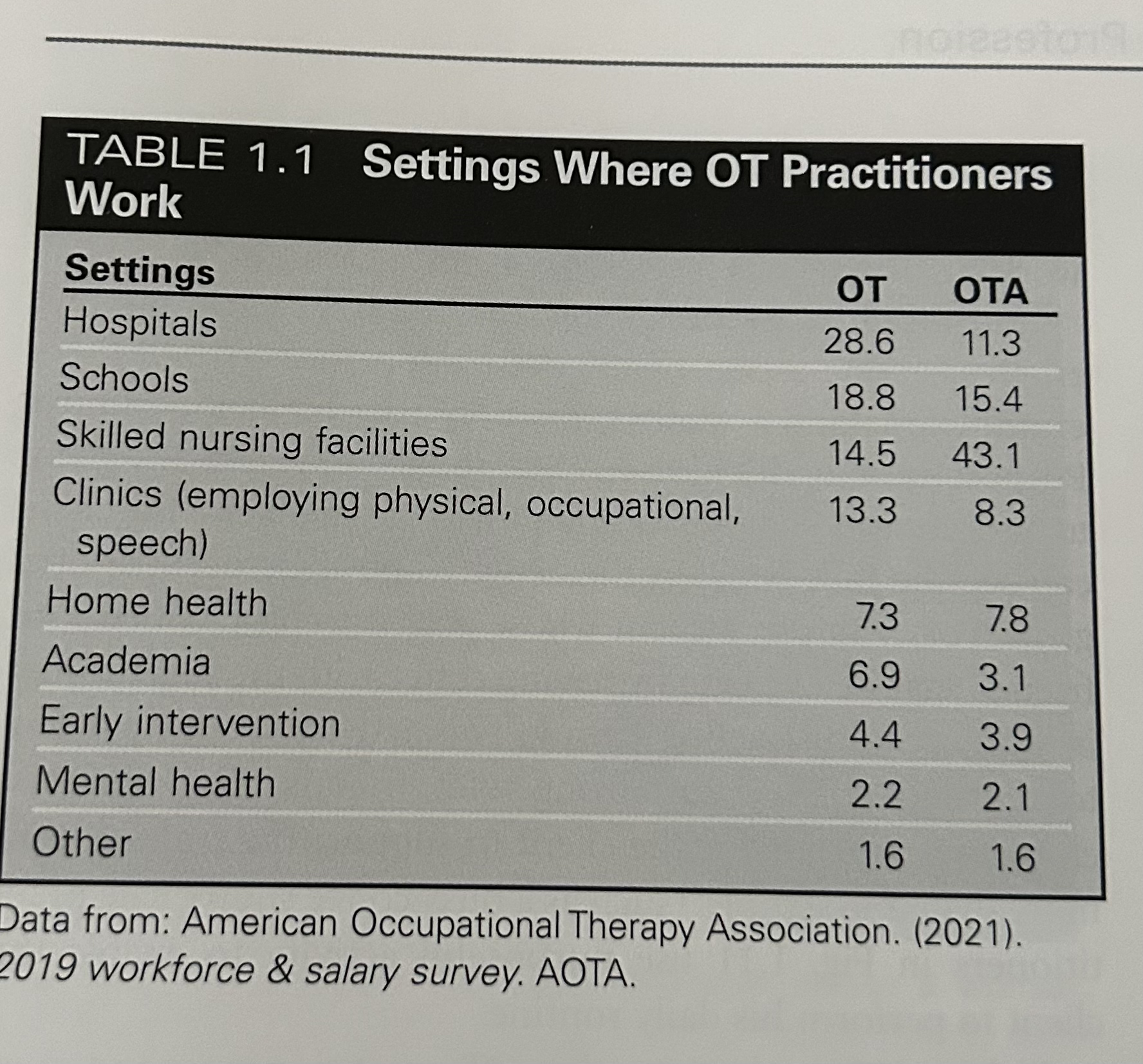
OTs and OTAs work in: hospitals, clinics, schools, nursing homes, homes, communities, mental health centers, recovery centers, private practice.
Workforce stats:
Hospitals: OT 28.6%, OTA 11.3%
Schools: OT 18.8%, OTA 15.4%
Nursing homes: OT 14.5%, OTA 43.1%
Specialty areas: driving, low vision, feeding/swallowing, school systems, environment.
Career growth: therapist → director → educator.
Challenges: shortage of faculty in OT/OTA programs.
Challenges OT Addresses
OT helps people with physical, developmental, emotional, and social conditions.
Examples:
Teaching budgeting, transportation, and routines for someone with schizophrenia.
Stress and emotional regulation strategies.
Adapting homes or creating splints after a stroke.
Intervention Activities and Tools
Preparatory: exercise, stretching, relaxation.
Contrived: practice with fake tools (e.g., tying shoes on a doll).
Purposeful: practice real activities that matter (e.g., making coffee).
Occupation-centered: therapy in natural settings (e.g., cooking in own kitchen).
Therapeutic media: crafts, games, sports, music, self-care, technology.
Diversity, Equity, Inclusion, and Justice
Vision 2025: OT is diverse, inclusive, and equitable.
Diversity: all the unique traits people bring (race, gender, culture, etc.).
Equity: fair access to opportunities.
Inclusion: everyone belongs and is valued.
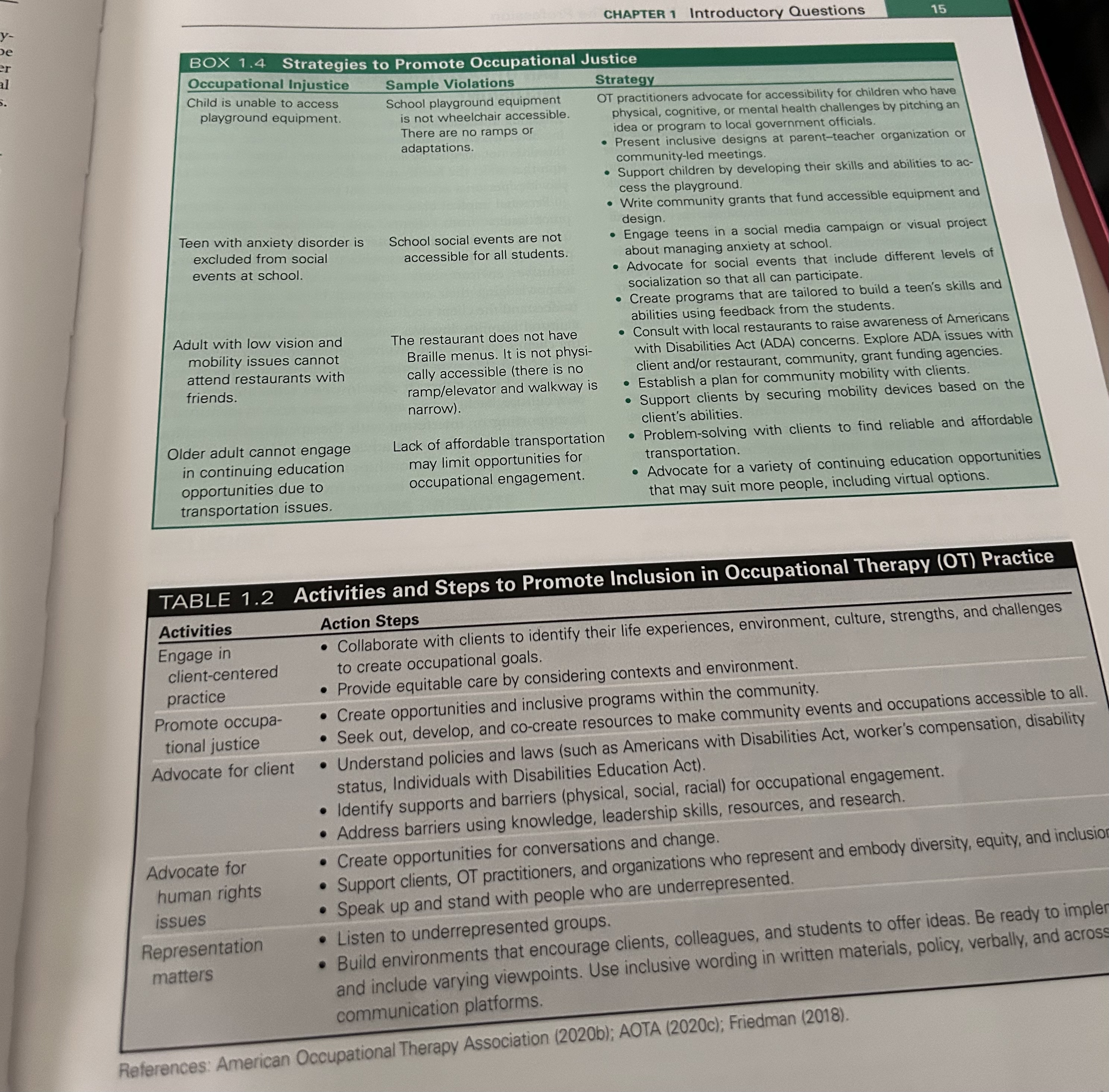
Occupational justice: everyone should access meaningful activities.
Barriers: racism, discrimination, lack of representation in OT.
Solutions: mentorship, recruitment, inclusive teaching, advocacy.
Occupational Justice: Strategies
Advocate for accessible transportation and after-school programs.
Design inclusive parks and community events.
Work with communities to remove barriers.
Help families find local resources.
Key Terms (Simplified)
Occupations: meaningful daily activities.
Activities: steps within occupations.
Tasks: small actions that make up activities.
Client-centered care: therapy based on the client’s goals.
Therapeutic reasoning: making decisions about therapy based on evidence and client needs.
Occupational justice: fair access to meaningful activities.
OT process: Evaluation → Plan → Implementation → Outcomes.
Diversity, equity, inclusion: respecting differences and making sure everyone has equal opportunity.
Professional responsibility: lifelong learning, advocacy, and staying updated
Quick Reference: Key Numbers and Facts (LaTeX-formatted)
Client ages and examples: Kareem , Macy , Trey , three deployments for Jaquan.
Fieldwork durations: Level II fieldwork totals typically ; entry-level Doctoral programs include of Level II fieldwork.
Faculty shortages: OT programs , OTA programs (AOTA, 2021).
Workforce demographics (AOTA, 2021): about of the workforce white and female.
Occupational areas: ADLs, IADLs, health management, rest/sleep, education, work, play, leisure, social participation (AOTA, 2020a).
Notation: All numbers above reflect content and data cited from AOTA sources (2020a, 2021) and are included here for study reference.
Glossary (condensed)
Occupation: meaningful daily life activities that give identity and health.
Activity: the components within an occupation.
Task: basic units of action within activities.
Client-centered care: practice tailored to the client’s life and goals.
Occupational justice: equal opportunity to engage in desired occupations.
ACOTE: accrediting body for OT education under AOTA.
NBCOT: national certification exam for OT and OTA.
IADL/ADL: instrumental activities of daily living and activities of daily living.
Special terms you’ll encounter: therapeutic reasoning, evidence-based practice, ethics, and lifelong learning.
Closing
The content above captures Chapter 1’s core ideas: what OT is, how OT is practiced, the roles of OTs and OTAs, the educational pathways, core processes, and the profession’s commitments to diversity, equity, inclusion, and justice. Use these notes to scaffold your understanding of how OT translates science, empathy, and practical problem-solving into real-world participation for clients across the lifespan.