Physical Science 1
Physical Science 1
- Physical Science Branches: Physics, Earth, Chemistry, and Astronomy.
- Big bang theory
- explains how the universe began
- this is an expansion
- Atom - is the building block of matter
- Molecules - atoms combine to form
- ATOMIC THEORY
- States of Matter - Solid, Liquid, Gas
- History:
- Thales - “water constituted all matter.”
- Empedocles - “Matter is made up of four elements.” (earth, air, fire, water)
- Leucippus - “A material will reach a point that it can never be divided.”
- Democritus - “Materials are made up of tiny, indivisible and indestructible particles called atom.”
- Newlands - increasing order of atomic masses.
- Mendeleev - Periods and Columns
- The Evolution of the Models of Atom:
Atomism
- 5th Century BC
- Proposed by Democritus.
- All matter is made up of tiny, indivisible particles called atoms.
- It is derived from the word “atomos,”
- Solid Sphere
- 1803
- Proposed by John Dalton
- Atoms are tiny, indestructible spheres with no internal structure.
- Plum Pudding Model
- 1904
- Proposed by J.J Thomson
- Atom have a + charge sphere and negative e- scattered.
- Also referred as the raisin bread model.
- Cathode Ray Experiment
- Nuclear Model
- 1911
- Proposed by Rutherford
- Most of the mass comes from the nucleus.
- E- are orbiting around it.
- It became the basis of the atomic structure today.
- Schrodingers Model
-1926
- describes the quantum mechanical behavior of electrons in atoms using wave functions
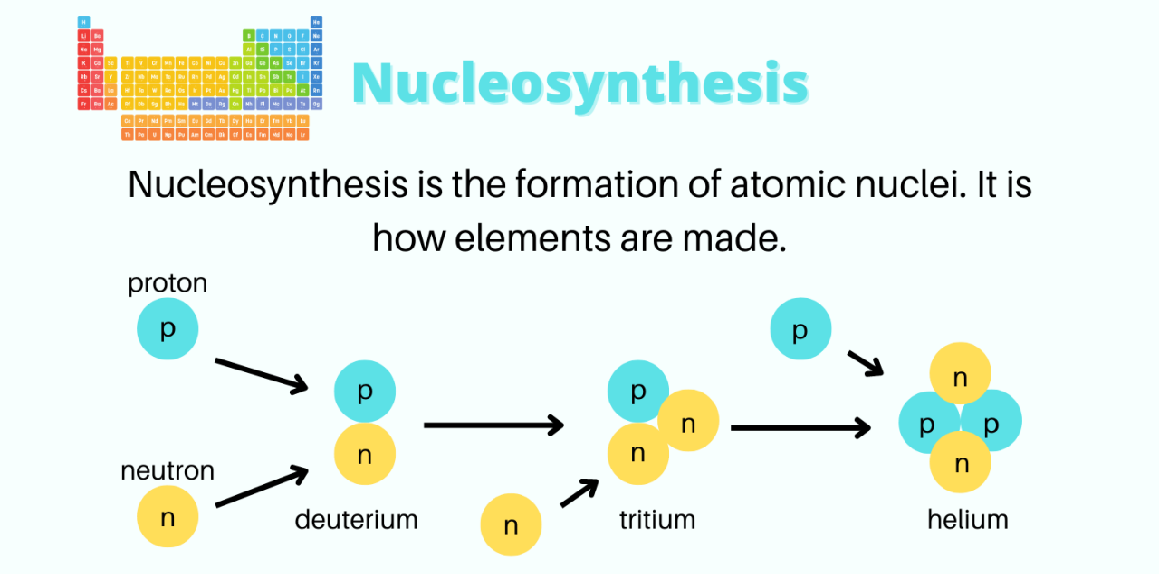
- Nucleosynthesis
- Evidences of the BIG BANG
- Cosmic Expansion
- CMB (Cosmic Microwave Background)
- Nucleosynthesis
- 3 Types of Nucleosynthesis
- Big Bang - refers to the formation of light elements like hydrogen, helium, and a small amount of lithium in the early universe, occurring within the first few minutes after the Big Bang.
- Stellar - In the cores of stars, nuclear fusion processes generate energy and create heavier elements from lighter ones. Main sequence stars like our Sun fuse hydrogen into helium through thermonuclear reactions
- Supernova - is a powerful stellar explosion that occurs at the end of a star's life, marking its dramatic collapse and subsequent release of immense energy.
- Big Bang Nucleosynthesis
- Factors that led to it:
- Temperature & energy.
- As a result, quarks & gluons formed the p+ and n0.
- The creation of a new element from p+ and n0.
- NUCLEAR FUSION.
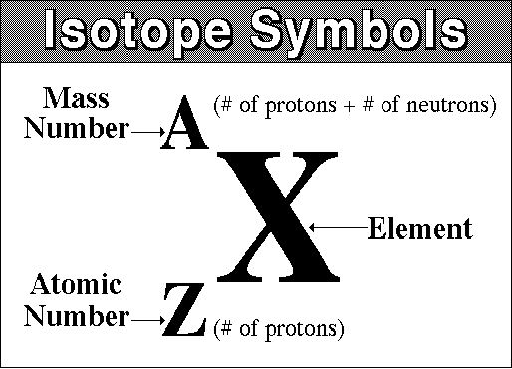
- It led to the creation of light elements. Ex: H to He
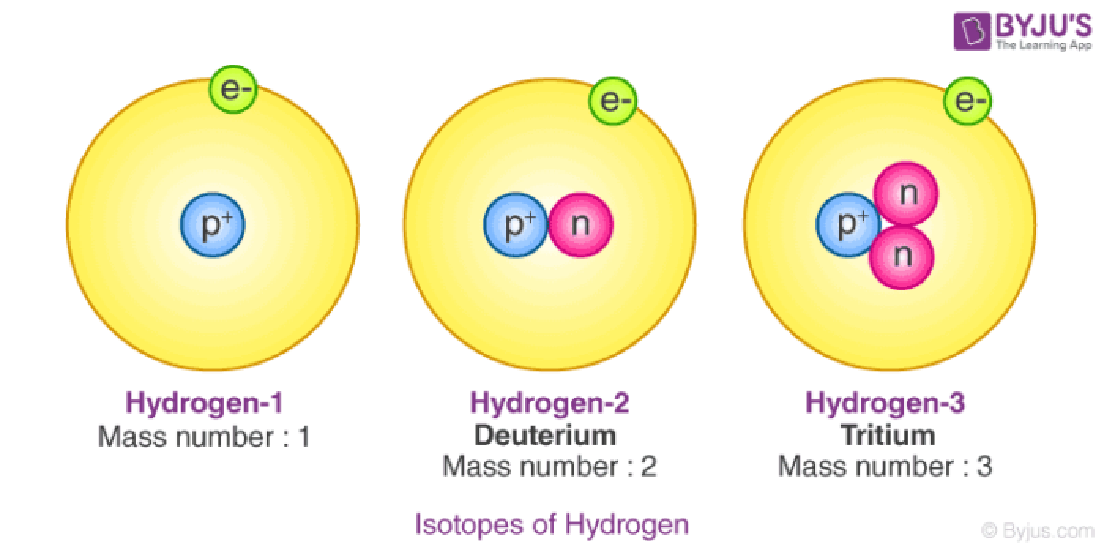
✭ Isotopes
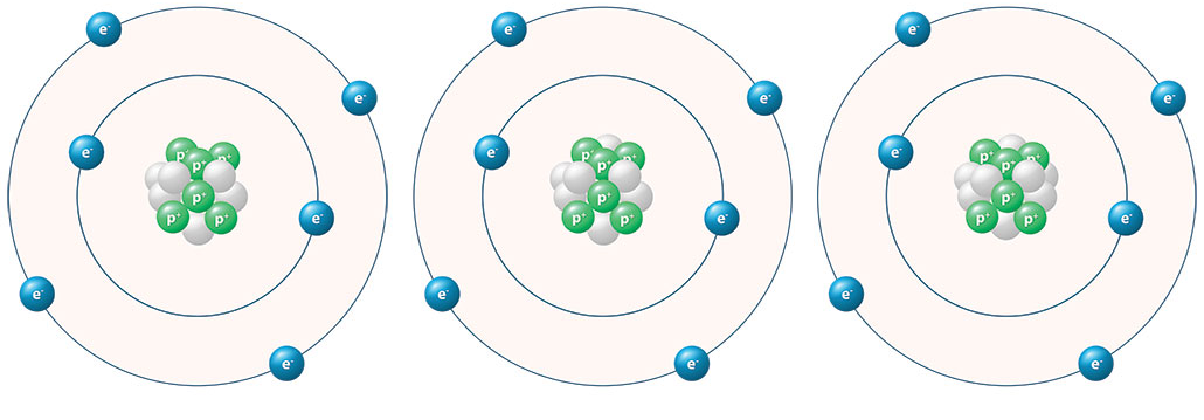
- Isotopes are family of element. It all has:
- Same # of p+, Different # of n0
- Same atomic #, Different mass #
- Isotopes may be stable or unstable.
✬
❀
❂
✫ Stellar Nucleosynthesis
- Formation of elements from the stars’ interior.
- Factors that led to it:
- Density & Temperature
- 1. Proton-Proton Chain: Fusion of 4 H nuclei to form He
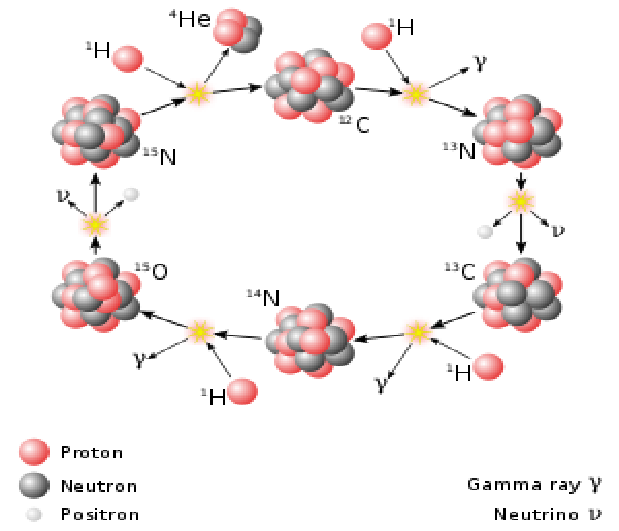
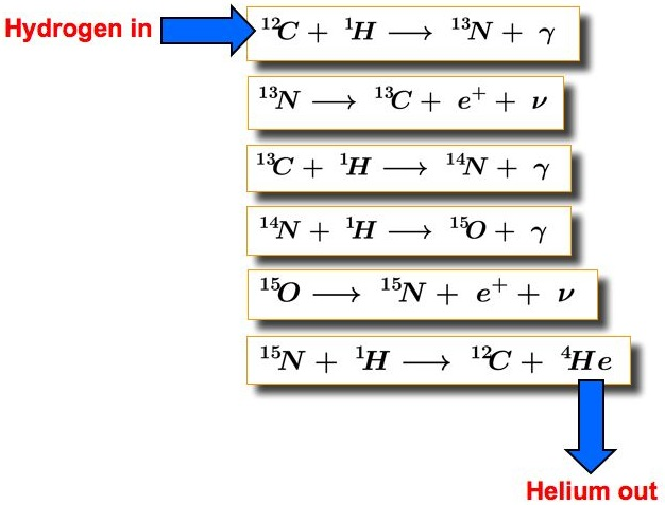
- 2. CNO Reaction: Conversion of H to He by using Carbon.
✯ Proton-Proton Chain Reaction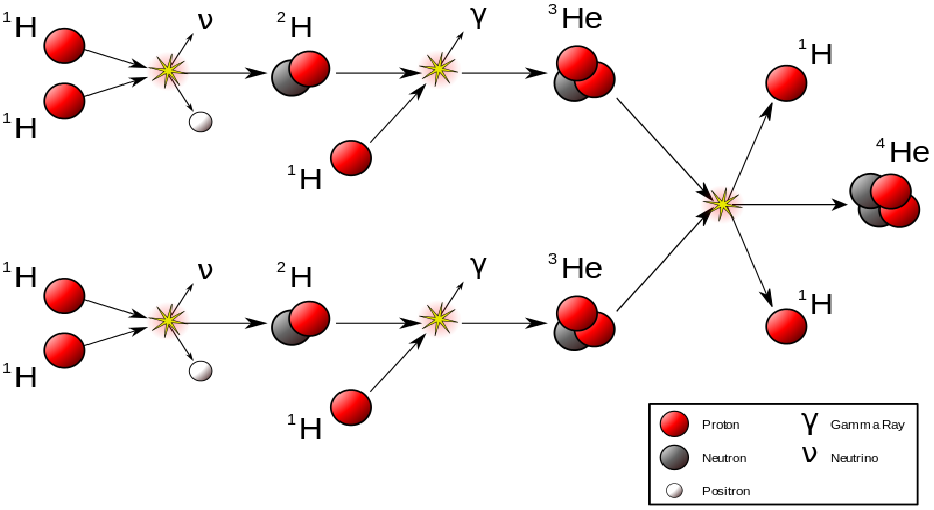
✬ CNO Cycle (Carbon, Nitrogen, Oxygen)
✮ Stellar Nucleosynthesis
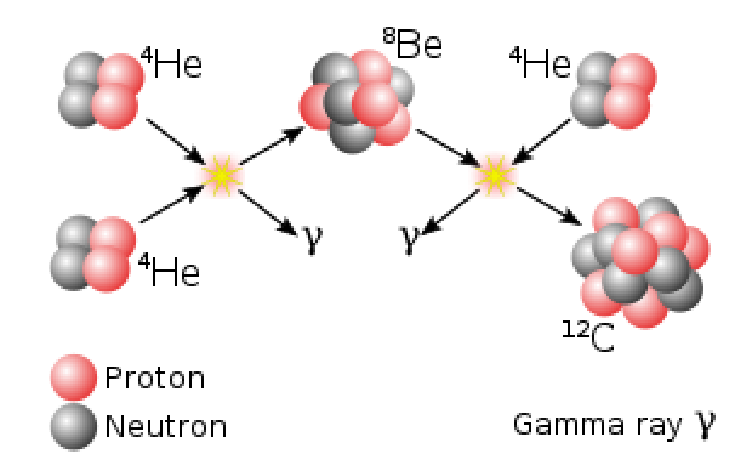
- 3. Tri-Alpha process:
- 3 He combine to form Be.
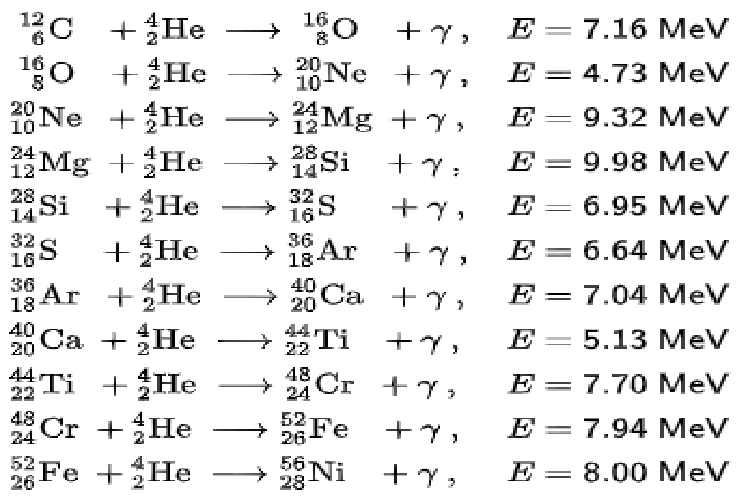
- 4. Alpha Ladder Process:
- Adding He for every element to form new element.
✯ Triple Alpha Process
✯ Alpha Ladder Process
✬✬✬✬✬✬✬✬✬✬✬✬✭✭✭✭✭✭✭✮✮✮✮✮✮✯✯✯✯✰✰✰✰✰✰✰✰✰✰✰✰✰✰✱✱✱✳✳✳✳✫✫✫✫✫✫✫