Astrophysics Concepts
Basic Properties of Stars
Stars appear as points of light
Can measure brightness, color, and position
Observations can help infer distance, temperature, size, and mass
Measuring Distance to Stars
Parallax method:
Stars appear to shift slihtly when viewed from different positions in Earth’s orbit
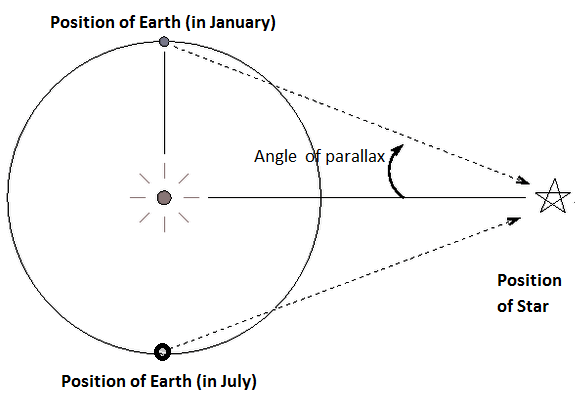
This phenomenon allows astronomers to calculate the distance to nearby stars by measuring the angle of this shift and applying trigonometry.
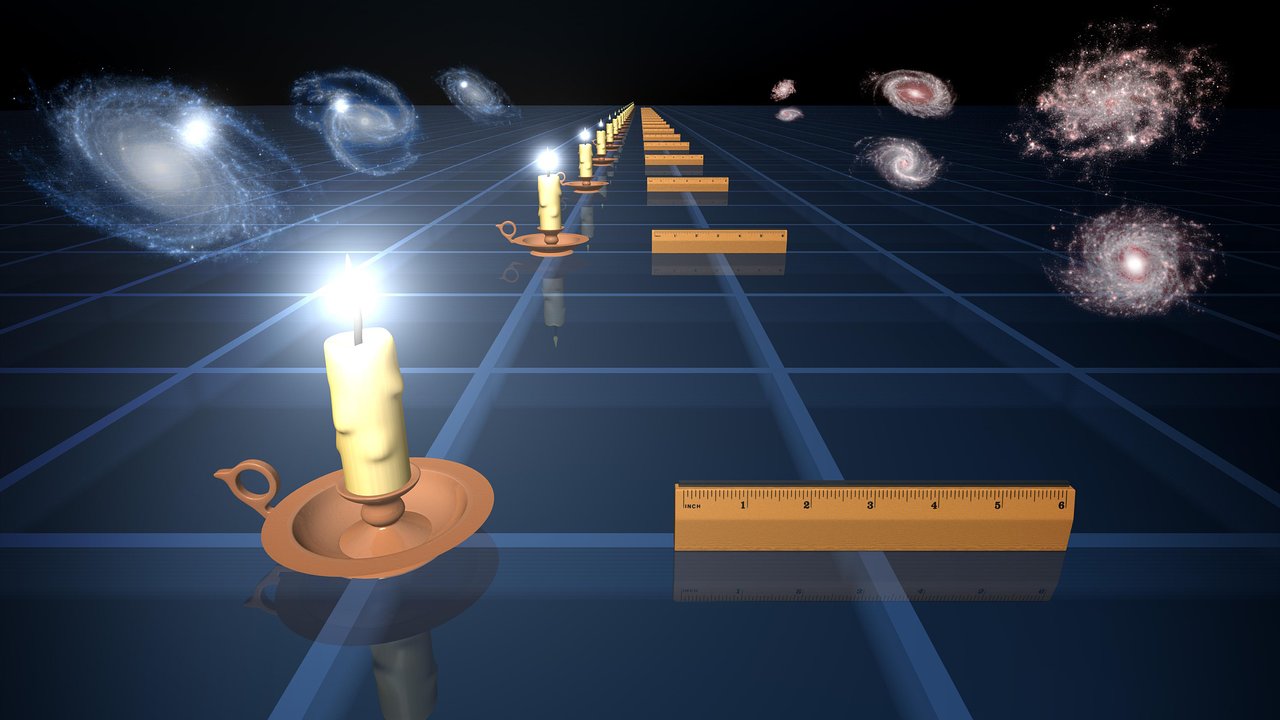
Standard Candles
Some stars have known brightness, allowing us to estimate their distance by comparing apparent brightness
Luminosity and Brightness
Luminosity (L): The total energy a star emits
Flux (F): The amount of energy reaching us per unit area
Inverse-square law: Brightness decreases with distance;
F = L / 4\pi d^2, where d is the distance from the star to the observer.
Magnitude system: Astronomers rank brightness using a logarithmic scale (lower values mean brighter stars)
Temperature and Color
Stars emit light in different colors based on temperature.
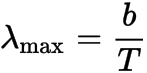
Wein’s law:
The peak wavelength of light emitted by a black body is inversely proportional to its temperature, which allows astronomers to determine the temperature of stars based on their color.
Hotter stars = shorter wavelength (blue)
Cooler stars = loner wavelength (red)
Clor Index (B-V): A nemerical value indicating a star’s color and temperature.
Stellar Size and the Stefan-Boltzmann Law
Larger and hotter stars are more luminous.
Stefan-Boltzmann Law: L = 4piR^2 σT^4, where L is the luminosity, R is the radius of the star, and T is its effective temperature.
Bigger or hotter stars emit more energy.
If you know a star’s luminosity and temperature, you can find its radius.
Stellar Classification (H-R Diagram)
Hertzsprung-Russell Diagram: A plot of stars’ luminosity vs. temperature.
Main sequence: Stars like the Sun fuse hydrogen.
Giants & Supergiants: Large, bright, stars
White dwarfs: Small, dim, hot remnants
Star Life cycle
Stars firn gas clouds, burn fuel, and eventually die.
Low-mass stars → White dwarfs
High-mass stars → Supernovae → Neutron stars or Black Holes