Module 1 : Energy & Decay Modes
Nuclear Decay Modes
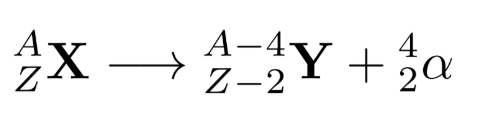
Alpha Decay (yellow)
The nucleus emits an alpha particle (a helium nucleus, made of two protons and two neutrons).The mass number decreases by 4; the atomic number decreases by 2.
Beta-minus Decay (light blue)
A neutron inside the nucleus turns into a proton, emitting a negatively charged electron, (hence beta-minus) and a very light particle called an anti-neutrino in the process. The mass number does not decrease; the atomic number increases by 1.

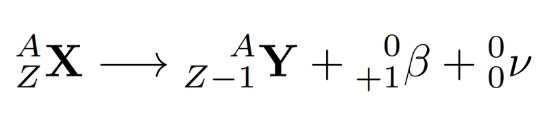
Beta-plus Decay (red)
A proton inside the nucleus turns into a neutron, emitting a positron, (the positively charged antiparticle of the electron) and a very light particle called a neutrino in the process.
The mass number does not decrease; the atomic number decreases by 1.
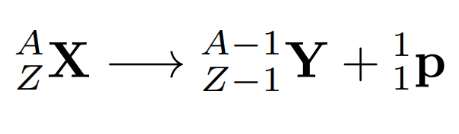
Proton Emission (orange)
The nucleus emits a proton.
The mass number decreases by 1; the atomic number decreases by 1.
Neutron Emission (dark blue)
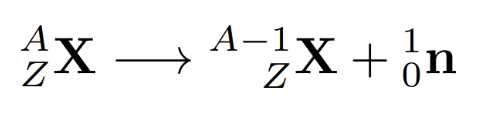
The nucleus emits a neutron.
The mass number decreases by 1; the atomic number does not decrease.
Fission (green)
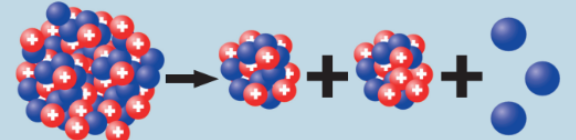
An unstable heavy nucleus splits to form two lighter nuclei, emitting neutrons as part of the process.
The mass number and the atomic number decrease.
Gamma Decay
The nucleus loses excess energy by emitting a photon.
The mass number and the atomic number do not decrease.
1.1 Super Heavy Elements
Uranium is the heaviest naturally occurring element with a mass number of 92. Oganesson is the current heaviest element with a mass number of 182. Elements with mass numbers greater than 103 are called ‘super-heavy elements'. The heavier an element, the shorter its half-life. Heavier elements are more radioactive due to the electrostatic forces in the nucleus.
1.2 Energy From Fusion
Nuclear Fusion products release energy due to the slight difference in the initial and final mass of the products and reactants. This difference is converted into energy. Elements all the way from hydrogen are produced up to Iron-56.
1.3 Energy Calculations
The tower height is equal to the atomic mass per nucleon (compare to Fe 56)
A nucleon is any particle within the nucleus
The mass excess is the difference between the atomic mass of the isotope and the mass of the nucleons, (protons and neutrons) that makes it up:
mass excess = matomic(A, Z) − A x u
i.e. A = Z + N is the number of nucleons. All terms are in units of the atomic mass unit: the atomic mass unit (u) is one twelfth of the mass of an atom of carbon-12, (in kg, u = 1.66 x 10⁻²⁷ kg). So, we are in fact comparing atomic masses with carbon-12 as a reference.
E = mc2
where E is the energy available, m is the mass excess, and c is the speed of light. So, E = 1.05 x 10⁻¹² J.
In our LEGO nuclide chart, we use the mass excess for the tower heights because the most stable isotope is the isotope with the lowest mass excess. Therefore, on our chart, the most stable isotope is at the bottom of the 'valley of stability', and beta decay (plus and minus) will go towards the bottom of this 'valley'. However, we may also want to calculate the binding energy or nuclear mass defect of the isotope. These do not compare the mass of the isotope to the mass of the carbon-12 atom. In contrast, the mass defect and binding energy are defined by comparing the mass of the nucleus to the mass of the protons (mp) and neutrons (mn) in the nucleus
For a nucleus with Z protons and N neutrons, and a nuclear mass of M(Z,N), the nuclear mass defect is:
nuclear mass defect = (Zmp + Nmn) - mnucleus
The binding energy for the same nucleus is defined as:
binding energy = (nuclear mass defect) x c2
binding energy = ((Zmp + Nmn) - mnucleus) x c2
In this equation c is the speed of light (3×10^8) .Since almost all nuclei we would deal with are bound, the binding energy of these nuclei must be positive. The nuclear mass defect is therefore also positive in almost all cases. Over future modules, we will explore the binding energy much further, and even use it to predict the minimum size of a neutron star in Module 3 (Nuclear Astrophysics).
1.4 Activity, Decay and Half Lives
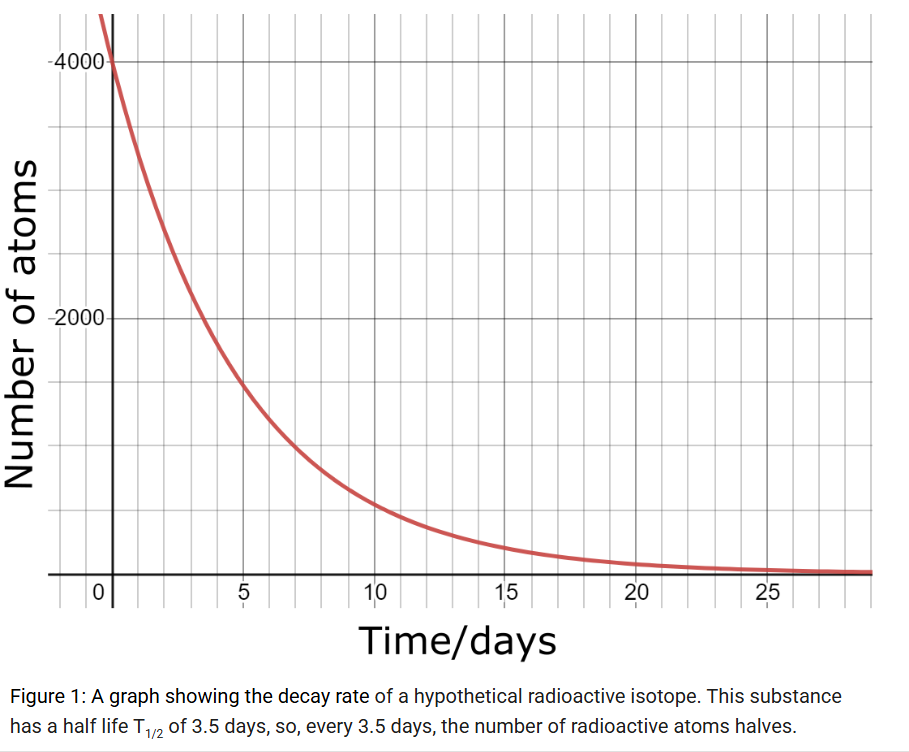
Radioactive Decay is the random process by which unstable nuclei release radiation to lose energy.
The Half-Life is the average time taken for half of the radioactive nuclei to decay (or the time taken for the count-rate to half).
Activity is the number of decays per second, measured in becquerels (Bq)
The Decay Constant is measured in per second (s^-1)
Where:
A - Activity (Bq)
Decay Constant ( )
N = The current number of radioactive particles
= The initial number of radioactive particles
T - Time (s)
The time at the Half Life.