Lecture 11: Geohazards
Natural Hazards
Geological phenomenon that may cause loss of life, injury, property damage, loss of livelihoods and services, social and economic disruption, or environmental damage. May be geological or hydrologic / hydrometeorologic
Quantified based on frequency and magnitude
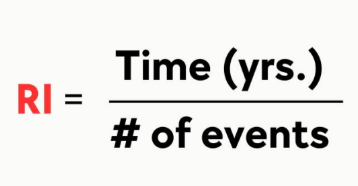
Recurrence Interval / Return Period
The average number of years between events of a certain size in a location
Disaster Risk
The probability of an event and its negative consequences (i.e. losses in life, health status, livelihoods, assets, and services) which could occur to a particular community or a society over some specified future time period (UNISDR, 2009)

The Philippine Engineering Geological and Geohazard Assessment (EGGA) System
Geologic Hazards
Fault-related / Seismic Hazards
Ground acceleration
Caused by the passage of seismic waves through populated areas. The most destructive waves are surface waves.
Ground Rupture
The surface of a fault broken during an earthquake. When a fault does not reach Earth’s surface, no rupture is evident.
Differential Settlement / Subsidence
Occurs when the ground settles due to changes in fluid levels underground
Some small faults cause some areas to drop more than others. In coastal areas, subsidence can sink communities closer to sea level and leave them more vulnerable to flooding.
Subsidence of the ground is a serious problem throughout North America. The lowering of the ground surface can be caused by a variety of human activities, including extraction of groundwater, drainage of organic or clay-rich soils, and thawing of permafrost.
Fault Creep
The slow, more-or-less continuous movement on a fault, in contrast to the sudden movement of a section of fault during an earthquake
Lateral Spread
Extension cohesive soil / rock mass combined with the general subsidence of the fractured mass of cohesive material into softer underlying material
May result from liquefaction or flow of the softer underlying material
Seiches
Generated by the back-and-forth motion associated with earthquakes, causing a body of water to rock back and forth, gaining amplitude and splashing up to higher levels than normally associated with that body of water.
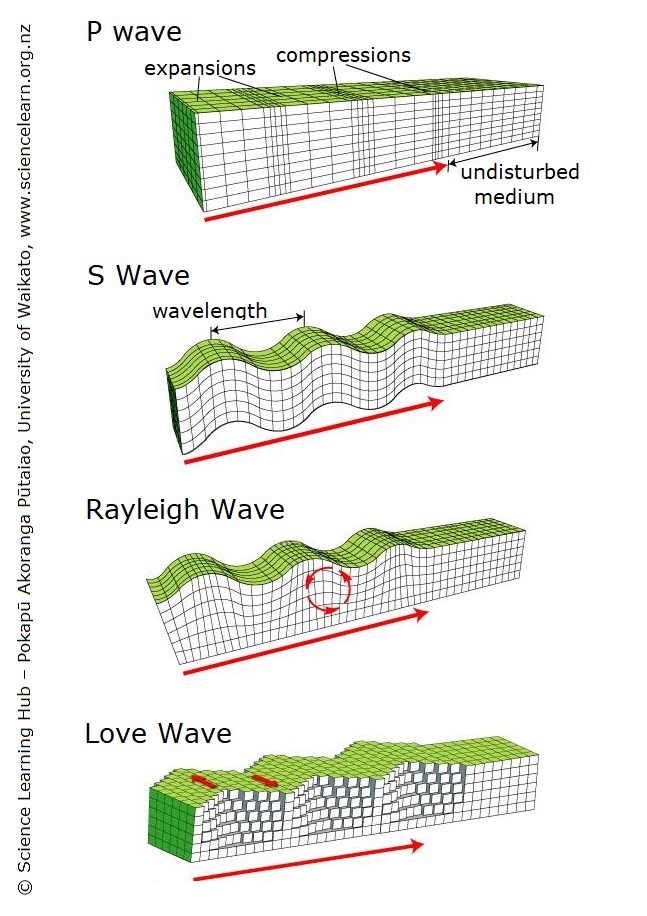
Main types of seismic waves
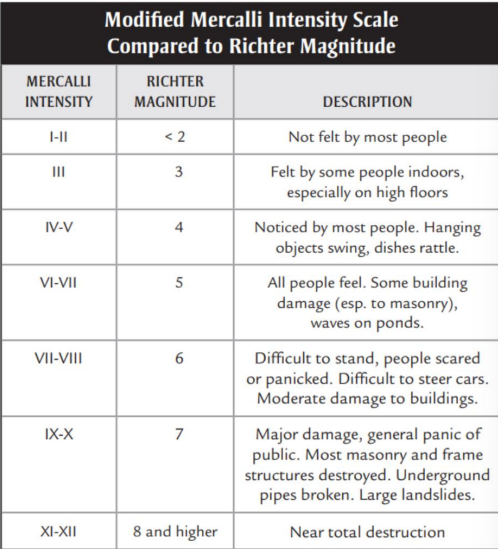
Mercalli Intensity Scale & Richter Scale
Volcanic Hazards
Lava
Lava Flow
Basaltic magmas that tend to spill out of a volcano (fluid, low gas content, low polymerization)
Outpourings of molten rock from a volcanic vent onto the Earth's surface during effusive eruptions
Lava Fountain
A volcanic phenomenon where molten rock (lava) is forcefully ejected from a vent, crater, or fissure, forming a jet or spray of lava
Tephra Fall
Most widespread volcanic hazard
The deposition of volcanic material, ranging from ash to larger rock fragments, ejected during an explosive volcanic eruption. This material, collectively called tephra, is propelled into the atmosphere and then settles downwind, impacting areas surrounding the volcano
Pyroclastic Density Currents
Hot, ground-hugging flows of ash and debris
Fall
Loose particles of volcanic dust or small fragments; < 2 mm in diameter
It collects loosely on the ground and in roofs
Eruption column
mass of ash and gases forcefully blown upward from a volcanic vent during an eruption
Base surge
high-energy blast of steam and ash that blows laterally from the base of an eruptive column during the initial stages of a strong volcanic eruption
Flow
These are dense, high-velocity currents that carry a large amount of solid material (e.g., pumice, ash, blocks) and gas. They are often described as "glowing clouds" or "nuée ardente"
Surge
These are more dilute, lower-density currents that can be turbulent and contain a smaller proportion of solid material compared to pyroclastic flows. They can be thought of as the "lighter" version of a PDC, often traveling faster and further than dense flows
Lahar
If ash and fragment deposits on a volcano’s flank soak up sufficient water from precipitation, the mixture may pour downslope as a volcanic mudflow called a lahar
Requirements
loose tephra deposit
water
Volcanic Gases
Emissions from volcanoes that consist of a variety of substances, mostly in gaseous form, released from magma or hot volcanic rocks. These gases can escape from a volcano before, during, or after an eruption.
CO2, SO2, H2S, HF, HCl
Vog (Volcanic Smog)
A form of air pollution caused by volcanic gases, primarily sulfur dioxide (SO₂), reacting with sunlight, oxygen, and moisture in the atmosphere.
Gas Plume
A visible or invisible column of volcanic gases and aerosols emitted from a volcano.
Fumaroles
Openings or vents in or near a volcano that release volcanic gases without explosive activity.
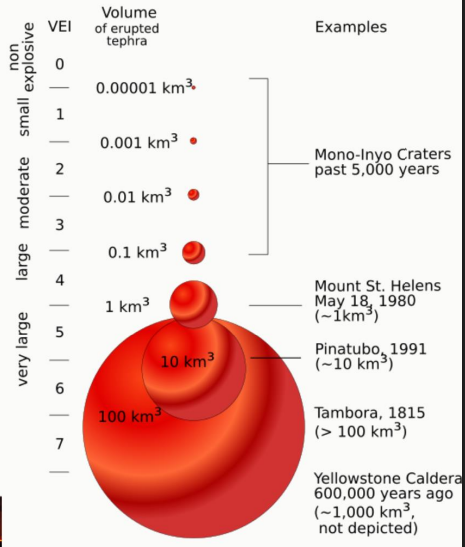
Volcanic Explosivity Index (VEI)
Earthquakes
Types of Earthquakes
Tectonic earthquake
Occurs due to the sudden release of energy when tectonic plates shift or grind against each other.
Volcanic earthquake
Caused by the movement of magma beneath a volcano, which puts pressure on surrounding rocks and causes them to fracture.
Tectonic-volcanic earthquake
A combination of tectonic forces and volcanic activity. These occur in areas where tectonic stress and magma movement both influence seismic activity.
Elastic Rebound Theory
Developed by Harry Fielding Reid
Explains that earthquakes occur when rocks on either side of a fault, locked by friction, deform and store elastic energy. When the accumulated strain exceeds the frictional resistance, the rocks suddenly snap back, releasing the stored energy as seismic waves, causing an earthquake
Epicenter vs Focus (Hypocenter)
Focus is the point inside the Earth where the earthquake actually starts, while Epicenter is the point on the Earth's surface directly above the focus
Fault trace vs Fault plane
Fault plane is the flat surface or zone along which a fault slip or fracture occurs beneath the Earth's surface.
Fault trace is the line where a fault plane intersects the Earth’s surface
Magnitude vs Intensity
Magnitude is the measure of the total energy released by an earthquake at its source (based on seismic readings)
Intensity is the measure of the earthquake's effects (shaking and damage) at a specific location (based on people’s experiences and damage observation)
Seismic Waves
P wave - primary waves
S wave - secondary waves
Surface waves
Love wave
Rayleigh wave
Secondary Hazards of Ground Shaking
Liquefaction
Soils that ordinarily seem stable become almost liquid when shaken and then solidify again when the shaking stops.
Tsunami
An abnormally long wavelength wave most commonly produced by sudden displacement of a large mass of water in response to fault movement on the seafloor. It can also form when a landslide, volcanic eruption, or asteroid impact displaces water.
Landslide
Downslope movement of soil or rock; it can be slow or fast
Mass Wasting
Downslope movement of rock & regolith (unconsolidated material) under the influence of gravity
Mass wasting happens when slopes become unstable
Slope stability is highly dependent on:
balance of forces affecting mass/material (slope angle)
properties of mass/material (saturation, geology, etc.)
Slope Stability
Balance of forces
Slope Angle
Horizontal Slope
Tilted Slopes
Gentle
Steep
Steeper slopes are less stable than gentler slopes
Properties of material
Angle of repose
Steepest angle at which sediment deposit or soil is stable and will not move downslope
Dependent on the sediments
Water content
Dry Sand
Friction holds grains together
Wet Sand
Small amounts of water creates surface tension between grains
Water-Saturated Sand
Water pushes grains apart
Water affects the angle of repose of the material
Geology
Daylighting Joints
Direction of the joints are almost parallel to the slope direction
Easier for materials to be unstable because joints are prepared to move at that direction
Daylighting increases the likelihood of sliding downslope
Triggering Events
Rainfall
Rain-induced landslide, Panaon Island, Southern Leyte, Dec 2003
Earthquake
Earthquake-induced rockslide, Brgy Conalum, Argao, Cebu, Oct 2013 - M 7.2 Bohol Earthquake
Oversteepening of slopes
Types of Landslides
Factors
Nature of material
Type of movement
Fall
Gravity sends rocks and other materials tumbling downslope
“Free-fall”
Abrupt, downward movements of rock or earth, or both, that detach from steep slopes or cliffs
Talus
foot of a hill where the masses are collected after falling
Slide
Slump / Rotational Landslide
Downward rotation of rock or regolith along a concave-upward surface
Ground rotates and slides along a curved failure plane
Parts:
Arcuate scar or depression
Slumped mass or slump
Translational Landslide
Ground slides with little rotation along a flat plane parallel to the surface
Rapid movement along a plane of distinct weakness between the overlying slide material and more stable underlying material
Block Slide
A type of translational landslide made of mostly one block of surface material that moves downslope
Parts:
Surface of rupture
Toe
Flow
Rapidly moving loose material mixed with abundant water
Slurry-like, long run out, high water content
Types:
Debris flow (coarser)
Earth flow (mud-like)
Avalanche
Rapid to very rapid landslides (~100 m/s)
Related to: collapse or disintegration of slopes or volcanic edifices
Do not require water
Parts:
Source
Path
Deposit
Toreva
tilted blocks related to the avalanche
DAD2
debris avalanche deposit
Soil Creep
Extremely slow (years) downslope movement of unconsolidated material
Manifests as: curved tree trunks, bent fences, tilted poles
Reason for Movement:
expansion and contraction of surface sediment
pull of gravity
Landslide mitigation
“Hard” Engineering Measures
Goal
To improve slope stability, and to lessen the impact of landslides
How
slope reinforcements, modifying slopes, and “shielding”, “catching” or rediverting landslide deposits
Examples:
Erosion Control
Use of coconut which simulates a soil surface for plants to thrive in this kind of material. Use in an open pit
Benching
Also used in open pits. It prevents landslides on big steep slopes by dividing it into smaller sections or benches of gentler slopes. So, each landslide that will happen on each bench will be limited or constrained or localized in that bench only and not affect the main road
Retaining walls
Reinforce the slopes
Acts as a “shield” from landslides
Riprap
Shields infrastructures from coastal waves or erosion
Shotcrete
Reinforces the slope
Uses some material or cement these material that is in vertical slope
Gabion walls
Flexible, permeable retaining structures composed of wire mesh baskets filled with rocks, used for erosion control, slope stabilization, and various other applications
Weep hole
This is where we redirect the water accumulating in hills or slopes after a rainy day
Drainage
The drainage that is cemented redirects collected water into this area
Rock Bolts
Specialized anchor bolts used to stabilize rock formations, particularly during tunneling, mining, and other geotechnical projects
Wire mesh
“shield” from rockfall
“Soft” Measures
Information and educational campaigns
Evacuation protocols
Rehabilitation program
Hazard maps from MGB & PHIVOLCS
Early Warning Systems
Monitoring systems designed to predict events that precede landslides in order to issue a hazard warning
Purpose: so authorities can order timely evacuation