Japan
Japan consists of four main islands (north to south): Hokkaido, Honshu, Shikoku, Kyushu; plus the Ryukyu Island chain to the south.
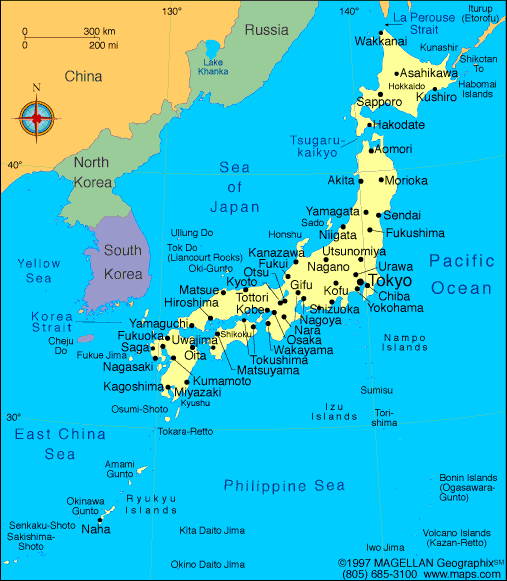
Its land mass slightly smaller than California
But its population 4 times as large as California
Introduction and Overview –
Japanese culture today is an intriguing mix of old and new, the traditional and the foreign.
True or False – Traditional Japanese music likes to include unpitched sounds: TRUE
True or False – Traditional Japanese music prefers steady beat pulses: FALSE
Cultural borrowing has been important in Japanese history—
Its writing system comes from China
Buddhism, one of its main religions, comes from India through Korea and China
It also has connections with Chinese and Korean music and musical instruments
But the Japanese have developed their own unique culture through their creativity and imaginative adaptation of foreign elements
They have modified the culture imported from China and elsewhere to suit their own needs and express their own individualism – making it into their own culture and developing their own cultural identity
Japan’s culture combines deep respect for tradition with creativity and flexibility
They keep and adhere to ancient traditions
They also develop new traditions alongside the old
As a result they have many layers of culture and much diversity of music that they listen to
Types of music in Japan include Japanese traditional music, Western classical music, rock, jazz, punk, country western, etc.—like most places the preference in music varies by age and generation
Types of ancient traditional music include –
Instrumental music – including sankyoku (meaning three instruments)
Taiko drum ensembles (originally associated with Shinto ritual practices)
Festival and dance music
Folksong
Court music and dance – Gagaku (court music) and bugaku (court dance)
Theatrical music (3 forms) – noh, kabuki, bunraku (puppet theater)
Buddist chant
We will be looking at sankyoku instrumental music and the instruments associated with that, and the new tradition of taiko drumming
Characteristics of Japanese Traditional Music –
Maximum effect from minimum means (getting a lot out of a little)
Minimal activity preferred
Silence is important – silence is an integral part of the musical soundscape considered to be just as important as sound
Often have sparseness of sound with strongly articulated notes
Requires calm and attentive listening
Most kinds of performance are formal and ritualized
Timbre
Traditional music likes to mix a variety of timbres
Example – the flowing sounds of the shakuhachi flute with more strongly articulated plucking sound of chordophones such as the koto
Traditional vocal style is nasal and tight (tight throat sound)
Unpitched sounds are commonly integrated into instrumental melodies
The idea of unpitched sounds comes from nature – the sound of water flowing or the wind blowing through the trees
Hear it in music in the breathy sound of the shakuhachi flute
Or slapping sounds, or twangy or buzzing of insects on the shamisen
Melody/Harmony
Often have short motifs (short musical ideas) repeated throughout a piece, in part or in entirety
Often repeat short sections several times in different ways with ornamentation
Complete repetition of phrases sometimes at beginning and end of a piece to lend air of finality to conclusion
Pitch movement can be slow—gets life from dynamic and timbre changes
Vocal music often has elaborate vocal ornamentation
Only Western-influenced Japanese music uses Western harmony
Traditional music is dominated by monophonic or heterophonic sound
Rhythm
Flexibility of pulse – often have irregular intervals between the pulses, and can change from free rhythms to more regular rhythms/beats
If there is a sense of beat, often in two, four, or eight
Have a wide variety of tempos, from very slow to very fast
A Basic Musical Form—Jo-ha kyu
Based on rhythmic rather than melodic changes
Jo—means introduction—slow beginning section
Ha—breaking apart—the tempo builds
Kyu—rushing—the tempo reaches its peak and slows before the piece ends
Idea of jo-ha-kyu – slow introduction, build up speed, different segments, rush to a peak and slow to close
Summary—main characteristics of traditional Japanese music
Maximum effect from minimal means
Variety of timbres including unpitched sounds
Monophonic and heterophonic textures in an ensemble
Flexibility of pulse
Japanese Traditional Instruments
Thought of as extremely refined artistic objects
We will look at the three main traditional instruments that are often played as solos or combined in groups of the sankyoku instrumental ensemble
The Shakuhachi –
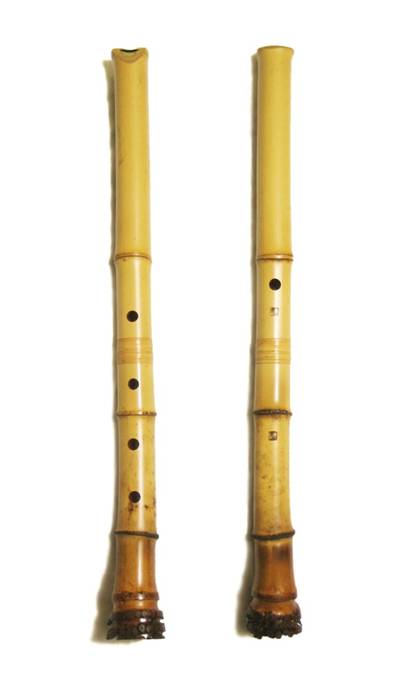
Classification – Flute type aerophone
Made of bamboo from bottom part of stalk, including part of the root
Name comes from length of the standard instrument:
Shaku = traditional unit of measure
Hachi=8
Meaning = 1.8 shaku (ca. 54 cm) (21 inches)
Has 4 holes in front, 1 in back for thumb (more modern 7-9 holes)
Can produce microtones and different timbres
Can get wavering tones (vibrato) from moving the head
When flourished – Tokugawa period (1600-1687) (after that period had great Western influence in Japanese music)
Who played and developed – Buddhist priests (often displaced Samurai) wandering the countryside playing the Shakuhachi and begging for upkeep –it was more honorable to beg than to lower oneself by becoming a merchant or farmer
[Because of its background the music has a Zen basis – Rely upon heightened awareness and intuition about life. Purpose—to reach enlightenment]
Traditional shakuhachi music in general –
Music has free rhythm; lacks regular beat
Breathing is crucial in playing it (and its connection with Zen)
Breathing patterns important—each phrase takes one full breath
Exhaling of breath heard in dynamic level and tone quality of pitch
There can be dramatic shifts in dynamic level according to how quickly air is expelled
Almost every phrase increases or decreases in volume
The sound grows fainter at the end of the phrase when the air runs out
When this dynamic pattern is broken it makes a pronounced impression
Often have repetitions of melodic material
There are often pauses and rests which emphasizes the relationship between sound and silence
The underlying idea is that sound enhances silence and silence enhances sound
Practice breathing in different ways and see if you can make different rhythmic and dynamic sounds with your breath
Example - Koden Sugomori (Tsuru no sugomori)
Tsuru no sugomori depicts various aspects of the life cycle of the crane, a bird symbolizing longevity in Oriental thought. A pair of cranes build a nest, lay an egg, raise a fledgling and rear it to maturity before bidding it farewell as it flies away and they are left to live out their allotted life span. Although the whole piece can be appreciated as a piece of absolute music, it is equally interesting to note the variety of programmatic playing techniques used in describing the wing flutters (trill-like fluttering effects, heard), the cries (another trill-like technique), and even the fledgling's departure from its parents (a simple melodic line). As a whole, this piece is thought to emphasize Buddhistic values of affection between family members
The Koto –
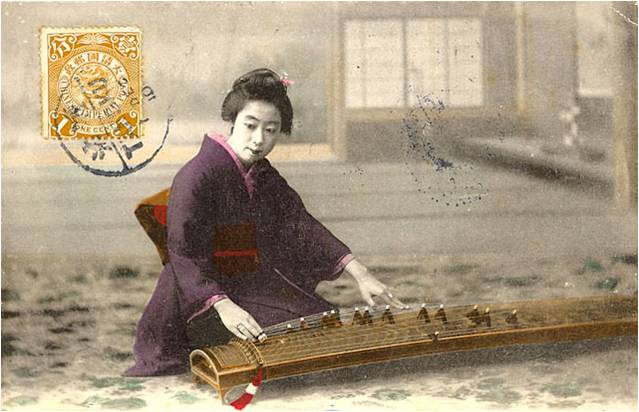
Classification – zither-type chordophone
Has a long wooden body (ca 1.8 meters, close to 6 feet)
13 strings, traditionally made of silk but now also made with nylon
Bridges (ivory or plastic) – one for each string – hold the strings above the surface of the inst
Bridges are movable to change tuning as needed
Came to Japan from China
Players pluck the strings with ivory or plastic picks attached to right hand thumb, first, second fingers
Left hand can press stings to get different pitches
The Shamisen –
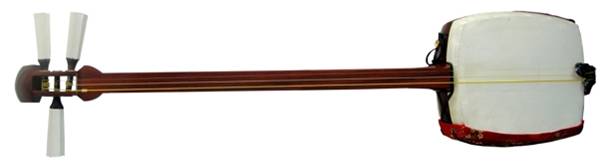
Classification – lute-type chordophone
Three-stringed long-necked lute
Unfretted
Square wooden body covered with cat skin
Excellent for theater—express highly dramatic situations
Related to shansin of Okinawa and san-hsien of China
Shansin covered with snake skin, shamisen uses cat or dog skin.
Sankyoku music = three instruments
Koto, Shamisen, Shakuhachi
Old traditional – very restrained, very rhythmically sparse
May add a voice – tight in throat, strained, a little nasal
Everyone plays the same melody – but in own style of ornamentation heterophonic texture
Koto and shamisen – sound decays quickly, have very sharp articulation with silence between notes
Shakuhachi and voice have more flowing and continuous sound
Be able to hear the difference between Japanese Sankyoku Music and Chinese Silk and Bamboo Ensemble music
Japanese Taiko – A New Tradition
Taiko = Japanese word for drum
Classification – Membranophone
Struck with 2 sticks called bachi
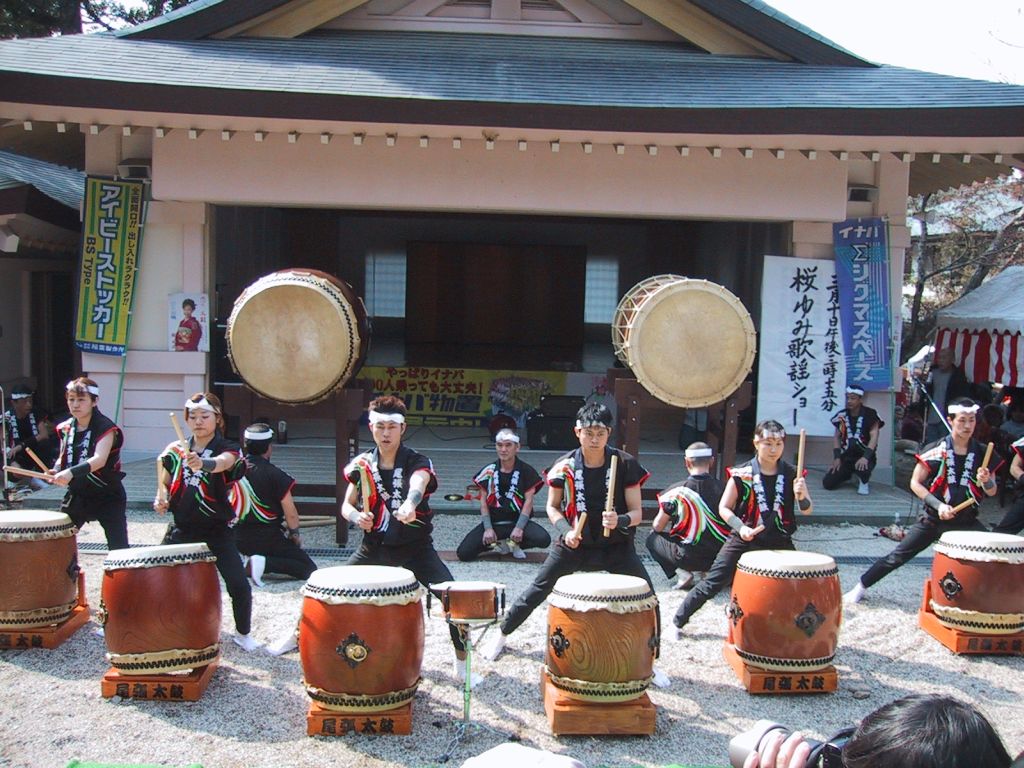
Historical Uses of Taiko –
History goes back 2000 years –
Used on battlefield to threaten and frighten the enemy and give commands
Also used in daily village life – temple, religious rites, festivals, harvest celebrations
Modern Taiko –
Began in 1950s
Daihachi Oguchi assembled the 1st modern taiko ensemble – called kumi-daiko
Immigrants brought taiko to the US in early 1900s – mostly played in temples, martial arts schools or accompanying other arts
1968 – 1st North American kumi-daiko group formed in San Francisco
About the drums -
There are two categories of taiko –
Byou-daiko category – nail headed taiko
Shime-daiko – rope tensioned taiko
Byou-daiko category of drums
Nail-headed drum
Head stretched onto the drum held with nails
Body carved from a single log
Heads made of cowhide – 3-4 year old black Japanese cows
Cannot adjust tension once nailed into place
Standard byou-daiko
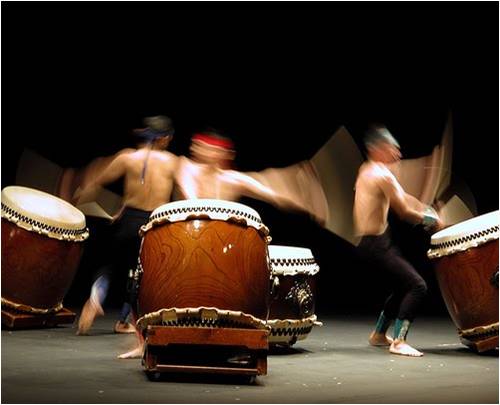
O-daiko = big fat drum
The head is 3-6 feetin in diameter
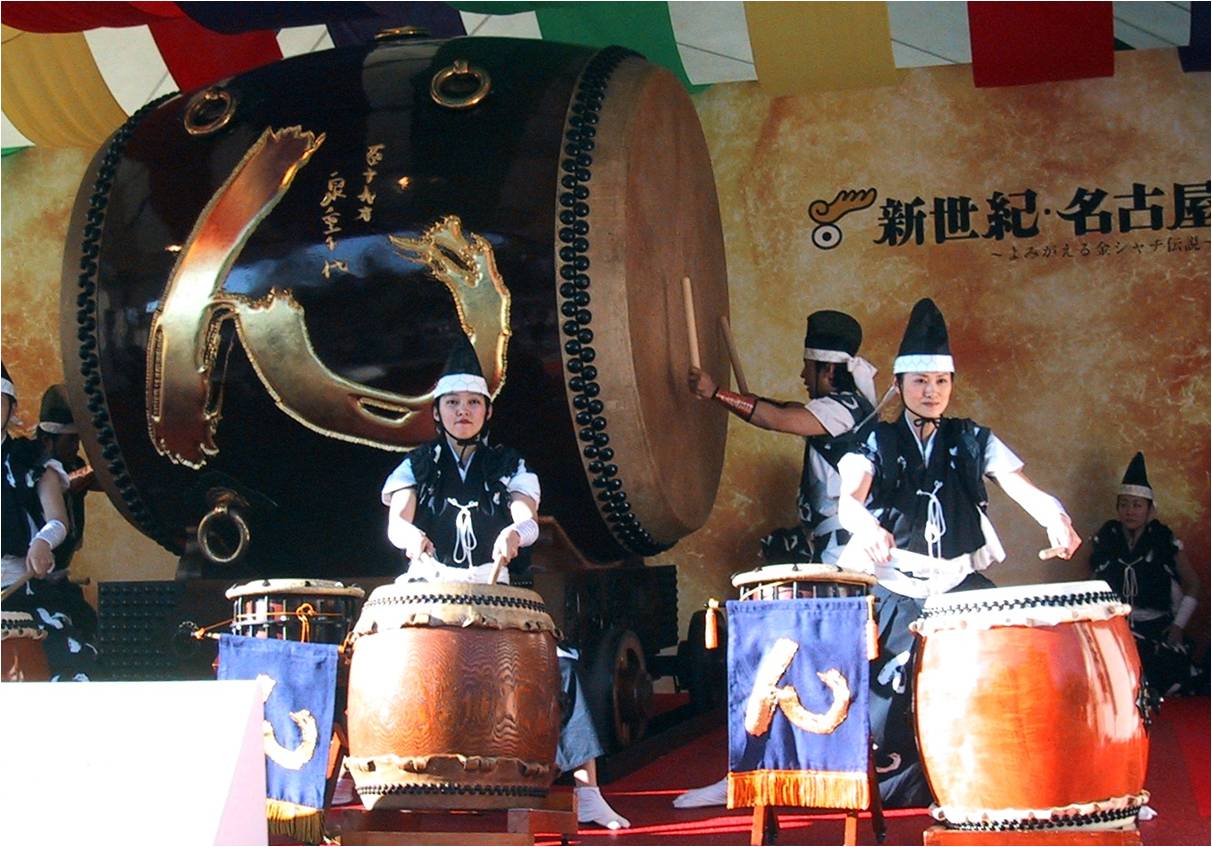
Shime-daiko category of drums
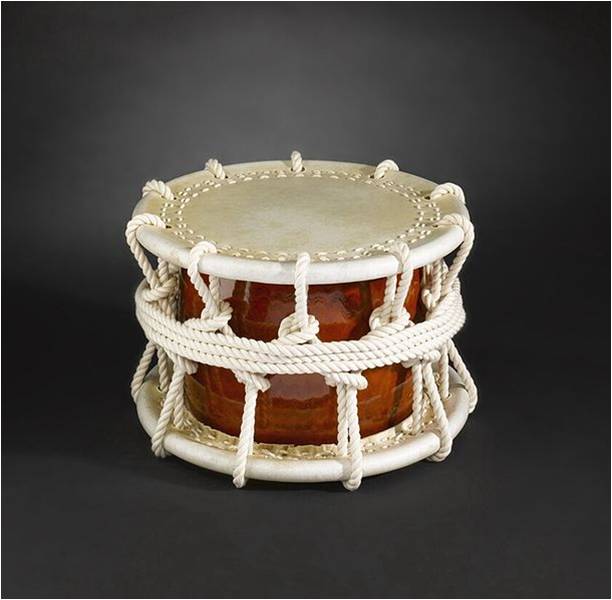
Rope tensioned drums
Heads tied into place with a rope – heads sewn onto metal rings and tied into place
Body is make from several slats fit together (barrel style)
Can adjust tension with ropes tied around the middle
Playing a taiko –
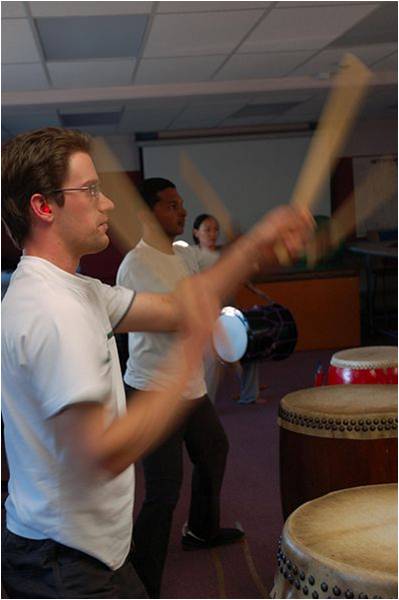
Basic rhythm:
San = 1 beat
Doko = 2 half beats
1 doko = same amount of time as 1 san
Practice:
1 2 3 4
San San San San
(right) (left) (right) (left)
doko doko doko doko [dokos should be played evenly]
(r-l) (r-l) (r-l) (r-l)
Drumming pattern 1:
San doko San doko
(Right right left) (Right right left)
(long short short) (long short short)
Drumming pattern 2:
Doko doko Doko doko
(right left right left ) (right left right left )
(short short short short) (short short short short)