Bacteria
Kingdom bacteria belongs to : Monera
What are the main features of members of kingdom Monera
Prokaryotic
Unicellular : exists as one single cell
Reproduction is asexual
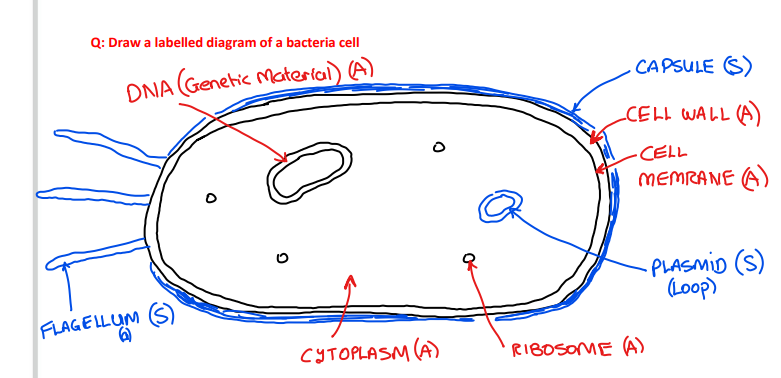
All bacteria have the following features:
DNA - code for protein
Cell membrane :
Semi permeable
structure and support
Cell wall : keeps cell turgid and prevents cell bursting
Cytoplasm : Suspends cell parts
Make protein
Some bacteria also have the following features:
Capsule : protection
Plasmid loop : Extra DNA has a role in antibiotic resistance
Flagellum : Help bacteria Swim
Name one way that scientists can classify bacteria : on shape
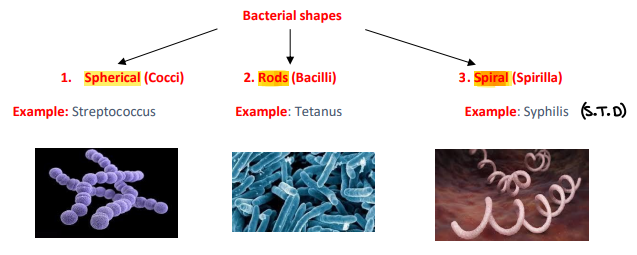
Bacterial shapes
Spherical
Rods
Spiral
Reproduction in bacteria
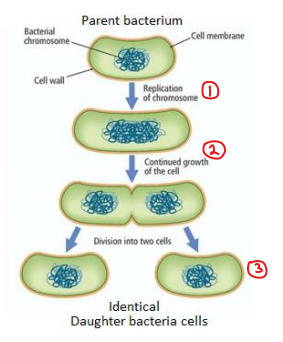
What name is given to the way by which bacteria reproduce? : Binary fission
Describe how binary fission occurs in bacteria
DNA replication occurs in parent cell
cell elongates
cell splits, forming two identical daughter cells
Endospores
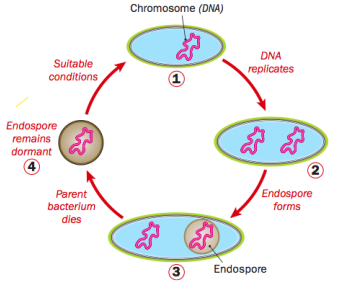
endospores : dormant tough walled structures that can form in some bacteria during adverse conditions to survive
adverse conditions : unfavorable conditions bacteria die in
Endospore formation in bacteria
RNA replication occurs
adverse conditions an endospore forms
remains dormant
conditions become suitable a new cell forms again
Nutrition in bacteria
Heterotrophic
take in food from other organisms, do not make their own food.
Saprophytes - feed on dead organic matter (bacteria of decay)
Parasites - feed on live host, causing harm (Streptococcus)
Autotrophic
Make own food using energy
Photosynthetic - use light make own food (Purple sulfur bacteria)
Chemosynthetic - use chemical reactions to make own food (Nitrifying bacteria)
Factors affecting bacteria growth - assuming they have food source
temperature
low temperatures - enzyme action is low
high temperatures - enzymes denatured
most bacteria grow well at temps between 20 and 30 degrees (optimum temperature)
pH
bacteria placed in an unsuitable pH will have its enzymes denatured
most bacteria grow well at pH close to 7
Oxygen concentration
aerobic bacteria require oxygen for respiration
anaerobic bacteria does no require oxygen for respiration
Anaerobic bacteria :
obligate anaerobes - cannot survive in oxygen
facultative anaerobes - can survive with or without oxygen
Concentration of growing medium
Salty/Sugary solution :
water leave cell by osmosis
plasmolyzed die
Fresh water solution :
water enter the cell by osmosis
cell wall prevent from bursting
cell turgid
Pressure
High pressures can destroy cell walls
Growth curve of bacteria
The growth curve for a typical bacteria culture is as follows:
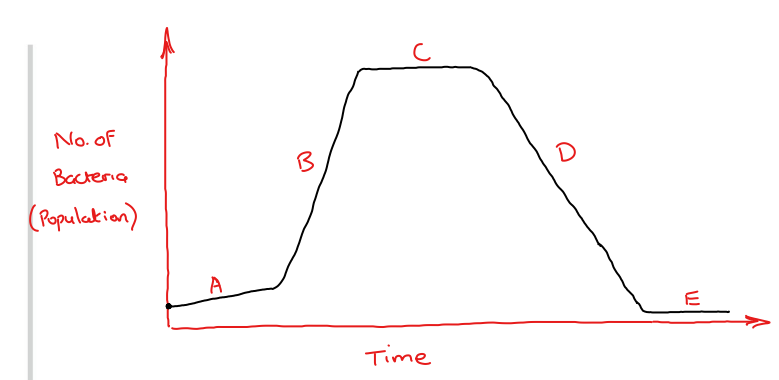
Explaining the growth curve
A) Lag phase
Little increase
adapting to environment
B) Log phase
Rapid increase
due to plenty of food, water, space, oxygen. Not much waste products or competition
C) Stationary phase
No increase or decrease
death rate = reproductive rate
due to:
Lack of food and water, space, oxygen
Build up of waste and competition
D) Decline phase
Numbers decrease - death rate greater than reproductive rate
Due to:
lack of food, water, space, oxygen
Build up waste + competition
E) Death or survival phrase
Most die, some survive as endospores
Antibiotics and Resistance
What are anti biotics? : produced by micro organisms that kill other micro organisms
example : penicillin
Why will antibiotics not be prescribed to a person suffering from cold/flu/covid like symptoms?
Antibiotics have no effect on viruses
cold/flu/covid caused by viruses
What are anti-biotic resistant bacteria?
bacteria not affected by antibiotics
What feature present in a bacteria cell plays a role in antibiotic resistance?
plasmids
Overuse of antibiotics result in the increased growth of anti-biotic resistant bacteria. Why?
mutations, anti-biotic resistant bacteria
widespread use of antibiotics “normal” bacteria are killed quickly
anti biotic resistant bacteria, no competition and reproduce rapidly and their numbers increase
Using your knowledge of antibiotics and bacteria, suggest why a person is more likely to pick up an infection in hospital than at home.
numbers thrive where many antibiotics are used. only bacteria can survive
Food processing
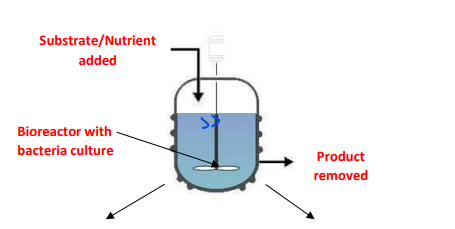
Batch Culture
fixed amount of nutrient and bacteria and left for time before product removed
lag log stationary and decline phase
Adv - easy to maintain
Dis - needs to be purified
Continuous flow
New nutrient constantly added and product constantly removed
log phase
Adv - product purity is higher
Dis - difficult to maintain
Economic importance of bacteria
Benefits
Bio processing (dairy)
Genetic engineering
Disadvantages
cause disease - pathogens (Streptococcus, tetanus, syphilis
cause food to decay