Movement through the Capillary Wall
Movement through the Capillary Wall
This document explores the movement of substances through capillary walls, focusing on the three main processes involved: diffusion, filtration, and reabsorption.
Three Main Processes
The movement of fluids and solutes across capillary walls occurs through three primary processes:
Diffusion
Filtration
Reabsorption
Diffusion
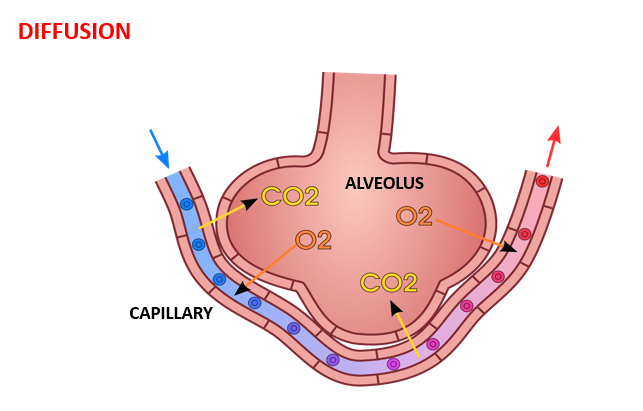
Diffusion is a fundamental process that describes the movement of particles from an area of higher concentration to an area of lower concentration. In the context of capillaries, this process is crucial for the gas exchange in alveoli.
Oxygen (O₂) and Carbon Dioxide (CO₂) exchange occurs through diffusion across the capillary-alveolus barrier.
The gradient of concentration drives the movement of O₂ from the alveolus into the blood (capillary), while CO₂ moves from the blood into the alveolus to be expelled from the body.
Filtration
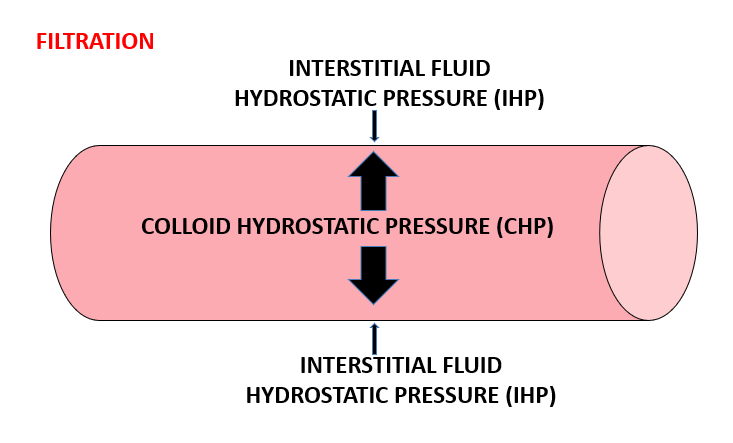
Filtration refers to the process whereby fluid is pushed out of the capillary into the interstitial space, primarily driven by hydraulic pressure.
Hydrostatic Pressure
Hydrostatic Pressure (HP) is the pressure exerted by a fluid at equilibrium due to the force of gravity. This pressure influences the movement of fluids across capillaries.
Key Components of Filtration Mechanisms:
Interstitial Fluid Hydrostatic Pressure (IHP)
- This is the pressure exerted by the fluid in the interstitial space.Colloid Hydrostatic Pressure (CHP)
- It refers to the pressure exerted by proteins in the plasma, influencing the movement of water and solutes.Net Hydrostatic Pressure (NHP)
- This is calculated as:
- A positive NHP indicates that there is a tendency for fluid to be filtered out of the capillary.
Reabsorption
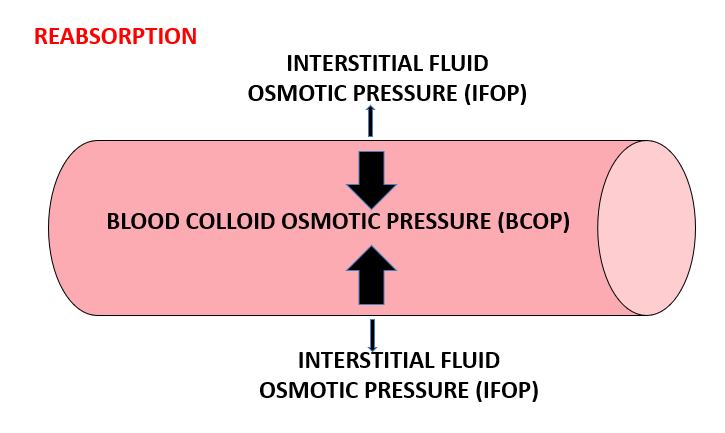
Reabsorption is the process by which fluids and solutes are reabsorbed back into the capillary from the interstitial fluid, primarily influenced by osmotic forces.
Osmotic Pressure
Osmotic Pressure is the pressure required to prevent the flow of water across a semipermeable membrane, driven by solute concentration differences.
Mechanisms of Reabsorption:
Blood Colloid Osmotic Pressure (BCOP)
- This represents the osmotic pressure due to protein concentration in the blood plasma.Interstitial Fluid Osmotic Pressure (IFOP)
- The osmotic pressure exerted by the solutes in the interstitial fluid.Net Colloid Osmotic Pressure (NCOP)
- Calculated as:
- This indicates the net effect of osmotic forces pulling fluid back into the capillaries.
Summarizing Reabsorption and Filtration
The overall Net Filtration Pressure (NFP) in the capillaries can be represented by the relationship between net hydrostatic pressure and net colloid osmotic pressure:
This formula highlights how the dynamics of pressure and osmotic forces work together to regulate the movement of fluids across the capillary wall, maintaining homeostasis in the fluid levels between the blood and interstitial compartments.