Chapter 19: Rococo and Neoclassicism
Key Notes
- Time Period:
- Rococo: 1700–1750
- Neoclassicism: 1750–1815
- Culture, beliefs, and physical settings
- Europe and the Americas experience great innovation in economics, industrialization, war, and migration. There is a strong advancement in social issues.
- The ideas of the Enlightenment and scientific inquiry affect the arts.
- Cultural interactions
- Architecture is expressed in a series of revival styles.
- Artists are exposed to diverse, sometimes exotic, cultures as a result of colonial expansion.
- Material Processes and Techniques
- Artists use new media including photography, lithography, and mass production.
- Audience, functions, and patron
- The Salon in Paris becomes important. Museums open and display art. Art sells to an ever-widening market.
- The importance of academies rises, as artistic careers become dependent on juried salons.
- Women artists become increasingly important.
- Theories and Interpretations
- Art history as a science continues to be shaped by theories, interpretations, and analyses applied to the new art forms.
Historical Background
- Early-eighteenth-century politics centered around European conquest of the rest of the world.
- Colonial powers established trading stations, then occupied distant places by layering new settlers, new languages, new religions, and new governments onto indigenous populations.
- Europeans hoped to make money by exploiting new lands, but the expense of keeping foreign armies soon started to outweigh the economic advantages.
- To make the New World appear more like the Old World, European settlers constructed structures with Baroque and Rococo influences and imported Rococo clothing.
- The Rococo breaks away from the Baroque's fascination with aristocracy and adopts a more aristocratic flavor, especially in the decoration of the opulent townhouses that the upper class maintained in Paris.
- The Industrial Revolution began in the latter half of the eighteenth century, and while it brought about improvements in quality of life, it was frequently countered by a new form of slavery to mechanized labor and harsh working conditions.
- The Enlightenment was a period of new intellectual development during which scientists and philosophers began to base their theories on logic and observation rather than on received wisdom and tradition.
- Knowledge began to be structured in a deliberate way:
- Diderot organized and edited a massive 52-volume French encyclopedia in 1764,
- Johnson composed the first English dictionary singlehandedly in 1755, and
- Rousseau discussed how a legitimate government was an expression of the general will in his 1762 Social Contract.
- With all of this change came political upheaval, and some artists became embroiled in the turbulent politics of the time, advocating the sweeping societal changes that they believed the French Revolution advocated.
Patronage and Artistic Life
- Rome became the center of art history after new artistic life emerged all over Europe.
- The discovery of Pompeii in 1748 inspired Johann Winckelmann to publish The History of Ancient Art in 1764, which is considered the first art history book.
- Winckelmann criticized the waning Rococo as decadent and celebrated the ancients for their purity of form and crispness of execution.
- Art academies began to spring up in Europe and the United States, and artists were trained in the proper classical tradition.
- Academy: an institution whose main objectives include training artists in an academic tradition, ennobling the profession, and holding exhibitions
- The French Academy showcased selected works by its members in an annual or biannual event called the Salon, which greatly increased an artist's prestige and the value of their paintings.
- The Salons had traditional standards, insisting on artists employing flawless technique with emphasis on established subjects executed with conventional perspective and drawing.
- Salon: a government-sponsored exhibition of artworks held in Paris in the eighteenth and nineteenth centuries
- No education was complete without a Grand Tour of Italy, where people could immerse themselves in the lessons of the ancient world and perhaps collect an antiquity or two.
- Grand Tour: in order to complete their education young Englishmen and Americans in the eighteenth century undertook a journey to Italy to absorb ancient and Renaissance sites
- The Neoclassical period was firmly entrenched in the mind of art professionals and educated amateurs.
Rococo Painting
- Rococo painting features curvy, delicate frames with limbs of figures spilling over the sides, blurring the line between painting and sculpture.
- Rococo art is sensual and erotic, with playful scenes of love and romance that tease the imagination.
- The French are most noted for Rococo, but there were also active centers in England, central Europe, and Venice.
- Rococo painting is the triumph of Rubénistes over Poussinistes, with artists captivated by Rubens's use of color to create form and modeling.
- Figures in Rococo painting are slender and often seen from the back, clothed in shimmering fabrics in bucolic settings with rich plant life and flowers.
- Fête galante painting features the aristocracy in garden settings, taking long walks or listening to sentimental love songs.
- Fête galante: an eighteenth-century French style of painting that depicts the aristocracy walking through a forested landscape
- Colors in Rococo art are typically pastel and never thick or richly painted, with some artists specializing in pastel paintings.
- Pastel: a colored chalk that when mixed with other ingredients produces a medium that has a soft and delicate hue
- Rococo art is more domestic than Baroque and intended for private rather than public display.
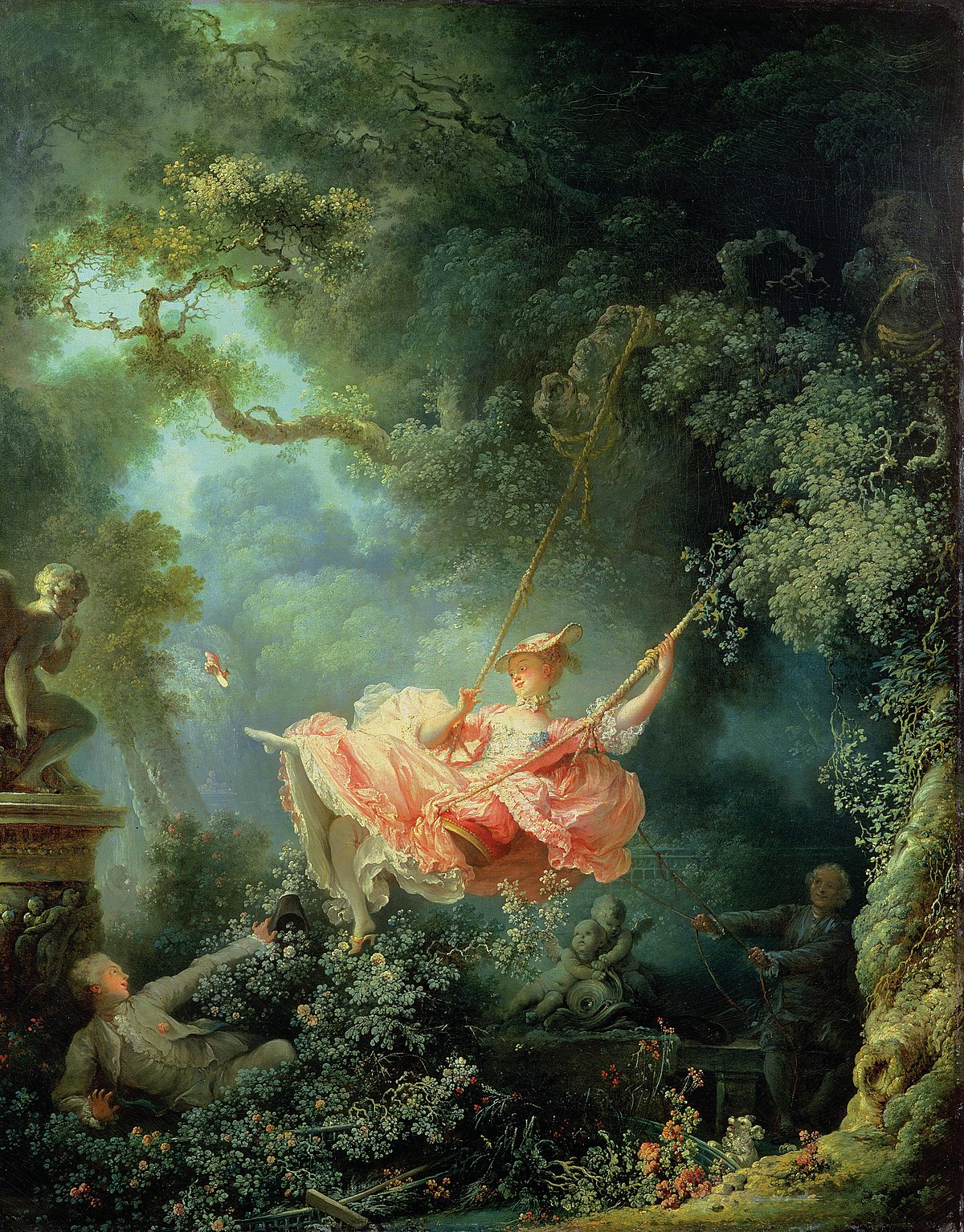
➼ The Swing
- Details
- By Jean-Honoré Fragonard
- 1767
- Made of oil on canva
- Found in Wallace Collection, London
- Form
- Pastel palette; light brushwork.
- Figures are small in a dominant garden-like setting.
- Use of atmospheric perspective.
- Puffy clouds; rich vegetation; abundant flowers; sinuous curves.
- Symbolically a dreamlike setting.
- Patronage and Content
- Commissioned by an unnamed “gentleman of the Court:” a painting of his young mistress on a swing; in an early version, a bishop is pushing the swing with the gentleman admiring his mistress’s legs from below.
- In the finished painting, the older man is no longer a priest, a barking dog has been added, and Falconet’s sculpture of Menacing Love comments on the story.
- The patron in the lower left looks up the skirt of a young lady who swings flirtatiously, boldly kicking off her shoe at a sculpture.
- The dog in the lower right corner, generally seen as a symbol of fidelity, barks in disapproval at the scene before him.
- Context
- Fragonard answers the libertine intentions of his patron by painting in the Rococo style.
- Fragonard often used different styles at the same time, and he seems to have seen the Rococo as particularly appropriate for an erotic scene.
- An intrigue painting; the patron hides in a bower; the garden sculpture of Menacing Love asks the lady to be discreet and may be a symbol for the secret hiding of the patron.
- Image
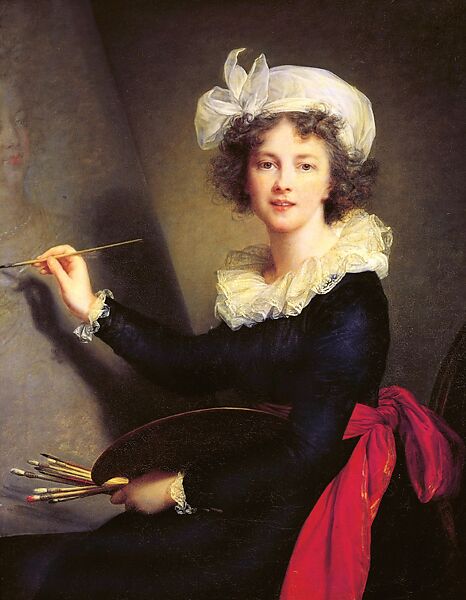
➼ Elisabeth Louise Vigée Le Brun Self-Portrait
- Details
- 1790
- Made of oil on canva
- Found in Uffizi, Florence
- Form
- Light Rococo touch in the coloring.
- Inspired by the portraits of Rubens.
- Context
- Forty self-portraits exist, all highly idealized.
- The artist was 45 when this was painted, but she appears much younger.
- Painted in Rome during the French Revolution when the artist was exiled for political reasons.
- The artist was granted admission to the male-dominated French Royal Academy through the influence of Marie Antoinette.
- The artist looks at the viewer as she paints a portrait of the French queen Marie Antoinette, who is rendered from memory since she was killed during the French Revolution.
- Subject in the painting looks admiringly upon the painter.
- Image
Eighteenth-Century English Painting
- Freedom of speech became popular in France and England in the early eighteenth century.
- Swift's Gulliver's Travels and Voltaire's Candide were examples of satirical literature.
- Visual arts followed suit with satirical paintings, often done in series to tell a story.
- Satirical paintings were then transferred to prints for mass production.
- Satirical themes ranged from exposing political corruption to spoofs on contemporary lifestyles.
- Hogarth's prints aimed to expose abuses in the upper class and were a didactic tool to reach a wider audience.
- Satirical painting was tolerated by those in power and flourished in England.
- Political cartoons are the modern-day equivalent of satirical prints.
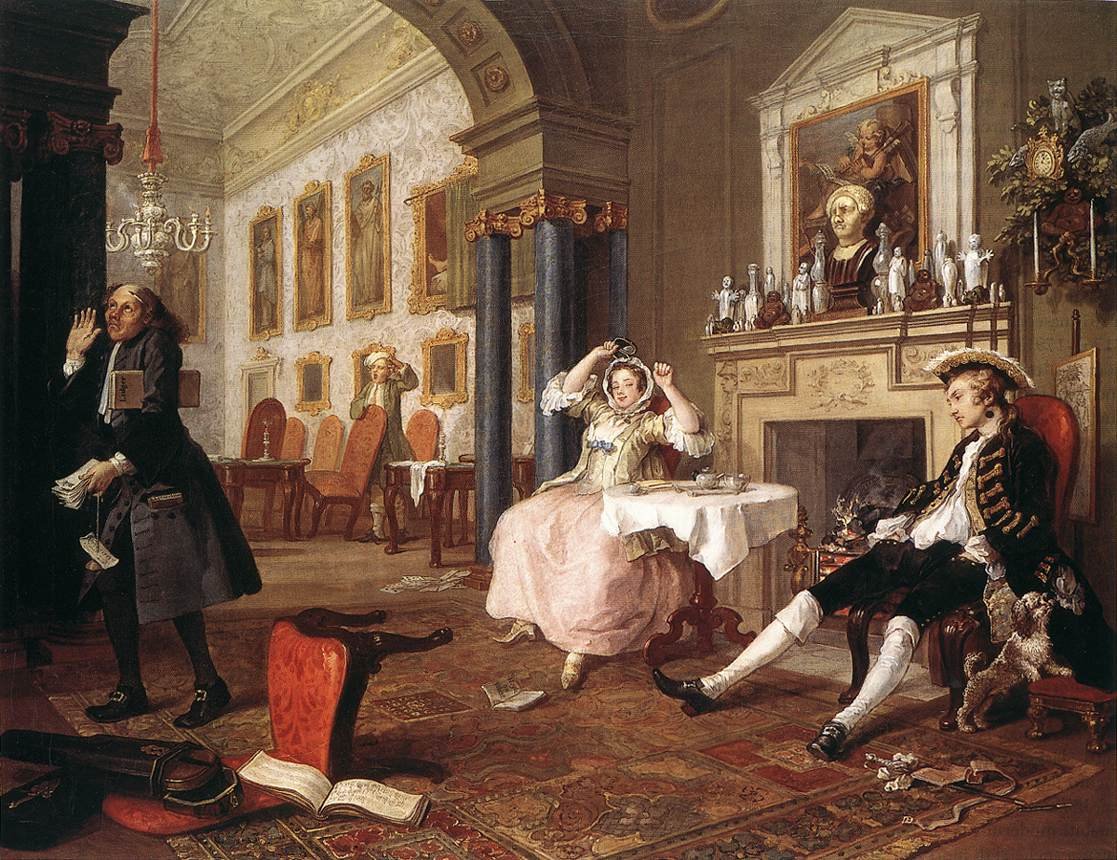
➼ The Tête à Tête from Marriage à la Mode
- Details
- By William Hogarth
- c. 1743
- Made of oil on canvas
- Found in National Gallery, London
- Marriage à la Mode
- Richly decorated rooms painted in brilliant color.
- Myriad of details; each detail adds to the symbolism in the work.
- Elements of French Rococo style used to indict those who are flattered in French art.
- Function
- Highly satiric paintings about a decadent English aristocracy and those who would have liked to buy their way into it.
- A series of six narrative paintings; later turned into a series of prints.
- Context: Second of six scenes in a suite of paintings called Marriage à la Mode.
- The Tête-à-Tête
- Shortly after the marriage each partner has been pursing pleasures without the other.
- The husband has been out all night with another woman (the dog sniffs suspiciously at another bonnet); the broken sword means he has been in a fight and probably lost (and may also be a symbol for sexual inadequacy).
- The wife has been playing cards all night, the steward indicating by his expression that she has lost a fortune at a card game called whist; he holds nine unpaid bills in his hand (one was paid by mistake, further illustrating their carelessness).
- The painting over the mantlepiece is a symbolic depiction of Cupid among the ruins.
- A turned-over chair indicates that the violin player made a hasty retreat when the husband came home.
- Image
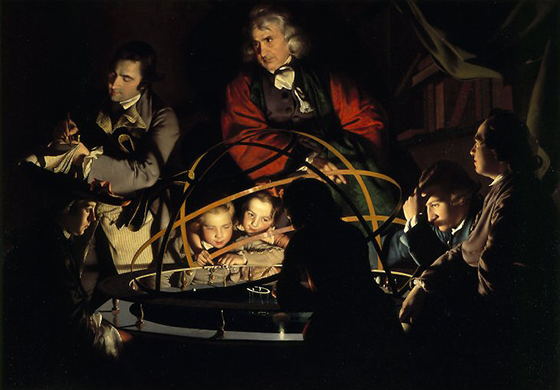
➼ A Philosopher Giving a Lecture on the Orrery
- Details
- By Joseph Wright of Derby
- 1763–1765
- Made of oil on canvas
- Found in Derby Museum and Art Gallery, Derby, U.K.
- Form
- One of a series of candlelight pictures by Wright; inspired by Caravaggio’s use of tenebrism.
- Clearly drawn and sharply delineated portraits of individuals.
- Content
- An orrery is an early form of a planetarium, imitating the motion of the solar system.
- The lamp in the center represents the sun; it is blocked by the silhouette of a figure.
- All ages of man are represented by the mixed group of middle-class people in attendance.
- Some curious, some contemplative, some in wonder, some fascinated.
- The philosopher is based loosely on a portrait of Isaac Newton; he is demonstrating an eclipse.
- The philosopher stops to clarify a point for the note-taker on the left.
- Context
- Influenced by a provincial group of intellectuals called the Lunar Society, who met once a month to discuss current scientific discoveries and developments.
- To complete the celestial theme, each face in the painting is an aspect of the phases of the moon.
- Illustrates the eighteenth-century period called the Enlightenment and the democratization of knowledge.
- Image
Neoclassical Architecture
- Neoclassical buildings were not simply imitations of ancient architecture but rather a smart adaptation of classical principles for modern living.
- These buildings had Roman features, but were also efficiently designed for 18th century living.
- Neoclassicists learned about symmetry, balance, composition, and order from the works of Andrea Palladio and Inigo Jones.
- Greek and Roman columns with appropriate capitals, pediments, and domes were common features of Neoclassical buildings.
- Even remote houses in Virginia featured Neoclassical architecture.
- The interior layout of Neoclassical buildings is nearly or completely symmetrical, with rooms mirrored on either side of the building.
- Each room is decorated with a different theme, some inspired by the ancient world, others with a dominant color in wallpaper or paint.
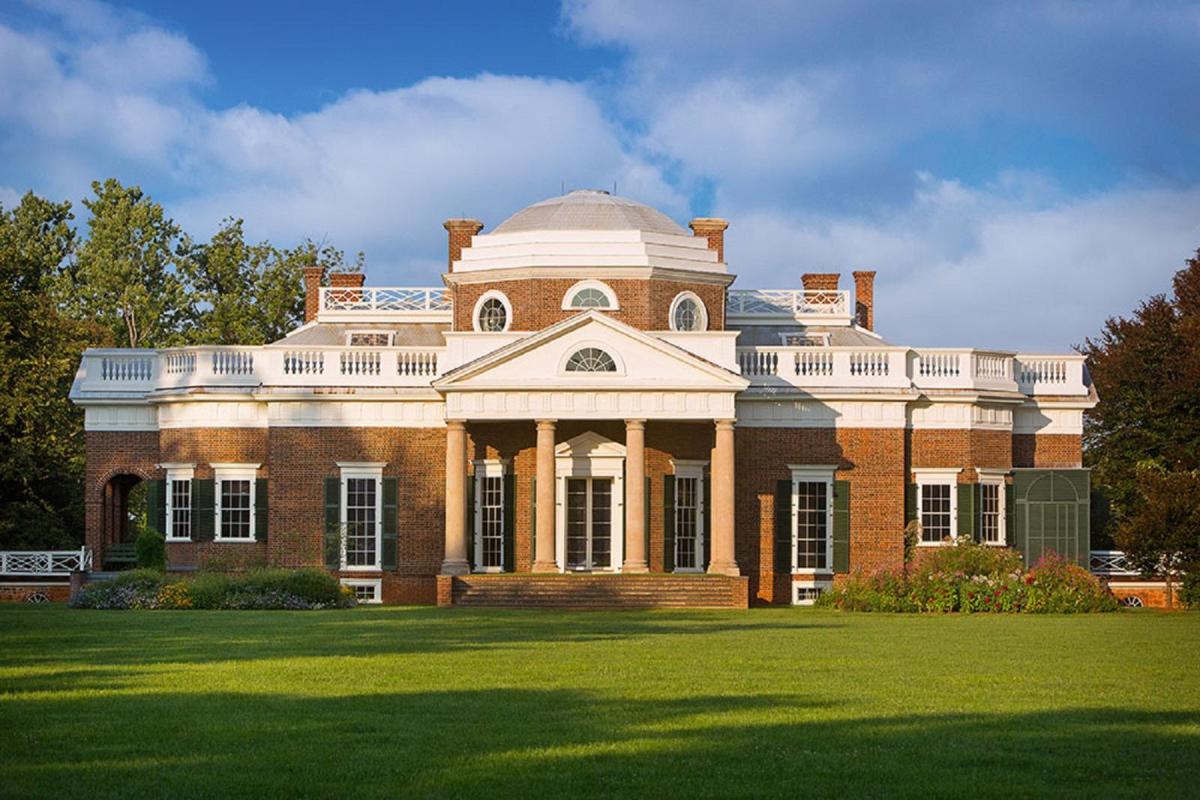
➼ Monticello
- Details
- By Thomas Jefferson
- 1768–1809
- Made of brick, glass, stone, and wood
- Found in Charlottesville, Virginia
- Form
- Monticello is a brick building with stucco applied to the trim to give the effect of marble.
- It appears to be a one-story building with a dome, but the balustrade hides a modest second floor.
- The octagonal dome functions as an office or retreat.
- The rooms generally have a symmetrical design.
- Tall French doors and windows allow air circulation in hot Virginia summers.
- Jefferson was concerned with saving space: very narrow spiral staircases; beds in alcoves or in walls between rooms.
- Function: Chief building on Jefferson’s plantation, supported by slave labor.
- Context
- Monticello is “little mountain” in Italian, sited on a hilltop in Virginia.
- Inspired by books by the Italian Renaissance architect Palladio and by Roman ruins Jefferson saw in France.
- The design is also impacted by eighteenth-century French buildings in Paris.
- Illustrates the Roman Republican goals of equality and democracy expressed in this adaptation of Roman architectural themes.
- Image
Neoclassical Painting
- Eighteenth-century painters found meaning in stories from ancient epics, and painted mythological or Biblical scenes with a modern context in mind.
- Neoclassical paintings often had subtexts that invited the viewer to reflect on a person, situation, or state of affairs.
- Paintings like the retelling of the story of the Horatii were called exemplum virtutis, as they emphasized self-sacrifice for the greater good.
- Neoclassical compositions were typically symmetrical, with linear perspective leading the eye into a carefully constructed background.
- The best Neoclassical paintings were marked by invisible brushwork and clarity of detail.
\n
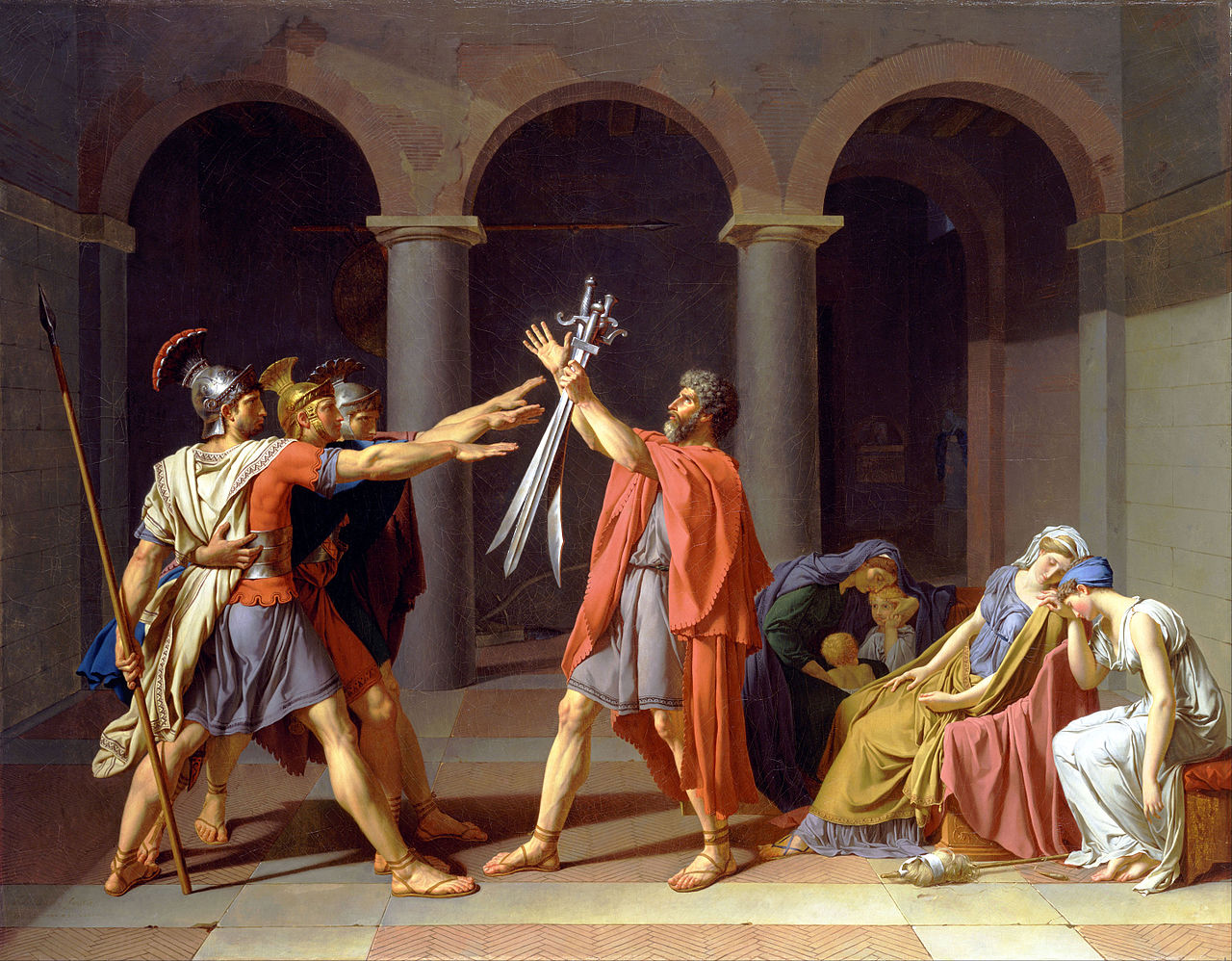
➼ The Oath of the Horatii
- Details
- By Jacques-Louis David
- 1784
- Made of oil on canvas
- Found in Louvre, Paris
- Form
- Male forms are vigorous, powerful, animated, emphatic, angular; symbolically they are figures of action.
- Female forms are soft and rounded, displaying “feminine” emotion; symbolically they are figures of inaction or reaction.
- Gestures are sweeping and unified.
- Figures are pushed to the foreground.
- Neoclassical drapery and tripartite composition.
- Not neoclassical in its Caravaggio-like lighting and un-Roman architectural capitals.
- Patronage
- Painted under royal patronage, Louis XVI.
- The artist presented the finished canvas in his studio in Rome in 1785 and at the Paris Salon later that year—on both occasions to acclaim.
- Content
- Story of three Roman brothers (the Horatii) who do battle with three other brothers (the Curiatii—not painted) from the nearby city of Alba; they pledge their fidelity to their father and to Rome.
- One of the three women on right is a Horatii engaged to one of the Curiatii brothers; another woman is the sister of the Curiatii brothers and wife of the eldest Horatii.
- Context
- Exemplum virtutis.
- David presents this episode as an example of patriotism and stoicism, which should override family relationships.
- Influenced by Enlightenment philosophers, such as Diderot, who advocated the painting of moral subjects.
- Emulated Grand Style of French painting of the seventeenth century.
- Image
Neoclassical Sculpture
- Bronze was the most expensive and highly prized sculptural medium before the Industrial Revolution.
- Mass production of metal in England and Germany caused the price of bronze to fall, while the cost of stonework relying on manual labor increased.
- Despite this, marble was considered more desirable due to the assumption that the ancients preferred it and that it possessed an authoritative appeal.
- The recovery of artifacts from Pompeii inspired sculptors to work in the classical medium, reaching a fever pitch with the importation of the Parthenon sculptures to London.
- Sculptors like Houdon saw Neoclassicism as a continuance of an ancient tradition, but also aimed for a realistic likeness of the sitter.
- Neoclassical sculpture moved away from figures in ancient robes to more realistic poses in contemporary drapery.
- Classical allusions were still present, but were secondary influences.
- Neoclassical sculpture was typically carved from white marble with no paint added, as it was believed that the ancients worked in this way.
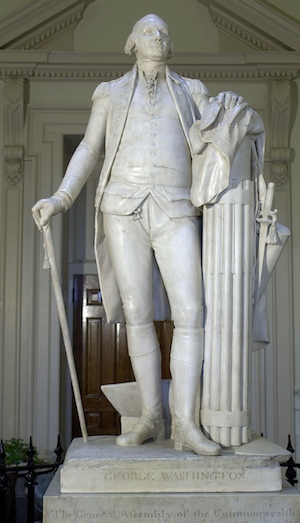
➼ George Washington
- Details
- By Jean-Antoine Houdon
- 1788–1792
- Made of marble
- Found in State Capitol, Richmond, Virginia
- Form and Content
- Washington is dressed as an eighteenth-century gentleman with a Revolutionary War uniform.
- Military associations minimized: he wears only epaulettes on his shoulders; the sword is cast to the side.
- Naturalistic details: the missing button on his jacket and the tightly buttoned vest around a protruding stomach.
- Seen as a man of vision and enlightenment.
- Stance inspired by Polykleitos’s Doryphoros linking Washington’s actions with the greatness of the past.
- Materials
- Marble, appreciated for its durability and luster, was used to associate the figure of Washington with the great sculptures of the Renaissance and the ancient world.
- Function and Patronage
- Commissioned by the Virginia legislature to stand at the center of the state capitol in Richmond, which was designed by Jefferson.
- Meant to commemorate the central position of Washington in the founding of American independence.
- Installed in 1796, the year Washington published his farewell address.
- Symbolism
- The badge of Cincinnatus is on his belt: Washington was a gentleman-farmer who left Mount Vernon to take up the American cause much as Cincinnatus from the Roman Republic left his farm to command Roman armies and then returned to the farm.
- Washington leans on the Roman fasces: a group of rods bound together on the top and the bottom; the 13 rods symbolize the 13 colonies united in a cause.
- Washington leans on the 13 colonies, from which he gets his support.
- Arrows between the rods likely refer to Native Americans or the idea of America as wild frontier.
- Plow behind Washington symbolizes his plantation as well as the planting of a new world order.
- Image