ADAPTATION
INTRODUCTION
Adaptation
A trait that increases the fitness of its possessor
Change in allele frequency that increases population mean fitness (a process)
Result from natural selection
Have genetic basis (not acclimation)
Non-adaptive variation
Causes
Direct effects of environment
Genetic drift -- random changes in allele frequency due to sampling error
Multiple adaptive phenotypes -- e.g. camouflage in grouse chicks
Laws of physics or chemistry -- e.g. flower colour in hydrangea
Constraints on adaptation
Trade-offs
Time and resources (energy, water, nutrients) are finite
Pleiotropy
One gene affects >1 trait
Selection on one traits causes change in a second
Developmental constraints
E.g. pollinated flowers remain attached until abscission layer forms
Demonstrating adaptation
is hard
What is the function of the trait in a focal organism? ----- e.g. hooks on a pigeon beaks reduce parasite loads
Do similar traits fulfill the same function in multiple species?
Did the trait originate for its current function?
Is the trait maintained by natural selection or merely inherited from ancestors?
Expecting a trait to be adaptive just because it is there often leads to flawed evolutionary thinking
Our default explanation should be that a trait is not adaptive… this is the null that needs to be rejected
Goal: show that trait developed or is maintained through natural selection
Type of study: experimental, observational, theoretical
Level of study: population, comparative (among species)
Good experiments:
Test the effect of changes in a single trait on fitness or components of fitness
Control for direct effects of manipulations
Test several hypotheses that may explain traits function
Good observational studies:
Use natural variation to test alternative hypotheses
Measure potential confounding variables
Require detailed information about natural history
Theoretical studies
Consider benefits and costs of contrasting phenotypes
Assign numerical values to benefits and costs or define relationship between trait value and benefit
Use mathematical approaches to predict the best phenotype under a given set of conditions
Comparative method
Each species is a data point
Usually observational
Greater generality than single species studies
Greater potential for confounding factors
Test for association between traits and environment or correlations among traits
Potential problem: closely related species may resemble one another due to shared inheritance of traits rather than because they experience similar selection pressures
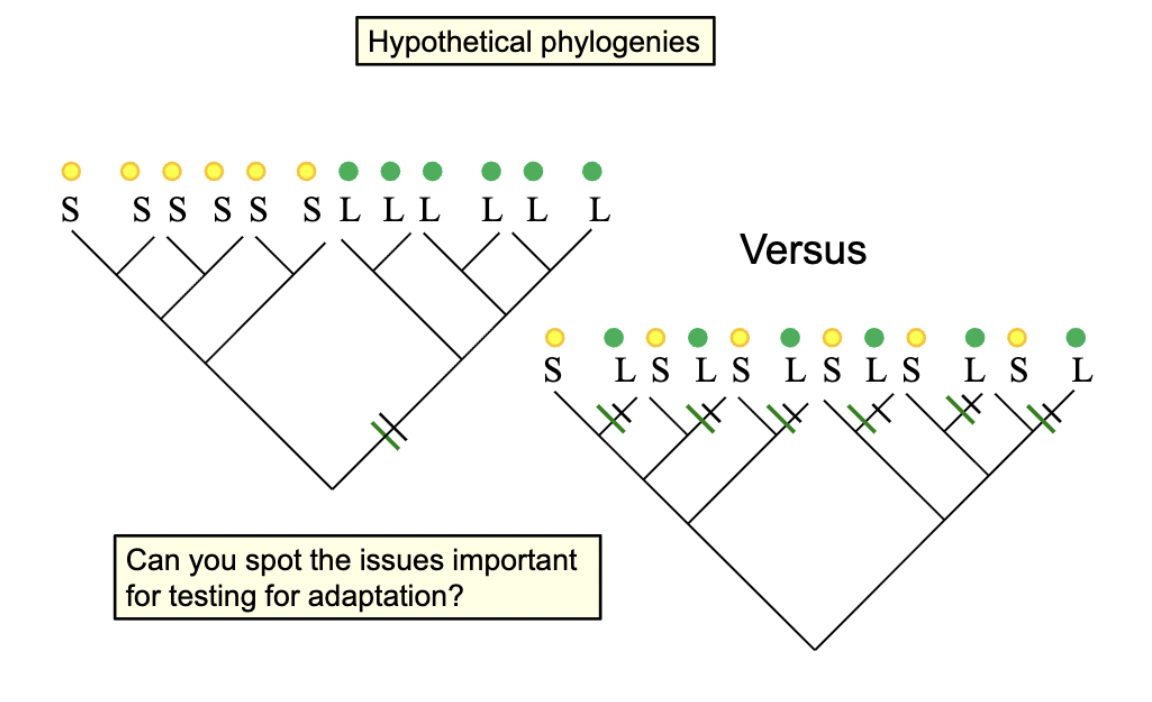 | Left:
- changes in seed size are consistently associated with changes in habitat - stronger support
|
Phenotypic resemblance due to shared ancestry is accounted for by examining evolutionary change since a common ancestor
Sister species comparisons
Require many species, frequent independent changes in hypothesized casual variable
Only involve comparisons of living species
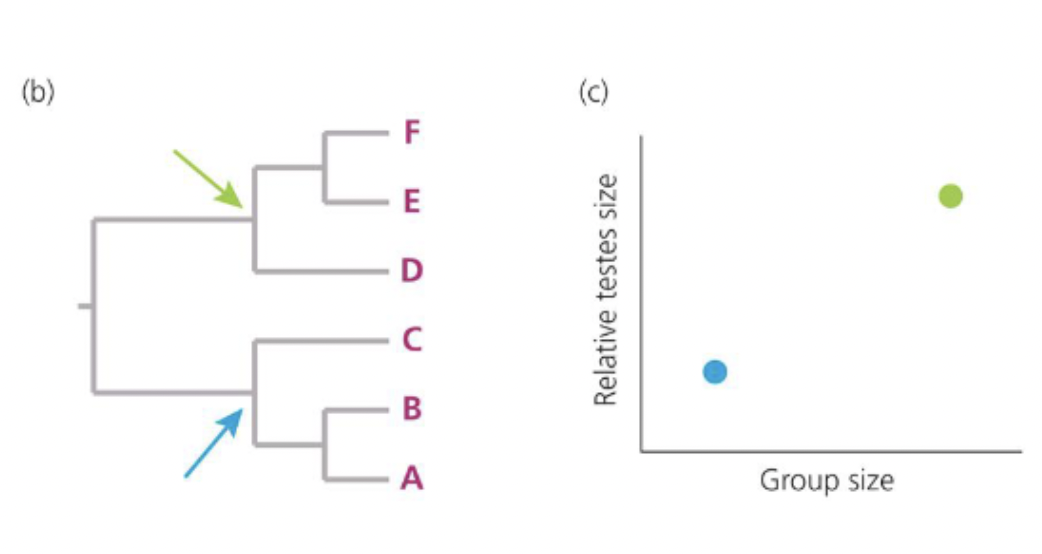
If ABC and DEF are all related share the same trait we should replace the data with data from the common ancestor
Phylogenetically independent contrasts (PICs)
Compare changes in casual variable with changes in dependent variable
Often involved estimation of ancestral phenotypes
Look for patterns of divergence as sister species evolve independently away from a common ancestor
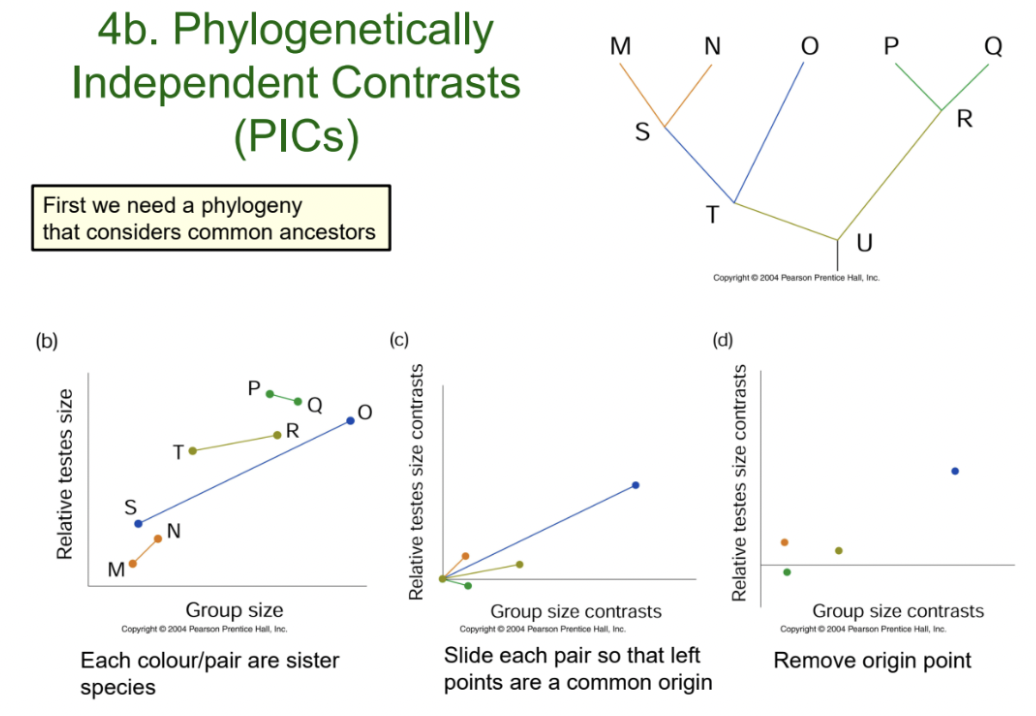
Independent contrasts
- discrete or continuous traits
- imply perfectly known phylogeny
- imply accurate reconstruction of ancestral phenotypes
- assume similarity among relatives is not maintained by natural selectionwe don’t say there is no evidence for natural selection --- we say that there is less evidence for natural selection
Phylogenetics vs Comparative Method
Phylogenetics
Goal: describe ancestral relationships
Can be confounded by independent/parallel evolution
Strategy: use many neutral characters
Comparative Method
Goal: describe adaptation
Can be confounded by shared ancestry
Strategy: consider independent/parallel evolution (PICs)
E.g. importance of wings vs feathers
Requires phylogeny based on characters that are independent of the study focus
LIFE-HISTORY EVOLUTION
Life histories
Age-specific schedule of survival and reproduction
Life history traits
"components of lifetime survival and reproduction" -- combine to determine lifetime reproductive success
Much variation in: lifespan, reproductive cycle, size & number of offspring
Big species reproduce less often because they take more time and more energy to grow up and the resources are limited
Principle of allocation
"Darwinian demon"
A hypothetical organism that can maximize all elements of its fitness simultaneously
Reproduce at bird, infinite life span, infinite reproductive episodes, large numbers of viable offspring
Why don’t we see these?
Finite time & resources cause trade-offs
Reproductive success decreases when survivability increases because you invest in yourself more than to reproducing
Rate of living
Senescence: late life decline in reproduction and probability of survival
There is a physiological limit to cell and tissue repair
"Evolutionary" Hypotheses
Mutation accumulation
Trade-offs between reproduction and repair
Mutation accumulation
Late-acting deleterious mutations accumulate because selections becomes weaker with age
Theory supporting mutation accumulation
Mutation causing death could be only mildly deleterious if it affects late life
Deleterious mutations that act late in life will accumulate because selection against them is weak (e.g. genes causing cancer/Alzheimer's)
Natural selection weakens age
One an organism has reproduced, there is less selective pressure to maintain itself
Mutations that have harmful effects late in life (after reproduction) can accumulate in the population, since they don’t strongly affect an individual’s reproductive success
Over time, late-acting mutations lead to physiological decline and aging
Investing heavily in early reproduction can reduce investment in repair and maintenance, leading to increased cumulative lifetime damage (senescence)
Species with fast life histories (short-lived, early-reproducing) experience stronger effects of mutation accumulation because selection after reproduction is very weak
Slow life history species (long-lived, delayed reproduction) experience stronger selection later in life, so they often evolve better maintenance and repair mechanisms, and thus age more slowly
Trade-offs
Strong selection for early reproduction
Mutation for early breeding can have negative effects late in life and still be advantageous
Trade-off between reproduction early in life and survival
Increased reproduction reduces subsequent growth and survival in many animals and plants
Contributions to mortality and aging
Intrinsic factors
Accumulation of late acting deleterious mutations
Trade-offs between reproduction and repair
Extrinsic factors
Predation, disease, resource depletion, resource accumulation
Logic of trade-offs applied to many aspects of life history
Reproductive effort, mate attraction vs gamete production, offspring size & number, reproduction vs defense
Evolution of aging
Strength of natural selection decreases over life-span --- accumulation of late-acting deleterious mutations
E.g. Menopause
Non-adaptive hypotheses: increased longevity with modern health care, social supports
Adaptive hypotheses
Prolonged childhood - time for children to reach maturity
Grandmother hypothesis - time/energy to care for grandchildren
Sexual selection - assumes female reproduction limited by access to mates
Life histories can give lots of information because they reflect how a species balances growth, survival and reproduction in its environment
Life history traits tell us a lots about a species' ecology, evolution, and vulnerability
Pace of life and ecology
Fast life histories
Early maturity, short lifespan, many offspring
Thrive in unstable or unpredictable environments
Can rebound quickly after disturbance
Tend to have large populations and small body sizes
Population size and density: maintain large populations and high densities
Slow life histories
Late maturity, long lifespan, few offspring
Adapted to stable environments
Recover slowly from population declines
Often large-bodied with low population densities
Population size and density: have smaller populations and lower densities, which make them more vulnerable to chance events (demographic or environmental stochasticity)
Range size and movement
Fast species
Often have smaller home ranges and limited dispersal, but high population turnover allows them to colonize new areas quickly
Slow species
usually have larger home ranges and greater movement, sometimes covering vast areas to find food or mates
Extinction risk and conservation
Fast species
Typically more resilient and recover faster after disturbance
Slow species
Generally more at risk of extinction because:
They reproduce slowly and recover poorly after declines
They require more space and resource
They often face strong human pressures (e.g. hunting, habitat loss, etc.)
Genetic and demographic consequences
Fast-reproducing species
Maintain larger effective population sizes and can, in general, adapt more readily to change
This links life history to evolutionary potential and conservation genetics
Slow-reproducing species
With small populations tend to have lower genetic diversity and a higher risk of inbreeding
Life history strategies summarize the evolutionary "choices" species make between living fast and dying young, or living slow and investing in longevity and survival
EVOLUTION OF SEX
Sex
Polygenic traits - continuous variation also reflects the environment
Domesticated species
Anyone with patience to breed organisms can see populations change over time
Size advantage model: changing sex at the right size maximizes lifetime reproductive success
E.g. reproductive success differs with size for males and females in fish -- smaller = reproduce successfully as females (producing eggs), larger = reproduce successfully as males (defending harems and fertilizing many eggs)
Biological sexes are defined by different gametic. Strategies for reproduction
Sexes are regions of phenotypic space which implement different gametic reproductive strategies
Sexes are life-history stages rather than applying to organisms throughout their lifespans
There is a difference between sex as a reproductive system and sex as an individual trait
At the species level: most sexually reproducing species are anisogamous (they have two distinct gamete types: large nutrient-rich eggs and small motile sperm
At the individual level: nature does not always produce a clean binary division of individuals into "male" or "female"
Concept of sex
Helps maintain how organisms reproduce, evolve, and allocate resources -- essential for understanding life histories, selection, and genetic diversity
Paradox of sex
Sexual -> new genotypes (mating types, male and female)
Asexual -> clones (vegetative propagation, apomixis, parthenogenesis)
Sex poses as a paradox
Sex is complicated, costly, and dangerous --- searching for a mate takes time, energy, and increases exposure to STDs --- once potential mate is found there is usually additional exertion required to 'woo' ………. All this and there is no guarantee that a mate will prove fertile
Asexual species can be highly successful (e.g. dandelion)
Breaking the paradox
Sexual reproduction introduces genetic recombination, which can:
New combinations of genetic variation --- more raw material for selection
Combine beneficial mutations from different individuals
Purge deleterious mutations more effectively (Muller's ratchet)
Help populations adapt faster to changing environments
Long-term advantages of sex
Sex predominant
Most asexual lineages recently evolved
Complete asexuality -> extinction
Asexual strategies tend to go into extinction than sexual
Short-term advantages
Many theories, some evidence
Theoretical explanations are not mutually exclusive
All assume recombination and selection:
Decreased frequency of non optimal genotypes
Increased frequency of superior genotypes
Temporal fluctuations in selection pressure
Avoidance of parasites/disease
Sex continually generates new phenotypes
"Red Queen Hypothesis" - continuous adaptation is needed for a species to maintain its relative fitness among the other species and systems it is co-evolving with
Sexual reproducers were more fit when there were parasites
Asexual reproducers were more fit when there were no parasites
Sex adds variability in the offspring
Heterogeneous environments (spatial variation in selection pressure)
Lottery model
Offspring disperse into various patches (sexual: many diff tickets; asexual: many copies of 1 ticket)
Asexual taxa often occur in biotically simple environments
Sibling competition
Genotypes differ in resource use
Diverse offspring compete less than identical offsprings
Eliminating mutations
Muller's ratchet
Can never lose mutations in selfing population and individuals with the fewest mutations will be lost by drift
Forward mutations are much more frequent than reverse mutations
Asexual offspring inherit all existing mutations and experience additional mutations
Mildly deleterious mutations accumulate in small clonal populations over time
Multiple mutations eventually have a drastic effect on fitness
Mutation threshold
Fitness is severely reduced in individuals with more mutations than a threshold number
Mutations are most rapidly eliminated when they occur with other mutations
Before selection, sexual reproduction recombination generates a wider range of mutations per individual than does asexual reproduction
SEXUAL SELECTION
Evolution of males and females
Isogamy - gametes with identical morphology; mutations affecting size
Anisogamy - functional divergence
Large gametes --- have higher survival capacity
Small gametes --- produced in higher numbers
W = offspring number x offspring survival
Sexual selection
"selection on mating success"
May oppose viability selection, but is still a component of natural selection
Females & males invest unequally in each offspring
"Batemans principle"
Male fitness is usually limited by number of mates; therefore males will usually compete for mates
Female fitness is usually limited by resources; therefore females will usually be choosy