apush midterm study 4th pd condensed
Marbury v Madison / McCulloch v Maryland
- Takeaways for both cases: strengthened the federal government’s role/power
Worcester v Georgia
- Forcing the movement of natives west so the acquisition of land in the west could be made.
- A. Jackson vs. the Supreme Court (John Marshall): federal had high power and was supposed to make the final decision, but Jackson took his opinion and ran with it, thus making it law. This displays one of many fits of abuse Jackson carries out during his administration.
Triangular Trade: raw materials (Americas) to GB to manufacture, sends to Africa, Africa sends enslaved people to North America.
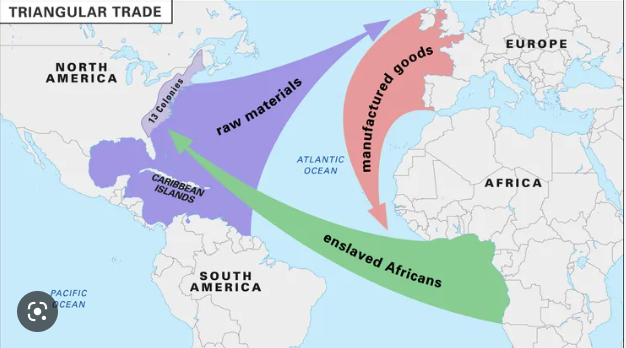
The economic system utilized in the Triangular Trade was mercantilism.
- Where a mother country (GB) uses a colony (US) for raw materials.
Navigation Laws
- GB restricted its colonies’ (US) trading with the rest of the world, limiting it to only being able to trade with GB.
Navigation Laws contrast with Salutary Neglect, as SN was a loose/non-strict way of holding rule over a colony.
General timeline:
- 13 colonies, utilizing mercantilism, self-gov’t (think: House of Burgesses, town meetings, etc)
- Ohio River Valley Acquisition leads to the French and Indian War
- GB wins, although they are in massive debt
- In order to pay off this debt, they taxed the colonies: everyday items (think: sugar tax, stamp tax, etc)
- People in colonies were mad, not primarily due to the taxes themselves, but due to the taxation without representation.
Attempts to nullify federal law: 2 noteworthy instances
- Kentucky/Virginia resolutions: T. Jefferson + J. Madison attempts to nullify the Alien and Sedition Acts placed by J. Adams. They were ruled unconstitutional but stayed in place (for the most part).
- Tariff of Abominations (Tariff of 1828): During A. Jackson’s administration, this tariff made people pay more for GB goods, which significantly hurt the Southern economy. SC (South Carolina) attempted to nullify the tariff, (Calhoun threatened to start a Civil War…. sent troops and everything) but ultimately failed.
Both were unsuccessful, as proved fed law > state law.
Strict/Loose Interpretations of the Constitution:
- T. Jefferson: strict. The bank is not in the Constitution.
- A. Hamilton: loose. The bank is not explicitly denounced in the Constitution, deemed necessary + proper (Elastic Clause)
Although it can also be made clear that Jefferson flipped the narrative: This is evident when he purchases LA (Louisiana), as the Constitution did not dictate how to/how not to purchase land.
General timeline:
- MO (Missouri) Compromise (1820)
- Acquisition of Texas (1845)
- Mexican-American War (1846-48)
- Compromise of 1850 CA (California) (free state)
- Utilization of popular sovereignty
- KA/NE (Kansas/Nebraska) Act (1854)
- Bleeding Kansas (1854-59)
- Dred Scott case (nullifies MO Comp) (1857)
Impact of Texas annexation on the slavery issue:
- Texas, leaving Mexico, was anti-slave (Mexico’s influence), but migrators tried to change Texas into a slave state if it was annexed.
Jackson was hated by the whigs. (He was a democrat)
- Common man president: universal male suffrage (to vote) - increased the democracy
- Abuses: spoils system, Indian Removal Act, excessive vetos, threatening Civil War
Emancipation Proclamation predated the Gettysburg Address.
- Stated that slaves in the South/Confederacy were to be freed (not border states)
The Gettysburg Address:
- Declared that the CW would be about slavery - no more dancing around the subject.
Sectionalism: term for regional specialties/interests/economic specialization
- North: industry
(Middle Colonies: breadbasket/grain production)
- West: resources/agriculture
- South: agriculture
Agrarian: term for agriculture
Women’s rights in the Colonial period
- no rights
- Jane Adams - “don't forget the ladies“
- post-Seneca Falls Convention, married women had some rights (keep wages/divorce)
cult of domesticity continuity (working until married)
Plessy vs. Ferguson - outcome and importance
- Ruled that segregation was legal and enforced in society. “Separate but equal” implied by the public.
- enforced jim crow laws (2nd black codes - except they were legalized)
Black Codes: Unofficial laws were placed to stop African Americans from being fully equal in society.
Freedmen's Bureau: Group that brought education to freedmen, but was ultimately disbanded after a lack of funding.
Reconstruction Amendments and what they did: (passed by the Radical Republicans)
- 13th: Emancipation of slaves
- 14th: Naturalization laws, equal protection under the law
- 15th: African American men able to vote
Sharecropping: One landowner rents property to a freedman, and the cycle of work until debts are paid/cycle of debt/dies
Join or Die cartoon - Albany Plan of Union:
- get more support for intercolonial unity + propaganda (Ben Franklin snake cartoon)