Anxiety Disorders
Anxiety- negative mood state that is accompanied by bodily symptoms such as increased heart rate, muscle tension, a sense of unease, and apprehension about the future.
High comorbitity rates with other types of anxiety
✧ ex: GAD with SAD
Most people feel anxiety everyday of their lives.
More common in women.
Typically occurs when there is an actual threat involved.
★ spontaneous illness risks and health anxiety (¬_¬")
★ living in a high-crime area worried about violence
Key Aspects of Anxiety (can include):
Emotional Response - apprehension, dread, worry (about the future, or past [rumination]).
Physical Symptoms - increased heart rate, sweating, shortness of breath, muslce tension, being tired, “fight or flight”.
Cognitive Impact - racing thoughts, difficulties concentrating, an overestimation of threats.
Behavioral Response - avoidance of certain situations, experiences, or tasks, cautiousness in dangerously percieved situation. Creates a cycle of fear.
Fear - involves an instantaneous reaction to an immenant threat.
Anxiety is NOT inherently harmful:
Alerts to danger
Improves performance
Motivates action
Problem-solving
Builds Resilience
7 Anxiety Disorders
Separation Anxiety Disorder - developmentally inappropriate and excessive anxiety when separated from whom the individual is attached.
𑣲 Juniper
𑣲 Adult disorder/occurs for 6 months or more in adults
𑣲 most common in children; more girls than boys
Natural part of the developmental process (stranger danger)
psychoeducational intervention for the family, CBT = treatment
Generalized Anxiety Disorder (GAD) - excessive worry for at least 6 months; 3 symptoms not associated with another anxiety disorder:
Feeling nervous or on edge, Not being able to control/stop
worrying, Worrying too much about different things, Trouble
relaxing, Being irritable, Being easily fatigued, Difficulty
concentrating, Having muscle tension, Having sleep issues;
difficulty falling or staying asleep, restlessness, or unsatisfying sleep
Risk Factors: being a woman, traits of shyness or behavioral inhibition (restricting themselves) in childhood, exposure to stressful and negative life or environmental events in early childhood or adulthood, history of anxiety or other mental illnesses in biological relatives, physical health conditions: thyroid problems, heart arrhythmias, cafffeine or other substances/medications.
CBT (thought-logging + homework) = effective treament
Panic Disorder - a person must experience both panic attacks (e.g., extreme physiological sensations) and intense anxiety and avoidance for at least one month.
.⋆❀° 2-5% in adults; 2-3% in adolescents/teens
❀ Hereditabilty is about 30-50%

Panic Attack: a period of extreme fear or discomfort that develops abruptly and reaches a peak within 10 minutes.
✴ IMMENSE TERROR OR FEAR OF DEATH
Agoraphobia: “fear of the marketplace,” characterized by intense fear, anxiety, and avoidance of situations in which it might be difficult to escape or receive help if one experiences symptoms of a panic attack.
☘ ݁ can occur with or without panic disorder
CBT (thought-logging + homework) = effective treament
Medications as well:
SSRIs, SNRIs, Beta-blockers, Benzodiazepines
Beta-blockers: taking as needed, manage physical symptoms; “I feel worried, but I don’t feel worried, so I’m not worried.”
☘︎ taken before a big presentation
Social Anxiety Disorder (SAD) - “social phobia” characterized by extreme and persistent fear or anxiety and avoidance of social situations in which the person could potentially be evaluated negatively by others.
❤︎ A fear of being evaluated by others
❤︎ 12% of all Americans exerience social anxiety
Safety behaviors: mental or behavioral acts that reduce anxiety in social situations by reducing the chance of negative social outcomes.
☁︎ rehearsing speech
☁︎ avoiding eye contact
Afraid to show symptoms of anxiety or fear of being rejected.
Extreme inhibition = not showing any emotions.
Behavioral inhibition: inhereted trait; a consistent tendency
to show fear and restrainst when presented with unfamiliar
people or situations.
CBT, Exposure Therapy, SSRIs = Treatment
°‧ 𓆝 𓆟 𓆞 ·。 ༝ °‧ 𓆝 𓆟 𓆞 ·。
SELECTIVE MUTISM
a situational mutism
anxiety disorder in which a person noramlly capable of speech cannot speak in specific situations or to specific people if triggered.
Usually coexists with social anxiety.
People with selective mutism stay silent even when the consequences of their silence include shame, social ostracism, or punishment. … (¬_¬")
Disturbances for at least a month (not including start of school year), Consistent failure to speak in specific social situations, Not connected to a dif. communication disorder.
SSRIs, CBT, family therapy = treatment
°‧ 𓆝 𓆟 𓆞 ·。 ༝ °‧ 𓆝 𓆟 𓆞 ·。
Specific Phobia - experiences excessive, distressing, and persistent fear or anxiety about a specific object or situation (such as animals, enclosed spaces, elevators, or flying).
- different categories:
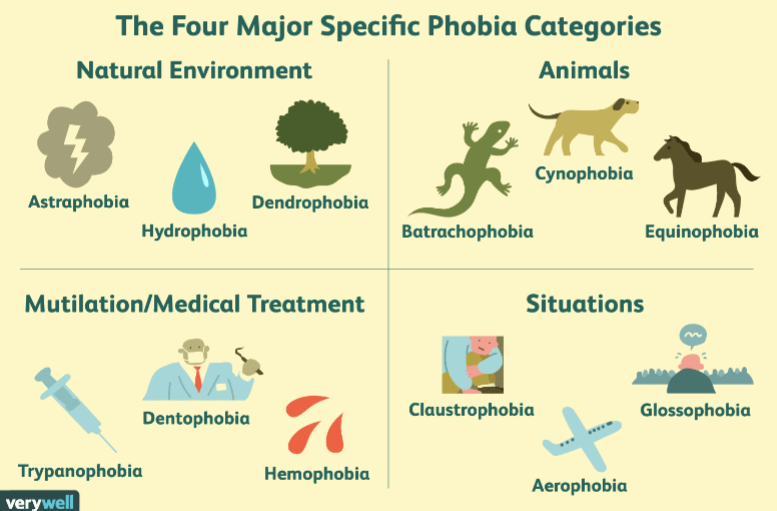
can happen via modeling (seeing someone affraid [like a parent] = you become afraid), verbal transmission (you hear about it somewhere).
CBT and Exposure Therapy (a form of CBT) = effective treatment.
Post-Traumatic Stress Disorder (PTSD)
Obsessive-Compulsive Disorder (OCD)
What is worry?
a symptom of anxiety, less intense but part of the process, the uncertainty aspect.
“What might happen?”
Cognitive, mental thoughts.
Perspectives and Treatment For Anxiety Disorders
Biological Perspective: addressing things through medication.
Cognitive and Behavioral: why do we think that?
Humanistic Approach: collaboration, empathy, clients find their own motivation to get better, motivational interviewing.
✮ ⋆ ˚。𖦹 ⋆。°✩
Therapies
CBT: cognitive; changing the way we think and behave because of the way we think.
Exposure: patients make contact with the feared stimuli and this contact is maintained until the anxiety associated with the contact subsides.
Systematic Desensitization: based on the idea of reciprocal inhibition proposing that two opposite emotions can not co-exist
𖦹 fear and relaxation are mutually exclusive.
Acceptance and Commitment Therapy (ACT): Core Goal, Psychological Flexibility, Philosophy; teaches individuals to live a meaningful life in alignment with their values despite emotional or psychological challenges.