AP Music Theory Unit 4: Harmony and Voice Leading - Chord Progressions and Predominant Function
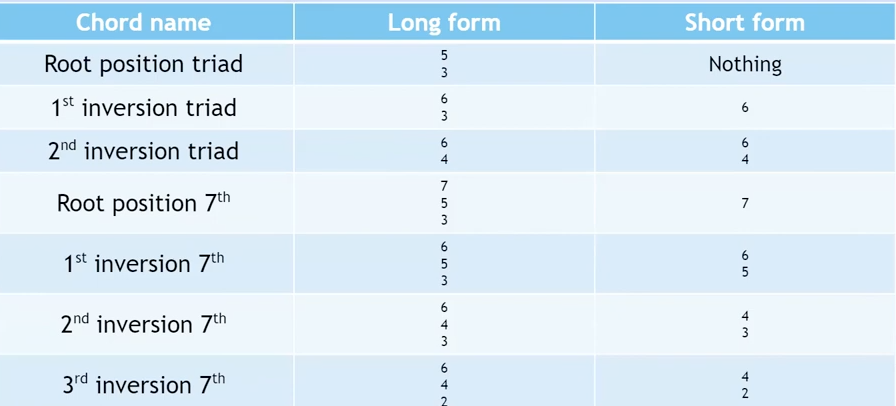
Figured Bass
shorthand method of notating chords
each number refers to an interval above the bass
accidentals affect the note indicated by the number
if there is no number, the accidental affects the note a 3rd above the bass
Chord Functions
chord’s purpose in a chord
tonic function
I
vi
iii
provides sense of rest and stability (home, happy)
starts and ends chord progressions
dominant function
V
viiº
provides instability
needs to resolve to the tonic
predominant function
IV
ii
goes between tonic and dominant
can prolong the tonic
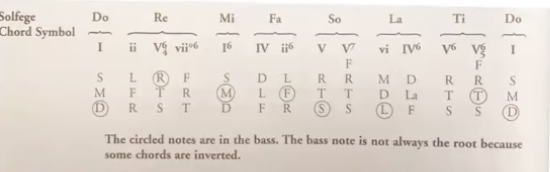
Fundamental Progression
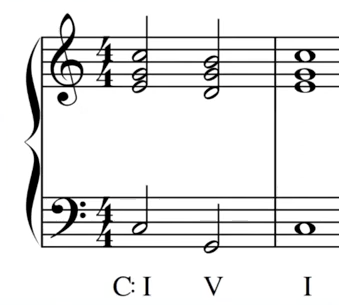
I-V-I
basis for all harmonic progressions
aspects of instability in dominant
leading tone wants to resolve up to tonic
supertonic wants to go down to tonic
Cadences
two-chord units that mark end of phrase
authentic
dominant tonic
usually V or V7 - I
provides sense of finality
perfect authentic cadence (PAC)
both chords are in root position
ends w scale degree 1 in top voice
inversions
Imperfect authentic cadence (IAC)
does not satisfy all conditions of a PAC
one or both chords are not in root position
scale degree 1 is not the top voice
Half (HC)
any number of chord going to V (usually I) in root positions
provides stability
plagal (PC)
IV-I
“Amen cadence”
like what you hear in church
deceptive (DC)
dominant - something other than the tonic (usually vi)
used to extend phrases
SATB Chorale Texture
four voices
soprano
alto
tenor
bass
each voice singing an individual melody
open position
space between soprano and tenor is greater than an octave
most stable
closed position
space between soprano and tenor is less than an octave
use when you want to move quickly between chords
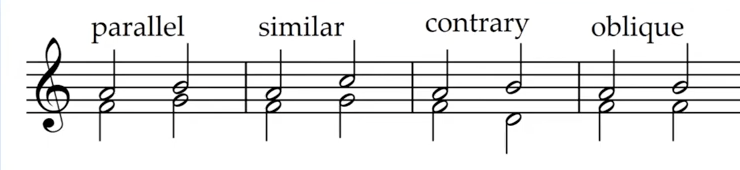
Types of Motion
Parallel motion: two voices moving in the same direction by the same intervals
Similar motion: two voices moving in the same direction by different intervals
Contrary motion: two voices moving in different directions
Oblique motion: one voice moves, while the other remains static
Common Errors in Part-Writing
parallel 5ths/octaves
detract from the independence of the melody
doubled leading tones
will cause parallel octaves when resolved
voice crossing
voice overlap
direct 5ths / octaves
in outer voices that is approached by a leap in the soprano, and a leap or step in the bass
spacing between voices
cannot be greater than an octave
except between tenor and bass
leap of diminished and augmented intervals
Voice Leading w Root Position Triads
identify common tones and repeat them
double the root
root motion of 4th / 5th
hold the common tone in 1 voice, teh other 2 voices move by parallel motion
upper voices move in similar motion
2 3rds, 1 step
root motion of 3rd / 6th
hold 2 common tones, one voice moves by step
root motion of 2nd / 7th
3 upper voices move in contrary motion against bass
2 steps, 1 3rd
Voicing the Fundamental Progression (I-V-I)
neighbor progressions
moves by step in one direction, then the other
passing progressions
moving by step in one direction
usually 1-2-3 or 3-2-1
incomplete neighbor progressions
includes a leap
The Dominant Seventh (V7)
four chord members
root, 3rd, 5th, 7th
do not correspond to scale degrees
has two tendency tone which makes it stronger than V
4th scale degree (chord 7th) which resolves to 3rd
leading tone (chord 3rd) which resolves to the tonic
creates a tritone that resolves to a third interval
the 5th may be omitted
root sets foundation
3rd determines the quality
7th creates dissonance (through tritone)
either go from complete 7th to an incomplete tonic or an incomplete 7th to a complete tonic
in order to go from complete 7th to complete tonic, the tritone is left unresolved
Inversions of the V7 Chord
first inversion
6/5, short for 6/5/3
chord 3rd (LT) is in the bass which resolves up to the tonic
commonly used in neighbor progression to prolong the tonic
prolongation
to make a chord span a longer period of time
second inversion (4/3, short for 6/4/3)
chord 5th (scale degree 2) is in the bass
can go to either I or I6, so it is often used in passing progressions
third inversion (4/2, short for 6/4/2)
chord 7th (scale degree 4) is in the bass which resolves down by step
resolves to I6
common chord progression is V-V4/2 - I6
Harmonic Composition
Counterpoint: rls of two lines between the bass (give) and the melody (composed by you)
step goes up for soprano and alto and down for tenor and bass
bass disjunct
alto and tenor conjunct
soprano melody
Part Writing to Figured Bass
write out the chord sack of each bass note from the figured bass
figure out respective root positions, add roman numerals
fill in the upper voices of each chord based on what you have mapped out in the chord stacks; rmbr to have everything in the correct inversion
try to avoid large sips and leaps on any part
check your work for parallel 5ths and octaves, accidentals, range, crossing, resolving, doubling
Chord Leading
circle progression
movement of chords where root of each chord is a diatonic 5th above the next chord
root ≠ bass
progression by 3rds and 2nds
can go up or down
inversions weaken function of chords in a TSDT sense, but can take on connection roles
includes
passing, neighbor, arpeggio, pedal
6 4 chords have variety of uses
Accidentals used in Figured bass
mode mixtures
usage of chords not found in key, usually borrowing from parallel minor / major
picardy 3rd
mode mixture were the third of a chord that was supposed to be minor borrows from the parallel major
secondary dominant
notated w (roman numeral) / (another roman numeral)
Rules of Progression v Retrogression
do not follow V w IV, ii6, ii65
do not follow VI w I
unstable to stable is bad