Sex determination
Primary sex determination is the determination of the gonads. In mammals, primary sex determination is strictly chromosomal and is not usually influenced by the environment. In most cases, the female is XX and the male is XY. Every individual must have at least one X chromosome. Since the female is XX, each of her eggs has a single X chromosome. The male, being XY, can generate two types of sperm: half bear the X chromosome, half the Y. If the egg receives another X chromosome from the sperm, the resulting individual is XX, forms ovaries, and is female; if the egg receives a Y chromosome from the sperm, the individual is XY, forms testes, and is male. The Y chromosome carries a gene that encodes a testis-determining factor. This factor organizes the gonad into a testis rather than an ovary. Unlike the situation in Drosophila (discussed below), the mammalian Y chromosome is a crucial factor for determining sex in mammals. A person with five X chromosomes and one Y chromosome (XXXXXY) would be male. Furthermore, an individual with only a single X chromosome and no second X or Y (i.e., XO) develops as a female and begins making ovaries, although the ovarian follicles cannot be maintained. For a complete ovary, a second X chromosome is needed.
In mammalian primary sex determination, there is no “default state.” The formation of ovaries and testes are both active, gene-directed processes. Moreover, as we shall see, both diverge from a common precursor, the bipotential gonad.
Secondary sex determination affects the bodily phenotype outside the gonads. A male mammal has a penis, seminal vesicles, and prostate gland. A female mammal has a vagina, cervix, uterus, oviducts, and mammary glands. In many species, each sex has a sex-specific size, vocal cartilage, and musculature. These secondary sex characteristics are usually determined by hormones secreted from the gonads. However, in the absence of gonads, the female phenotype is generated. When Jost (1953) removed fetal rabbit gonads before they had differentiated, the resulting rabbits had a female phenotype, regardless of whether they were XX or XY. They each had oviducts, a uterus, and a vagina, and each lacked a penis and male accessory structures.
The general scheme of mammalian sex determination is shown in Figure 17.2. If the Y chromosome is absent, the gonadal primordia develop into ovaries. The ovaries produce estrogen, a hormone that enables the development of the Müllerian duct into the uterus, oviducts, and upper end of the vagina. If the Y chromosome is present, testes form and secrete two major hormones. The first hormone—anti-Müllerian duct hormone (AMH; also referred to as Müllerian-inhibiting substance, MIS)—destroys the Müllerian duct. The second hormone—testosterone—masculinizes the fetus, stimulating the formation of the penis, scrotum, and other portions of the male anatomy, as well as inhibiting the development of the breast primordia. Thus, the body has the female phenotype unless it is changed by the two hormones secreted by the fetal testes. We will now take a more detailed look at these events.
The developing gonads
The gonads embody a unique embryological situation. All other organ rudiments can normally differentiate into only one type of organ. A lung rudiment can become only a lung, and a liver rudiment can develop only into a liver. The gonadal rudiment, however, has two normal options. When it differentiates, it can develop into either an ovary or a testis. The path of differentiation taken by this rudiment determines the future sexual development of the organism. But, before this decision is made, the mammalian gonad first develops through a bipotential (indifferent) stage, during which time it has neither female nor male characteristics.
In humans, the gonadal rudiments appear in the intermediate mesoderm during week 4 and remains sexually indifferent until week 7. The gonadal rudiments are paired regions of the intermediate mesoderm; they form adjacent to the developing kidneys. The ventral portions of the gonadal rudiments are composed of the genital ridge epithelium. During the indifferent stage, the genital ridge epithelium proliferates into the loose connective mesenchymal tissue above it (Figure 17.3A,B). These epithelial layers form the sex cords. The germ cells migrate into the gonad during week 6, and are surrounded by the sex cords. In both XY and XX gonads, the sex cords remain connected to the surface epithelium.

Differentiation of human gonads shown in transverse section. (A) Genital ridge of a 4-week embryo. (B) Genital ridge of a 6-week indifferent gonad showing primitive sex cords. (C) Testis development in the eighth week. The sex cords lose contact with (more…)
If the fetus is XY, the sex cords continue to proliferate through the eighth week, extending deeply into the connective tissue. These cords fuse, forming a network of internal (medullary) sex cords and, at its most distal end, the thinner rete testis (Figure 17.3C,D). Eventually, the sex cords—now called testis cords—lose contact with the surface epithelium and become separated from it by a thick extracellular matrix, the tunica albuginea. Thus, the germ cells are found in the cords within the testes. During fetal life and childhood, the testis cords remain solid. At puberty, however, the cords will hollow out to form the seminiferous tubules, and the germ cells will begin to differentiate into sperm.
The cells of the seminiferous tubule are called Sertoli cells. The Sertoli cells of the testis cords nurture the sperm and secrete anti-Müllerian duct hormone. The sperm are transported from the inside of the testis through the rete testis, which joins the efferent ducts. These efferent tubules are the remnants of the mesonephric kidney, and they link the testis to the Wolffian duct, which used to be the collecting tube of the mesonephric kidney (see Chapter 15). In males, the Wolffian duct differentiates to become the epididymis (adjacent to the testis) and the vas deferens, the tube through which the sperm pass into the urethra and out of the body. Meanwhile, during fetal development, the interstitial mesenchyme cells of the testes differentiate into Leydig cells, which make testosterone.
VADE MECUM
Mammalian gonads. The histology of the mammalian ovary and testis can be seen in labeled photographs that show progressively smaller regions at higher magnifications. [Click on Gametogenesis]
In females, the germ cells will reside near the outer surface of the gonad. Unlike the sex cords in males, which continue their proliferation, the initial sex cords of XX gonads degenerate. However, the epithelium soon produces a new set of sex cords, which do not penetrate deeply into the mesenchyme, but stay near the outer surface (cortex) of the organ. Thus, they are called cortical sex cords. These cords are split into clusters, with each cluster surrounding a germ cell (Figure 17.3E,F). The germ cells will become the ova, and the surrounding cortical sex cords will differentiate into the granulosa cells. The mesenchyme cells of the ovary differentiate into the thecal cells. Together, the thecal and granulosa cells will form the follicles that envelop the germ cells and secrete steroid hormones. Each follicle will contain a single germ cell. In females, the Müllerian duct remains intact, and it differentiates into the oviducts, uterus, cervix, and upper vagina. The Wolffian duct, deprived of testosterone, degenerates. A summary of the development of mammalian reproductive systems is shown in Figure 17.4.
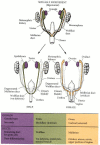
Summary of the development of the gonads and their ducts in mammals. Note that both the Wolffian and Müllerian ducts are present at the indifferent gonad stage.
The mechanisms of mammalian primary sex determination
Several genes have been found whose function is necessary for normal sexual differentiation. Unlike those that act in other developing organs, the genes involved in sex determination differ extensively between phyla, so one cannot look at Drosophila sex-determining genes and expect to see their homologues directing mammalian sex determination. However, since the phenotype of mutations in sex-determining genes is often sterility, clinical studies have been used to identify those genes that are active in determining whether humans become male or female. Experimental manipulations to confirm the functions of these genes can be done in mice.
Sry: the Y chromosome sex determinant
In humans, the major gene for the testis-determining factor resides on the short arm of the Y chromosome. Individuals who are born with the short arm but not the long arm of the Y chromosome are male, while individuals born with the long arm of the Y chromosome but not the short arm are female. By analyzing the DNA of rare XX men and XY women, the position of the testis-determining gene has been narrowed down to a 35,000-base-pair region of the Y chromosome located near the tip of the short arm. In this region, Sinclair and colleagues (1990) found a male-specific DNA sequence that could encode a peptide of 223 amino acids. This peptide is probably a transcription factor, since it contains a DNA-binding domain called the HMG (high-mobility group) box. This domain is found in several transcription factors and nonhistone chromatin proteins, and it induces bending in the region of DNA to which it binds (Figure 17.5; Giese et al. 1992). This gene is called SRY (sex-determining region of the Y chromosome), and there is extensive evidence that it is indeed the gene that encodes the human testis-determining factor. SRY is found in normal XY males and in the rare XX males, and it is absent from normal XX females and from many XY females. Another group of XY females was found to have point or frameshift mutations in the SRY gene; these mutations prevent the SRY protein from binding to or bending DNA (Pontiggia et al. 1994; Werner et al. 1995). It is thought that several testis-specific genes contain SRY-binding sites in their promoters or enhancers, and that the binding of SRY to these sites begins the developmental pathway to testis formation (Cohen et al. 1994).

Association of DNA with the SRY protein can cause the DNA to bend 70–80 degrees. The black structure represents the HMG box of the SRY protein. The red coil is the double helix of DNA specifically bound by SRY. (After Haqq et al. 1994 and Werner (more…)
If SRY actually does encode the major testis-determining factor, one would expect that it would act in the genital ridge immediately before or during testis differentiation. This prediction has been met in studies of the homologous gene found in mice. The mouse gene (Sry) also correlates with the presence of testes; it is present in XX males and absent in XY females (Gubbay et al. 1990; Koopman et al. 1990). The Sry gene is expressed in the somatic cells of the bipotential mouse gonad immediately before or during its differentiating into a testis; its expression then disappears (Hacker et al. 1995).
The most impressive evidence for Sry being the gene for testis-determining factor comes from transgenic mice. If Sry induces testis formation, then inserting Sry DNA into the genome of a normal XX mouse zygote should cause that XX mouse to form testes. Koopman and colleagues (1991) took the 14-kilobase region of DNA that includes the Sry gene (and presumably its regulatory elements) and microinjected this sequence into the pronuclei of newly fertilized mouse zygotes. In several instances, the XX embryos injected with this sequence developed testes, male accessory organs, and penises (Figure 17.6). (Functional sperm were not formed, but they were not expected, either, because the presence of two X chromosomes prevents sperm formation in XXY mice and men, and the transgenic mice lacked the rest of the Y chromosome, which contains genes needed for spermatogenesis.) Therefore, there are good reasons to think that Sry/SRY is the major gene on the Y chromosome for testis determination in mammals.
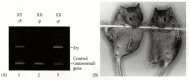
An XX mouse transgenic for Sry is male. (A) Polymerase chain reaction followed by electrophoresis shows the presence of the Sry gene in normal XY males and in a transgenic XX Sry mouse. The gene is absent in a female XX littermate. (B) The external genitalia (more…)
Sry/SRY is necessary, but not sufficient, for the development of the mammalian testis. Studies on mice (Eicher and Washburn 1983; Washburn and Eicher 1989; Eicher et al. 1996) have shown that the Sry gene of some strains of mice failed to produce testes when placed into a different strain of mouse. When the Sry protein binds to its sites on DNA, it probably creates large conformational changes. It unwinds the double helix in its vicinity and bends the DNA as much as 80 degrees (Pontiggia et al. 1994; Werner et al. 1995). This bending may bring distantly bound proteins of the transcription apparatus into close contact, enabling them to interact and influence transcription. The identities of these proteins are not yet known, but they, too, are needed for testis determination.
SRY may have more than one mode of action in converting the bipotential gonads into testes. It had been assumed for the past decade that SRY worked directly in the genital ridge to convert the epithelium into male-specific Sertoli cells. Recent studies (Capel et al. 1999), however, have suggested that SRY works via an indirect mechanism: SRY in the genital ridge cells induces the cells to secrete a chemotactic factor that permits the migration of mesonephric cells into the XY gonad. These mesonephric cells induce the gonadal epithelium to become Sertoli cells with male-specific gene expression patterns. The researchers found that when they cultured XX gonads with either XX or XY mesonephrons, the mesonephric cells did not enter the gonads. However, when they cultured XX or XY mesonephrons with XY gonads, or with gonads from XX mice containing the Sry transgene, the mesonephric cells did enter the gonads (Figure 17.7). There was a strict correlation between the presence of Sry in the gonadal cells, mesonephric cell migration, and the formation of testis cords. Tilmann and Capel (1999) showed that mesonephric cells are critical for testis cord formation and that the migrating mesonephric cells can induce XX gonadal cells to form testis cords. It appears, then, that Sry may function indirectly to create testes by inducing mesonephric cell migration into the gonad.

Migration of the mesonephric cells into Sry+ gonadal rudiments. In the experiment diagrammed, urogenital ridges (containing both the mesonephric kidneys and gonadal rudiments) were collected from 12-day embryonic mice. One of the mice was marked with (more…)
WEBSITE
17.2 Finding the male-determining genes. The mapping of the testis-determining factor to the SRY region took scientists more than 50 years to accomplish. Moreover, other testis-forming genes have been found on the autosomes. http://www.devbio.com/chap17/link1702.shtml
Sox9: autosomal sex reversal
One of the autosomal genes involved in sex determination is SOX9, which encodes a putative transcription factor that also contains an HMG box. XX humans who have an extra copy of SOX9 develop as males, even though they have no SRY gene (Huang et al. 1999). Individuals having only one functional copy of this gene have a syndrome called campomelic dysplasia, a disease involving numerous skeletal and organ systems. About 75% of XY patients with this syndrome develop as phenotypic females or hermaphrodites (Foster et al. 1994; Wagner et al. 1994; Mansour et al. 1995). It appears that SOX9 is essential for testis formation. The mouse homologue of this gene, Sox9, is expressed only in male (XY) but not in female (XX) genital ridges. Moreover, Sox9 expression is seen in the same genital ridge cells as Sry, and it is expressed just slightly after Sry expression (Wright et al. 1995; Kent et al. 1996). The Sox9 protein binds to a promoter site on the Amh gene, providing a critical link in the pathway toward a male phenotype (Figure 17.8; Arango et al. 1999).