Hobbes
Ethical and political implications of scientific rationalism
Aristotle + Aquinas - Nature is something known through the physical senses
The forms
the shape or definition something has
what goals
purposes
what something is made of
Aristotelian form of thinking is found in scientific rationalism
Descartes - we know something in relationship to something else (measuring)
Aristotelian Science and Natural Law
In Aristotelian science and ethics, all things tend toward their “good.”
When humans are “ethical” in Aquinas’ or Aristotle’s sense, they do what is good according to their nature
When humans fail to be ethical, it’s because they misjudge what is good, because of passion, pride, or desire
Remember Augistine’s definition of moral evil: choosing a lower good rather than a higher good
It is our nature to judge among goods and pursue the highest good we perceive because we are teleological beings
The new Science and Natural law
In the new science natural objects no longer tend toward a final goal, but act automatically as a result of the immutable laws of nature
Example: Aristotelian idea that all motion is directed toward final rest, vs. Newtonian idea of inertia
even biological beings are explained by appeal to the mechanical laws of nature
Descartes’ anatomy attempts to describe the biological body as a complex machine made up of many different interacting parts
Rational science after Descartes begins to turn its focus from external nature to internal human nature
A divorce between the “natural” and the ethical”
for the new scientific rationalists like Descartes, physical nature is no longer seen as having its own internal ends
The only “goals” nature could have are those goals that are set for it by minds
What is “natural” is just what happens as a result of the interaction of bodies according to the various mechanical laws of motion
Descartes, however, continues to think of the “ethical” as being the human tendency toward the good, a good that we grasp through our minds
Thomas Hobbes is dissatisfied with the divorce between mind and body/ethics and nature. But in bringing the “natural” and the “ethical” back together again, he undermines the whole idea of morality.
Hobbes: method
Hobbes’ methods of philosophy are inspired by Descartes
He first uses analysis — breaking down human nature into the most basic components, and considering each of the simplest qualities abstracted from the rest.
Then, he uses synthesis — he puts these qualities back together to see how these basic truths interact to produce the complex behaviors and societies he sees in his own time.
Honnes hopes that analysis and synthesis will yield basic truths about human nature that can be used to form a more stable society
Hobbes vs. Descartes on the mind
Descartes
The mind is:
Immaterial
Substantial
Connected to the body as a ray of light through a window
Free
Operates by reasoning, understanding, judging, willing, etc
Hobbes
The mind is:
Material
Dependent on the body
United to the body like a flame with warmth
Determined by desire
Operates through the association of ideas and the organization of signs
Hobbes on reason
Hobbes has, in some ways, a very Aristotelian theory of rationality
rationality is built on sense experience
Rationality consists of ordering sense experience
However, Hobbes disagrees with Aristotle on the nature of the mind and the nature of how sense experience is ordered
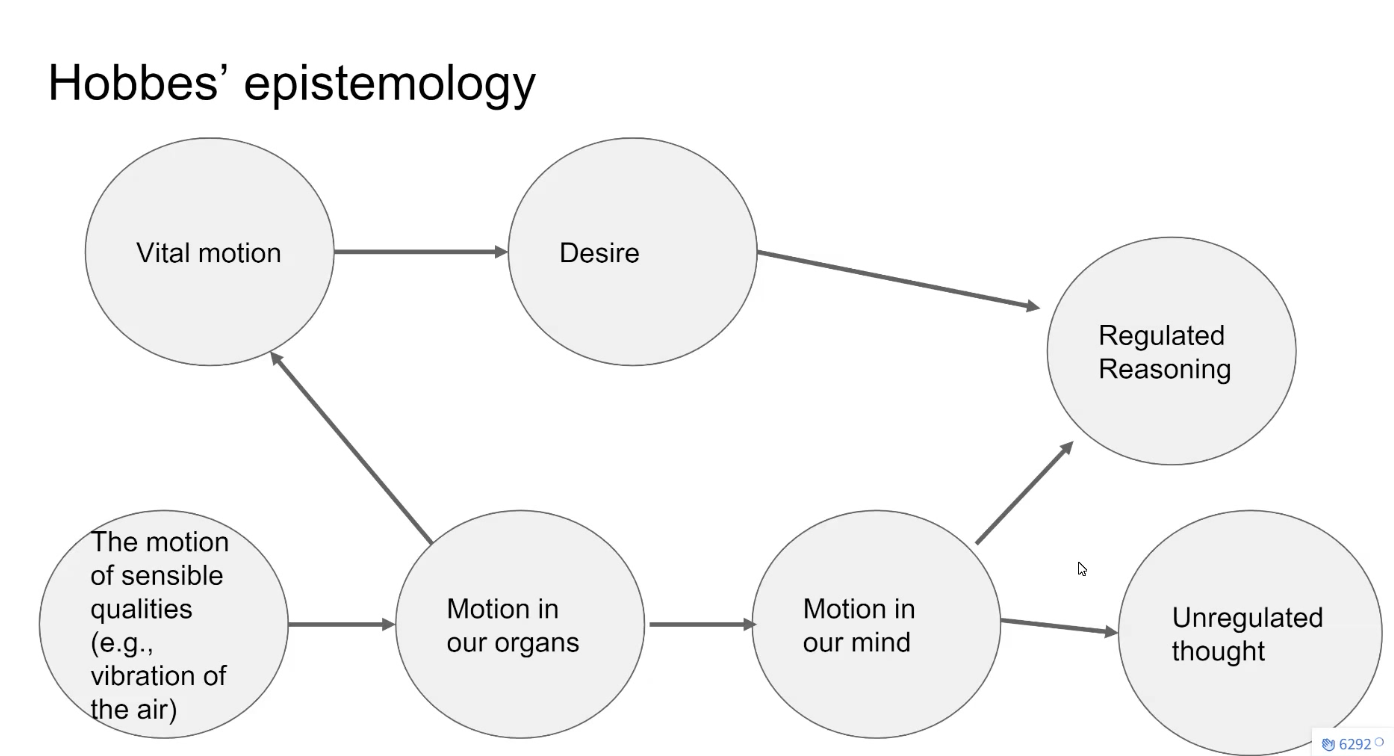
Some of our thought is disordered; it consists merely in unregulated successions of images left in our minds by sense impressions
Even when our thought is regulated, we do not perceive the “forms” or “universals” of things, but rather construct signs or placeholders for things; these signs are triggered in our brain whenever we have similar sense experiences
Because we do not create universals, there is no need to posit an active intellect. The role played by the active intellect in ordering experience is, for Hobbes, played by desire.
Hobbes on desire
Desire stems from our internal motion
When our internal vial motions (physical, emotional, etc) fail to operate well, we desire to improve their operation
When our internal motions are operating well, we desire to increase their activity and maintain good operation
Desire is just a motion directed to our mind or our limbs as a result of internal vital motion
Hobbes on desire and rationality
I desire to avoid pain (i.e., anything that hinders vital motion) and experience pleasure (i.e., anything that sparks or promotes vital motion).
Certain sense experiences are associated with pain or danger of pain, and certain experiences are associated with pleasure
By creating signs o stand in for the sense of experiences, my mind helps me recognize sources of pain and pleasure.
Hobbes on free will
From this picture of epistemology, it follows that there is no such thing as free will
All thinking, reasoning, emotion, etc, is just the outcome of material things operating according to immutable natural laws
I no more “choose” the thoughts in my head than the earth “chooses” to rotate the sun
The irrevelence of ethics to human life
Augustine, remember, bases the entirety of morality on the faculty of the free will:
When we freely choose higher things over lower things, we act ethically
When we freely choose lower things over higher things, we act wrongly
Aquinas also bases morality on the notion that humans have free will:
Humans are rational and can therefore freely choose to act according to their nature to against it. When they act according to their nature, they act well, when they act against it, they act wrongly.
But for Hobbes, humans can’t act against nature. They can’t be said to have any choice in how they act at all. Ethics, in the Medival Christian sense of the term, simply has no meaning whatsoever.
This is huge: in a sense, for Augustine/Aquinas, “the good” in some sense is the only thing that causes humans to act. How does Hobbes fill this gap?
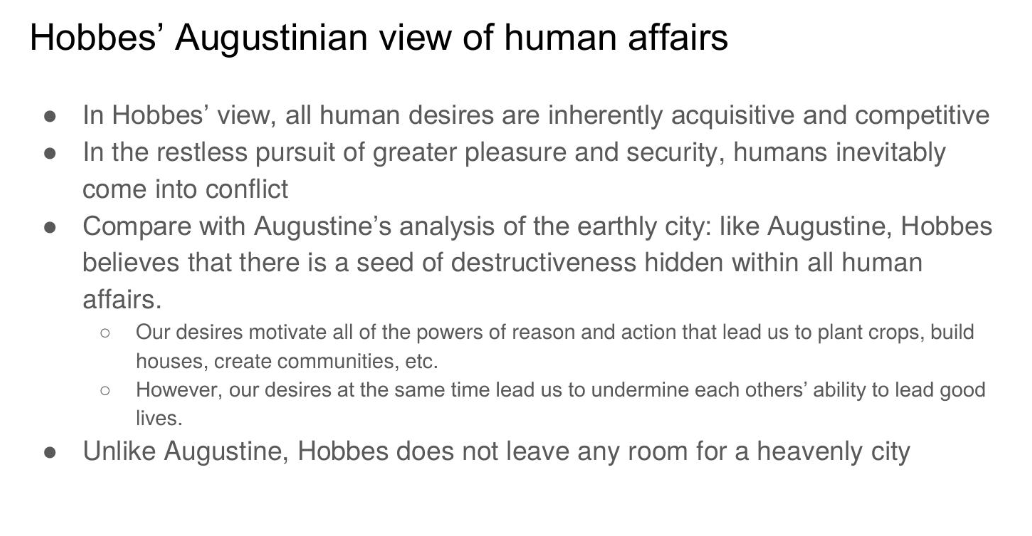
Pleasure and power as the drivers of human action
Humans reason and act only from desire for pleasure or fear of pain
All action, ultimately is egotistic
Even supposedly generous action has to be interpreted in. this way; we act generously because it feels good to do so or because we would feel bad if we didn’t
But pleasure is not a satisfying good
The moment we achieve some object of desire, we begin to want something else, or we begin to fear that our object will be taken away
In order to achieve more permanent satisfaction of pleasure and protection from pain, humans seek power over their environment and over other humans
no need to bring in the hypothesis of free will when we could use the operation of desire.
Think
“this hurt I don’t want to do it”
“oops other option hurts more so I do option 1”