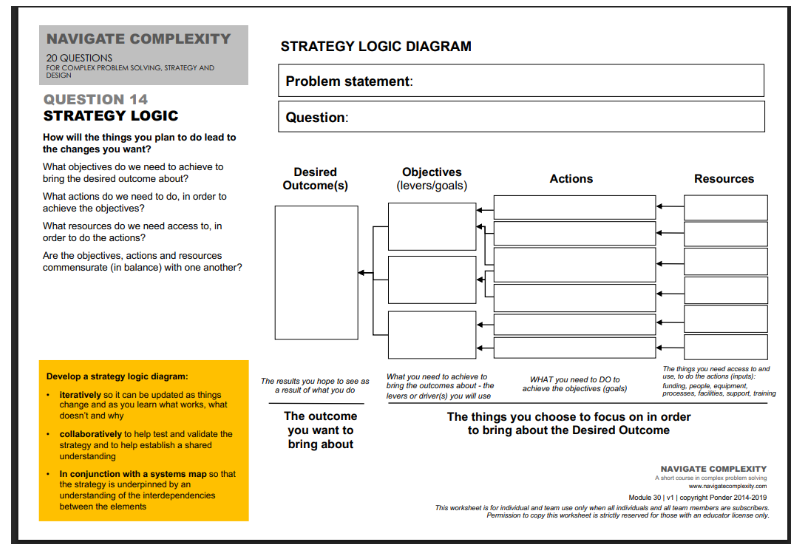
Strategy Logic and the Strategy Logic Diagram: Strategy Logic Diagram - Module 30
Overview of Strategy Logic
Foundational Premise: Based on Cartwright and Hardy's book on Evidence Based Policy, the most critical element of any strategy or policy is a deep understanding of how and why you believe it will work.
The Importance of "How" and "Why": Expanding on the original text, there are significant benefits to understanding the internal logic of a strategy: - Ease of Explanation: If the mechanics are understood, the strategy is easier to communicate to stakeholders. - Feedback and Testing: Understanding the logic allows for better feedback, enabling the diagnosis of flaws and subsequent improvements during the design phase. - Real-World Monitoring: Once implemented, logic helps identify which specific parts are working (allowing for replication elsewhere) and which are failing (allowing for specific adjustments). - Persuasion and Defense: A sound understanding provides a "case" for the idea, making it more compelling for building support and persuading others.
Question 14: The Mechanics of Strategy Logic
Core Question: "How will this strategy work? How will the things we plan to do bring about the outcomes we want?"
Definitions of Strategy Logic: This concept refers to how a solution is intended to work. It is known by several other names in various fields: - Policy Logic. - Program Logic. - Program Theory. - Theory of Change. - Theory of Action.
The Strategy Logic Diagram: This is a tool used to summarize how planned actions lead to desired outcomes on a single page. It is considered one of the most underused but high-value tools in strategy development.
Components of the Strategy Logic Diagram
The most useful version of this diagram consists of six interconnected parts:
The Problem or Opportunity: The core issue being grappled with (linked to Question 1).
The Question: Usually a reframing of the problem statement or desired outcome in interrogative form.
The Desired Outcome: The intended impact or end state; what will be different about the world if the work is successful.
The Objectives (Goals/Levers): The specific milestones that must be achieved to bring about the outcome. If the objectives are met, the desired outcome should result (contingent on good implementation).
The Actions: The concrete things that must be done to achieve the objectives (pulling the levers). Objectives without actions are merely "thought bubbles."
The Resources (Inputs): The necessary items to perform actions, including: - Funding. - People. - Facilities. - Tools and equipment.
Reading and Interpreting the Diagram
Directional Logic: - Left to Right (Objective-Driven): To bring the outcome about, we need these objectives; to achieve objectives, we need these actions; to do actions, we need these resources. - Right to Left (Resource-Driven): We need these resources to do these actions; we do these actions to achieve these objectives; we achieve objectives to realize the outcome.
Relationship Dynamics: A single action can contribute to multiple objectives, and multiple actions might be required for a single objective. Arrows indicate these contributions.
Ends, Ways, Means Model: This is a related model of strategy first introduced in the context of National Security in . - Ends: Desired outcome. - Ways: Objectives and actions. - Means: Resources.
Strategy as a Choice
Defining Strategy: Strategy is fundamentally a choice about how to use available resources to achieve a desired outcome. It comprises two sets of choices: 1. The Objectives that need to be met. 2. The Courses of Action chosen to meet those objectives.
Avoiding Conflation: It is common but counterproductive to confuse objectives with actions. People often agree on objectives while disagreeing on actions. Distinguishing them avoids muddying the waters and prolonging development.
Design vs. Wordsmithing: Teams often focus on writing long, discursive papers or choosing graphics and color schemes (the "glossy document"). The Strategy Logic Diagram keeps the focus on the actual design of how the strategy works rather than the writing style.
Case Studies in Strategy Logic
Hospital Medication Errors
Problem: High number of mistakes in medicine dispensing.
Outcome: Lower number of mistakes.
Objective Choice: Based on systems analysis identifying interruptions as the main driver, the chosen objective was to reduce the number of times nurses were interrupted.
Action Choice: Nurses wear a high-vis vest while dispensing medicines as a visual "do not disturb" indicator.
Resources: High-vis vests, funding for purchase, and storage space.
Childhood Malnutrition in Myanmar (Burma)
Problem: Childhood malnutrition.
Observation: Children were expending high levels of daily calories carrying heavy water buckets to rice paddies.
Objective: Reduce children's daily calorie expenditure.
Action: Introduce simple water pumps to communities for water distribution.
Resources: Pumps, distribution channels, and funding.
Childhood Malnutrition in Vietnam
Desired Outcome: Improve the health of children within months in a scalable way.
Strategy: Implementation of specific objectives and associated actions informed by system mapping.
Resources: Soap, clean water, volunteers, and nets/cans to catch shrimp and crabs.
Systems Analysis vs. Strategy Logic
The Tool Combination: Systems maps and strategy logic diagrams are best used together. - Systems Map: Holistic, non-linear, and detailed. Excellent for design but often seen as "spaghetti" by those not involved in the process; thus, it is a difficult communication tool. - Strategy Logic Diagram: Linear and simplified. Excellent for communication and distilling information into a format people can cope with.
The Difference Between System and Strategy: - System: The interacting parts that produce a current (often problematic) outcome. - Strategy: The specific choice made to redesign the system structure/behavior to produce a better outcome.
Feedback Loop: The system informs the strategy, the strategy changes the system, and that updated system informs the next iteration of the strategy.
The "Stool" Metaphor and Resource Alignment
Commensurate Elements: Outcomes, objectives, actions, and resources must be balanced. As Thomas Friedman stated, "A vision without resources is a hallucination."
Art Liqueurs' Military Model: Strategy is envisioned as a seat (Outcome) supported by three legs (Objectives, Actions, Resources). - If one leg is shorter (e.g., ambitious objectives but low resources), the stool sits at an angle. - The greater the angle, the higher the risk the strategy will "fall over."
Role of Funding: Funding is just one leg (a resource). It is necessary to prevent the stool from falling, but it is not the strategy itself.
Practical Implementation and Traffic Light Evaluation
Collaboration and Buy-In: Diagrams should be developed collaboratively to build agreement one level at a time (Outcome -> Objectives -> Actions).
Monitoring Progress: Traffic lights can be used during implementation: - Green: On track or complete. - Amber: Behind schedule or experiencing challenges. - Red: Significantly behind or major issues.
Scenario Analysis using Traffic Lights: - Incomplete Action (Red): If a late action is red and the outcome is not met, that specific action is likely holding up the strategy. - Redundant Action: If an action is red/not done but objectives and outcomes are green, that action might not be necessary, presenting a resource-saving opportunity. - Strategy Failure vs. Time Lag: If all actions/objectives are green but the outcome is red: 1. The logic of the strategy might be fundamentally flawed. 2. Time Factor: Complex challenges often require time to resolve; the strategy may be good, but outcomes have not yet eventuated.
Strategic Iteration and Evolution
Living Documents: Strategies should not be static five-year plans. They must be dynamic activities updated as understanding of the challenge evolves.
Team Integration: - The Design Team must stay involved during implementation to update the logic. - The Evaluation Team must work closely with designers so that findings about what works can be fed back into the strategy design seamlessly.
Next Steps: Question will address the specific evidence for "why" a strategy is expected to work and the rationale for choosing specific objectives over others.
Random diagram