Kingdom Plantae – Bryophytes, Vascular and Seedless Vascular Plants
Phylogeny and Ancestry of Life
All extant organisms trace back to a single “Common Ancestor of All Life.”
Three Domains recognised
Domain Bacteria
Domain Archaea
Domain Eukarya
Plants
Animal
Fungi
A branch point leading to multiple lineages is a polytomy—an unresolved divergence pattern.
Kingdom Plantae – Core Features
Eukaryotic,
multicellular
photosynthetic
cellulose cell walls.
*These organisms are characterized by their ability to adapt to terrestrial environments, which includes the development of structures like roots, stems, and leaves that facilitate nutrient absorption and gas exchange. *
Chloroplasts house photosynthetic machinery (from cyanobacterial endosymbiosis).
Adapted to terrestrial life: cuticle, stomata, protected embryos, alternation of generations, spores/seeds.
Two broad structural grades
Non-vascular (bryophytes)
Vascular (pteridophytes, gymnosperms, angiosperms)
Fossil evidence: land plants present by (Ordovician).
Four Major Extant Land-plant Groups & Key Innovations
Bryophytes (mosses, liverworts, hornworts) – non-vascular.
Pteridophytes (lycophytes, ferns, horsetails, whisk ferns) – seedless vascular.
Gymnosperms (conifers & allies) – naked seeds.
Angiosperms – flowers & enclosed seeds.
Seed Evolution & Significance
Seed = embryo + nutritive tissue + protective coat.
Appeared (late Devonian) giving rise to gymnosperms then angiosperms.
Allowed reproduction away from water & dormancy during unfavourable periods.
Flower & Angiosperm Radiation
Flowers first appear early Cretaceous .
Ovary encloses ovules → fruit; drives co-evolution with pollinators & dispersers
.
Angiosperms now dominant plant group
Fundamental Life-cycle Pattern: Alternation of Generations
Two multicellular stages alternate:
Gametophyte (n) → produces gametes by mitosis.
Sporophyte (2n) → produces spores by meiosis.
In bryophytes, the gametophyte stage is dominant, appearing as the primary photosynthetic plant.
The sporophyte in bryophytes is smaller and remains dependent on the gametophyte for nutrition.
For seedless vascular plants like ferns, both the sporophyte (the recognizable leafy plant) and the gametophyte (often a small, heart-shaped structure that produces gametes) are distinct phases
In vascular plants, the sporophyte stage is dominant, featuring larger, complex structures capable of independent photosynthesis.
Bryophytes (Mosses, Liverworts, Hornworts): Taxonomy, Distribution, and Lifecycle
Three phyla diverged early; not monophyletic collectively.
Hepatophyta (liverworts)
Anthocerophyta (hornworts)
Bryophyta (mosses) – closest bryophyte group to vascular plants.
Prevalent vegetation for first years after land colonisation.
Australian richness and distribution:
Liverworts spp (≈ endemic)
Hornworts spp (≈ endemic)
Mosses spp (≈ endemic)
Bryophyte Life-Cycle Specifics (e.g., Moss):
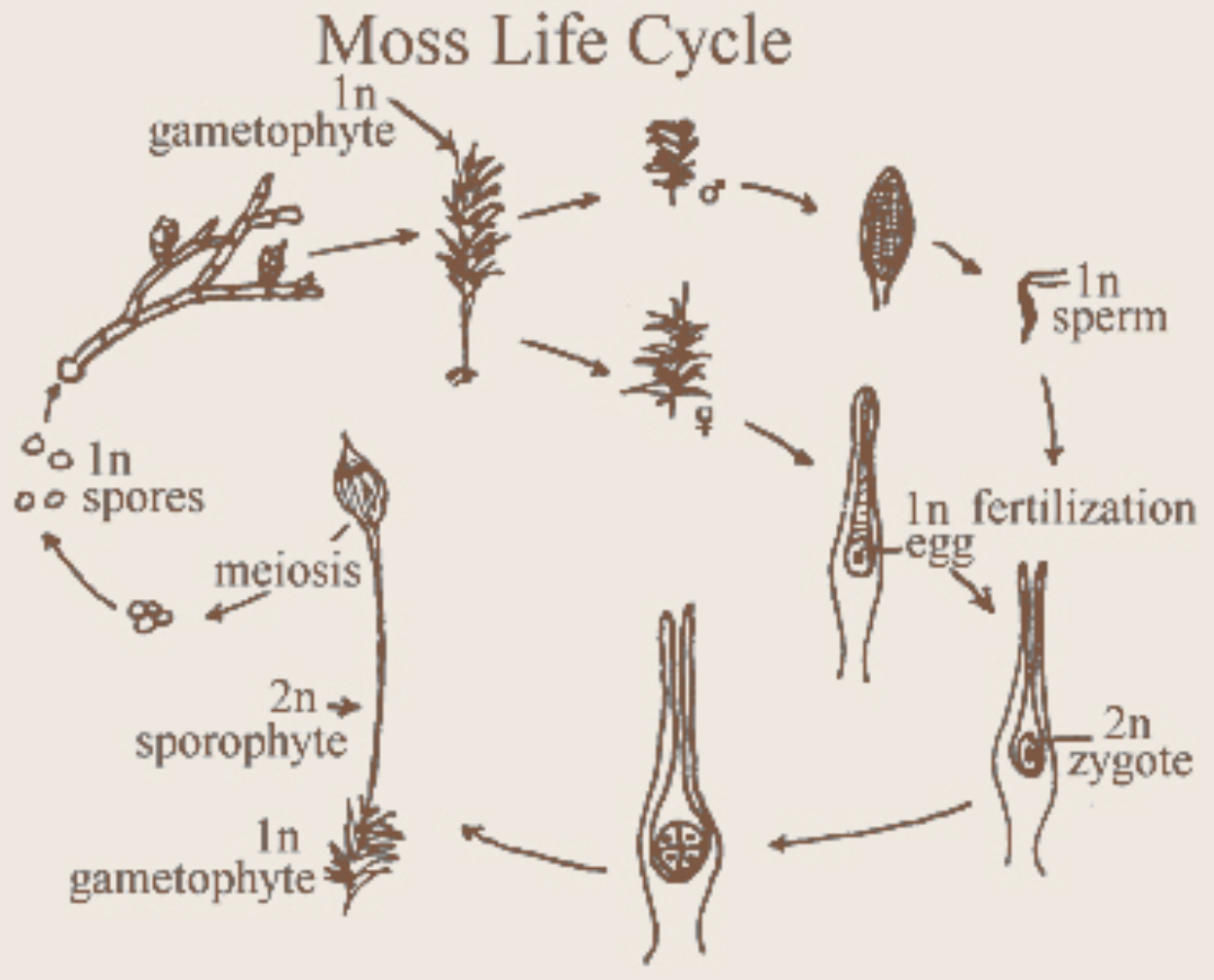
Dominant gametophyte (primary photosynthetic plant); sporophyte small & transient, dependent on gametophyte.
Spore germinates into a protonema (filamentous stage).
Protonema develops into meristems, which then grow into gametophores (the leafy structures).
Sex organs: antheridia (produce sperm) and archegonia (produce eggs) form on the gametophyte.
Fertilised egg is retained within the archegonium.
Zygote develops into a sporophyte (consisting of a seta and capsule), which remains dependent on the gametophyte for nutrition.
Spores are produced by meiosis within the capsule and are typically wind-dispersed.
Structural & Physiological Notes:
One-cell-thick tissues keep cells near water/minerals.
Absence of lignin limits height (few cm).
Rhizoids for anchorage not absorption.
Hornwort & liverwort gametophytes often thalloid (flattened).
Ecological Role of Mosses (Sphagnum):
Form peatlands (≈ land area) storing ≈ global soil carbon.
Evolution of Vascular Plants
Earth’s surface lifeless for first years; land cyanobacteria by . First small terrestrial plants, fungi, animals ≈ .
Timeline of Major Evolutionary Innovations:
Origin of land plants (Ordovician).
Development of vascular tissue .
Evolution of seeds (late Devonian).
Appearance of flowers (early Cretaceous).
Vascular Adaptations (leading to vertical growth and independence):
Lignified xylem (water/mineral transport upward) & phloem (bidirectional sugar/organic transport).
Roots (anchorage, absorption) derived from subterranean stems.
Leaves (microphylls vs megaphylls) increasing photosynthetic area.
Sporophyte dominance and independence.
Increased height for spore/seed dispersal and light competition.
Shift in Generational Dominance (Evolutionary Trend):
a) Bryophytes – sporophyte fully dependent on gametophyte.
b) Ferns – independent sporophyte; small, freeliving gametophyte.
c) Seed plants – microscopic gametophyte dependent on sporophyte.
Ferns and Allies (Pteridophytes): Characteristics, Lifecycle, and Significance
Two extant phyla:
Lycophyta – club mosses, spike mosses, quillworts.
Pterophyta – ferns, whisk ferns (Psilotum), horsetails (Equisetum).
Modern forms descended from multiple early vascular lineages; seedless.
Sporophyte-Dominant Fern Life-Cycle (e.g., Ferns):
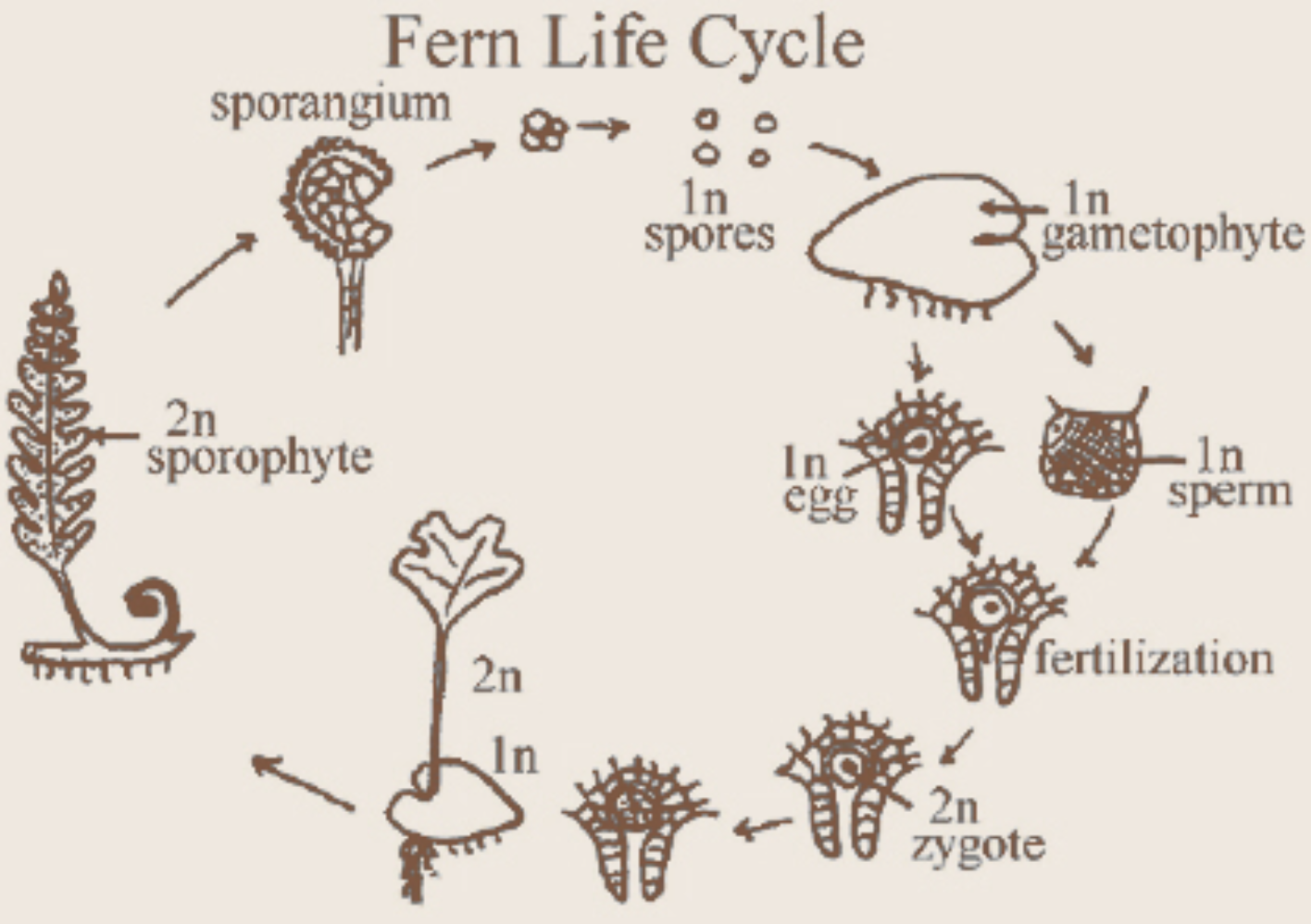
Sporangia (found in sori on the underside of fronds) undergo meiosis to produce haploid spores .
Spore germinates, developing into a small, bisexual gametophyte (prothallus).
The prothallus forms antheridia (producing sperm) and archegonia (producing eggs).
Sperm swim via water to fertilize the egg.
The resulting zygote develops into a new sporophyte, which initially grows from the prothallus.
The mature sporophyte becomes independent (the recognizable leafy plant), and the gametophyte disintegrates.
Fern Morphology & Identification:
Frond parts: stipe (petiole), rachis, pinnae, pinnules; crozier/fiddlehead = circinate vernation.
Identification relies on venation patterns (free vs anastomosing), indusia shapes (cup, linear, false), leaf margins (entire, serrate, crenate), and presence of scales/hairs.
Cultural References to Ferns:
“Silver fern” (Cyathea dealbata) is an emblem of New Zealand, appearing on its national coat of arms & Air NZ logo.
Fiddleheads are used as edible greens (caution: some species are carcinogenic).
Fern Diversity & Ecology:
>12,000 species globally; centres of diversity in tropics, also temperate & arid zones.
Growth typically from rhizomes; megaphyllous fronds often highly dissected.
Sporangia possess an annulus – a spring mechanism for ejecting spores metres away.
Australian Ferns & Allies Snapshot (Examples and Locations):
native species (≈ endemic), plus naturalised.
Hotspots: Wet Tropics ( spp), Border Ranges (), Sydney (), Tasmania ().
Examples:
Tree ferns: Cyathea cooperi.
Epiphytes: Elk horn (Platycerium bifurcatum), Staghorn (P. superbum).
Weedy natives: Bracken (Pteridium esculentum), Fishbone fern (Nephrolepis cordifolia).
Indoor ornamentals: Maidenhair (Adiantum spp.), Bird’s Nest (Asplenium australasicum).
Whisk fern Psilotum nudum found in dry Eucalyptus forests.
Horsetails (Equisetum) are non-native, invasive & toxic to livestock; high silica content once used for scouring pots.
Global and Ecological Impact of Early Vascular Forests:
Devonian/Carboniferous lycophytes, horsetails, ferns formed first tall forests.
Massive drawdown via photosynthesis likely triggered global cooling.
Burial of lignin-rich biomass produced coal; burning coal today returns that carbon, driving climate change.
Modern Plant Diversity & Habitats
>280,000 described species (most terrestrial; some secondarily aquatic like sea-grasses).
Occupy deserts, grasslands, forests, alpine zones, and coastal/marine shallows.
All land plants derived from a green-algal ancestor.
Global vs Australian Species Numbers
Flowering plants: World ; Australia (≈ of world, endemic, threatened).
Gymnosperms: World ; Australia (≈ endemic).
Ferns & allies: World ; Australia (≈ endemic, threatened).
Liverworts, hornworts, mosses likewise show high endemism.