Reaction time
Psychophysiological Research Notes
Key Distinctions
Subjective Variables: can be assessed only via self-report.
Can only be evaluated through self-report methods (e.g., questionnaires, visual analogue scales).
Reflect personal experiences that cannot be externally observed.
Sensitive to biases (e.g., demand characteristics, participant motivation).
Many subconscious brain processes cannot be assessed via self-reports.
Objective Variables: can be measured with various devices.
Providing quantifiable data.
Allow for simultaneous assessment with subjective variables for comprehensive insights.
Objective Measurements
Reaction Time (RT):
Participants respond to stimuli (visual/auditory) as quickly as possible, measuring their performance in milliseconds.
Speed of sensing and processing input and motor response organization.
Average RT is approximately 160 ms for auditory and 190 ms for visual stimuli in ideal conditions; visual RT can increase with age.
Males generally perform slightly better (10-20 ms faster) than females.
Effects of Stimulus Pattern on RT
Fixed Interval vs. Random Interval:
Fixed intervals reduce average RT indicating the role of predictability in sensory processing.
Complexity of Response
Complex Decisions:
More complex tasks (e.g., identifying specific stimuli in a series) result in longer RTs.
Examples:
Conner’s Continuous Performance Test: Respond to most stimuli except a designated one (e.g., letter X).
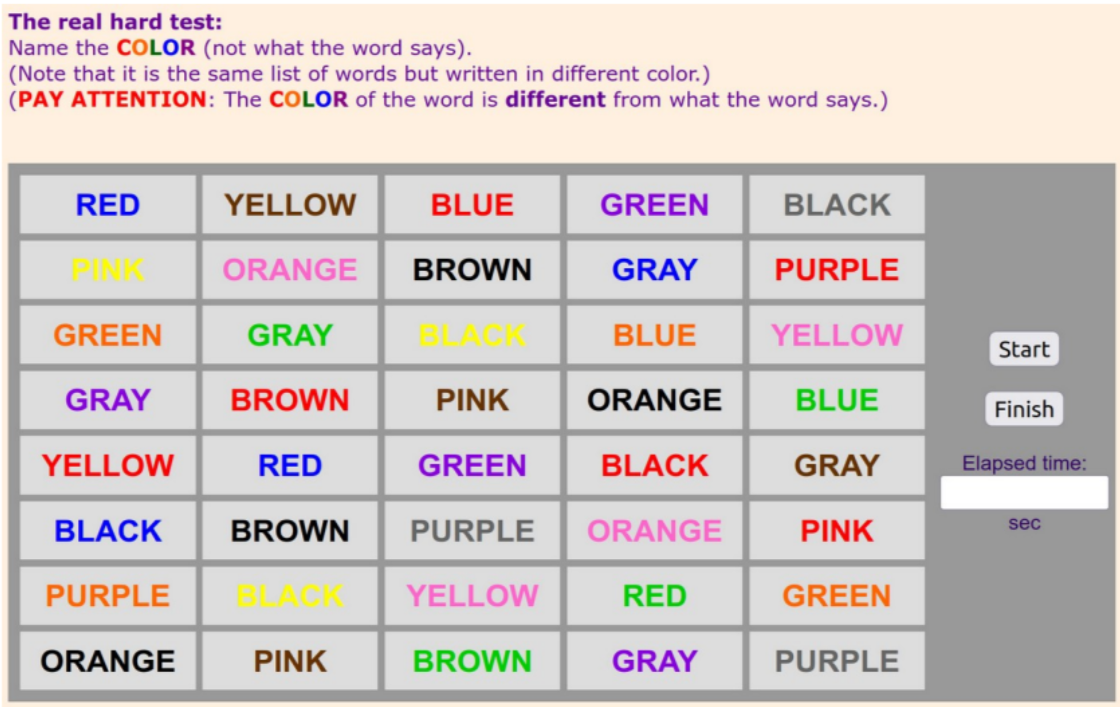
Stroop Test: Measures processing delay due to incongruence between color names and the color of letters (e.g., naming the color of 'red' written in 'blue').
Emotional/Affective Evaluation
Negative feelings can increase RT (e.g., Carl Gustav Jung's experiments).
Implicit Association Test (IAT) measures increased RT as an indication of needing to inhibit default responses.
Advantages of RT Measurements
Flexible and widely applicable in exploring human information processing.
No complex machinery needed; many tasks can be completed online and easily.