Species
What is a species
Biological species concept
A species is a population or a group of populations whose members have the potential to interbreed in nature and produce viable, fertile offspring
Criteria: potential reproduction
Problems
Key — genetic isolation, impractical/impossible to speculate about interbreeding or conduct breeding experiments for all species
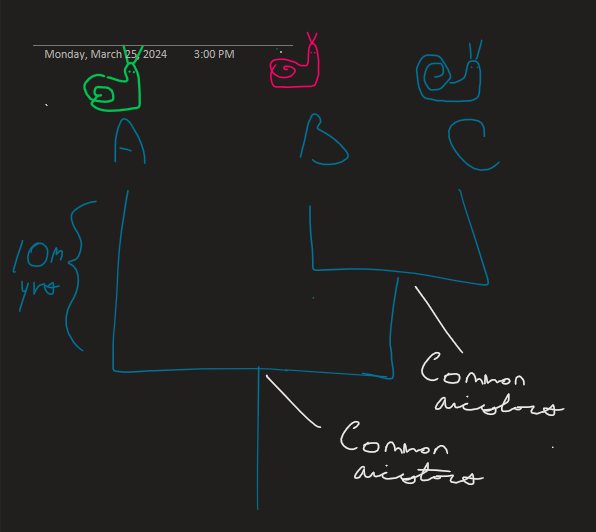 A & B cannot mate, B & C cannot mate
A & C can mate
Prezygotic isolation
Prezygotic barriers to fertilization between two species
Habitat isolation (ex. animal species in the desert opposed to other habitats)
Temporal isolation (ex. diurnal/nocturnal creatures)
Behavioral isolation (ex. morphological incompatibility)
Mechanical isolation
Gametic isolation
Postzygotic isolation
Postzygotic barriers between two species
Donkey x mule = sterile mule
Reduced hybrid viability
Reduced hybrid fertility
Hybrid breakdown
does reproduction isolation cause speciation
No, reproductive isolation & speciation are a by-product of genetic changes that occur during changes of populations for other reason
What drives speciation?
Genetic drift/mutation
Unifying theme of biology
Theodosius Dobzhansky “nothing in biology makes sense except in the light of evolution”
Nictitating membrane—vestigial in humans, useful to sharks & cats
What is evolution?
The unifying theme to explain the diversity of life on Earth
All species have descended—with modifications—from one/few common ancestors through the process of natural selection
Descent with modification
Evolution only occurs when there is a change in gene frequency within a population (group of organisms in the same species) over time
These genetic differences are heritable and can be passed on to next gen
Industrial revolution & Kettlewell’s Moth study—birds eat moths that are more conspicuous on trees
Soot from industrial pollution had turned trees sooty black—frequency of dark-colored moths increase by 95%
Modes of speciation
Allopatric speciation by variance — barrier removed or new species disperse oer it, re-establishing sympatry
Peripatric speciation—range expansion re-establishes sympatry
Parapatric speciation—range expansion leads too sympatry (different habitats right next to each other)
Sympatric speciation—genetic differences result in reproductive isolation
Allopatric speciation
Allopatric speciation: evolution of genetic reproductive barriers between populations that are geographically separated by a physical barrier
Most prevalent mode of speciation in animals
Populations that begin speciation process in allopatry come back into contact, and either interbreed freely at hybrid zones, or not at all
Clades: monophyletic groups
Freshwater fish speciation—western clades and eastern clades in spotted sunfish, warmouth sunfish, gluegill sunfish, redear sunfish, bowfin, mosquitofish
diverged 3-4 million years ago when sea level was higher, creating a barrier to gene flow
 Homology: a character state shared by taxa without modification for a common ancestor
Characters can be morphological (shape of wing, number of bones); behavioral, biochemical, or involve DNA sequence data
Different forms of a character are character states
Homoplasy: a character state that has independently evolved two or more times, or similarity that is NOT from common ancestry (often convergent evolution)
Autapomorphy: derived character state present in a single lineage
ex. lack of strips in automorphy
Plesiomophy: ancestral character state (ex. gelatinous eggs)
Synapamorphy: homologous character state that supports the monophyly of a group through common ancestry (ex. amniotic eggs)
Genetic changes in closely related species
Small changes in sequences such as base changes and small deletions
Duplications of genes and DNA
rearrangements on all scalesAcquisition of foreign DNA and genes
Loss of DNA and genes
Maximum parsimony: All mutations are considered equally likely
Long-branch attraction: Species with many autapomorphies will be chosen as sister groups, when in reality they are not
Model-based analyses
Transition mutations occur at a higher frequency than transversion
Maximum likelihood assigns probabilities of character change to each state and then calculates the likelihood of any potential of any potential phylogenetic tree, using complex models
Likelihood asks: what is the probability of the data, given the preferred
How we know this works: Mutagen used to mimic speciation in viruses, scientists could document mutation changes and “cladogenesis” events, phylogenetic analysis produced one true tree
Molecular clocks
Concept: DNA sequences mutate at a constant rate, so it is possible to correlate # of mutational changes to a node in a phylogenetic tree, this estimating the date of speciation
molecular clock estimates can be calibrated w/ fossils, by providing a minimal estimate of time since divergence
Problems: distantly rated taxa and different genes rarely have similar mutation rates, creating issues for molecular clocks. Fossils used in calibrations have inexact ages, making clock estimates inexact also