A Modern View of the Universe
Two Philosophical Views of Space and Time
NEWTON
Space and Time are continuous, smooth (flat), and endless
Space and time were absolute- unchanging no mater which or what matter and energy occurred
It is an absolute pre-existing container
All matter, energy, and information (including all of us and all of our wisdom) are contained in this container
LEIBNITZ
The is a succession of events, rather than an absolute entity
there is no absolute time
Space is not a real entity itself but an abstract, relational concept. it’s existence and properties were derived from the relationships between real objectsand their properties
Space does not exist without real objects
If all physical objects ceased to exist, so too would space and time
RELATIVITY THEORY
Einstein’s theory
Most physic theories were based on Newton’s ideas
Special Relativity, a theory focused on objects moving at constant speeds—particularly speeds close to the speed of light.
The laws of physics are the same for all observers, no matter how fast they’re moving, as long as they’re not accelerating.
The speed of light in a vacuum is constant for all observers, regardless of their motion.
Time and space themselves must stretch or contract depending on your motion.
General Theory of Relativity, deals with gravity and accelerated motion.
General Relativity offered a completely new view of gravity—not as a force, as Newton thought, but as a curvature of spacetime caused by mass and energy.
Special and general relativity have profoundly affected physical science and human existence
Relativity and its rethinking of the fundamental categories of space and time have provided a basis for certain philosophical, social, and artistic interpretations that have influenced human culture in different ways.
Feature | Leibniz’s Relationalism | Newton’s Substantivalism |
Space | An order of coexisting objects. Space does not exist independently of the matter within it; it is simply the relationships between objects | An empty, absolute, and independent container that exists even without matter inside it. All objects are situated within this pre-existing entity. |
Time | An order of successive events. Time does not flow independently, but is a record of the succession of changes in events. | Absolute time flows uniformly without relation to anything external. |
Motion | Inherently relative. The “true” motion of a body is defined only by its relative change in position compared to other bodies | Can be absolute. An object’s true motion is defined by its movement through absolute, unmoving space. |
Principle of Sufficient Reason | Used to argue against absolute space. Leibniz asked: Why would God have created the universe at one specific location in absolute space over another, if all locations are identical? A sufficient reason for this choice cannot exist. | Rejects this argument. The existence of absolute space is a metaphysical reality independent of a creator’s arbitrary choice. |
Principle of Sufficient Reason → everything must have a reason or cause for its existence or occurrence; no fact can be real or true without a sufficient explanation for why it is so.
Our Cosmic Address
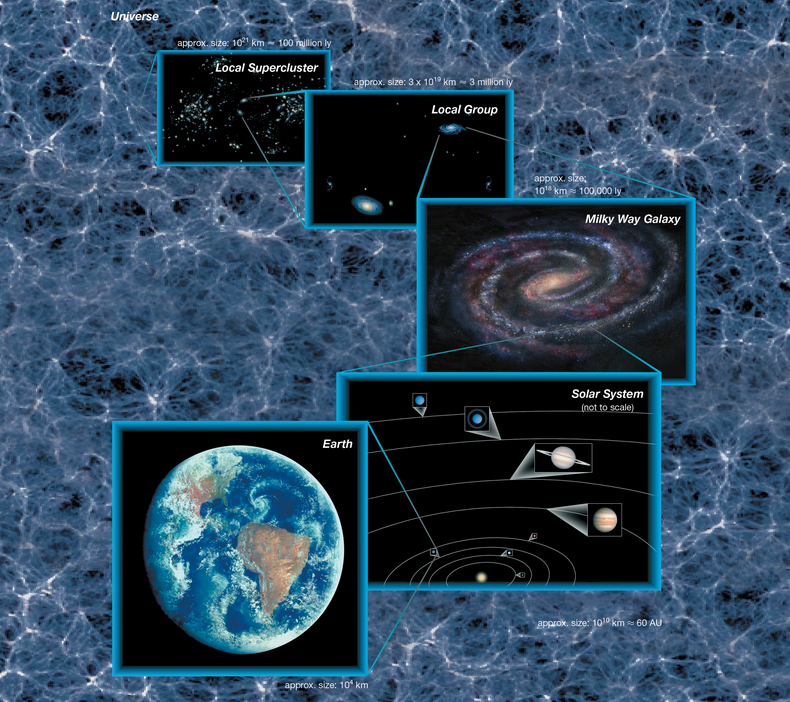
Universe (cosmos) → the sum total of all matter and energy—that is, all galaxies and everything between them.
Observably Universe → the sum total of all matter and energy—that is, all galaxies and everything between them.
Super-clusters → The regions in which galaxies and galaxy clusters are most tightly packed
Galaxy Clusters → A collection of a few dozen or more galaxies bound together by gravity; smaller collections of galaxies are simply called groups.
Local Group → The group of about 40 galaxies to which the Milky Way Galaxy belongs.
The Milky Way Galaxy → a great island of stars in space, all held together by gravity and orbiting a common center.
contains more than 100 billion stars
one of the two largest among more than 50 galaxies (most relatively small) in the Local Group
Solar System → consists of the the Sun, the planets and their moons, and other smaller objects (e.g., asteroids and comets)
located a little over halfway from the galactic center to the edge of the galactic disk.
Planetary System/Star System → a star (sometimes more than one star) and any planets and other materials that orbit it.
Star → a large, glowing ball of gas that generates heat and light through nuclear fusion ; stars form the fundamental building blocks of galaxies and can vary significantly in size, temperature, and brightness, playing a crucial role in the cosmic ecosystem.'
Moon (Satellite) → an object that orbits a planet. Moons can vary in size and composition, with some hosting atmospheres or even potential signs of life, and they influence the gravitational forces and tides of their respective planets.
Asteroid → a relatively small and rocky object that orbits a star. Asteroids can range from a few meters to hundreds of kilometers in diameter, and their orbits can often be found in the asteroid belt between Mars and Jupiter, where they are thought to be remnants from the early solar system.
Comet → a relatively small and icy object that orbits a star. Comets are characterized by their distinctive tails, which develop when they approach the sun and their icy nuclei begin to sublimate, releasing gas and dust into space.
Nebula → An interstellar cloud of gas and/or dust. It is often the birthplace of stars, where gravity pulls the material together to eventually form new stellar objects.

Cosmic Calculations
Cosmic calculations involve measuring distances, velocities, and the mass of galaxies to better understand the expansion of the universe and the distribution of dark matter.
Astronomical Unit (AU) → Earth’s average distance from the Sun
~150 million kilometers (93 million miles)
distance within the solar system
Light-Year (ly) → the distance that light can travel in 1 year
~10 trillion kilometers (6 trillion miles)
distance of stars and galaxies
a unit of distance, not time
light second = 300,000 kilometers
- light takes a little more than one second to reach the earth to the moon
- light takes about eight minuets to reach earth from the sun
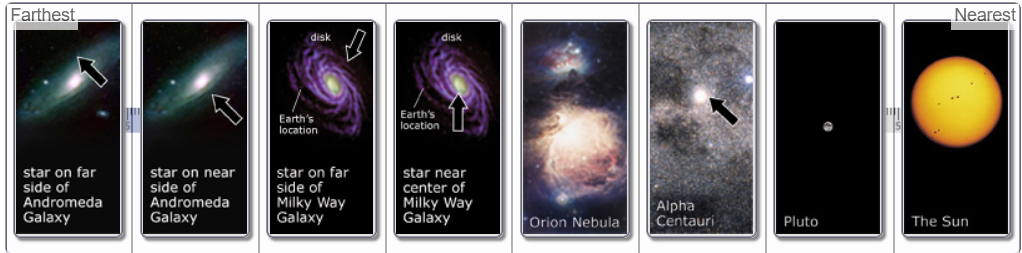
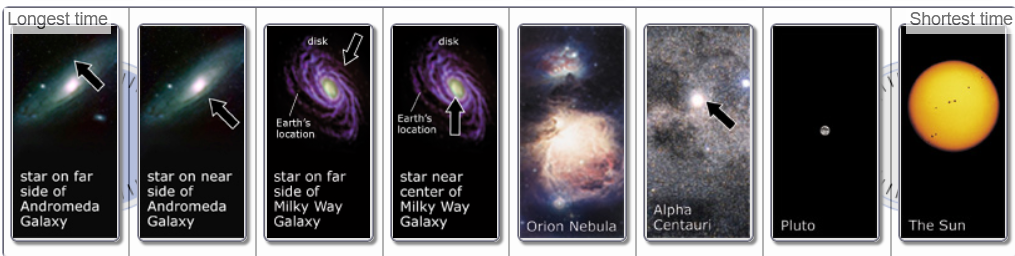
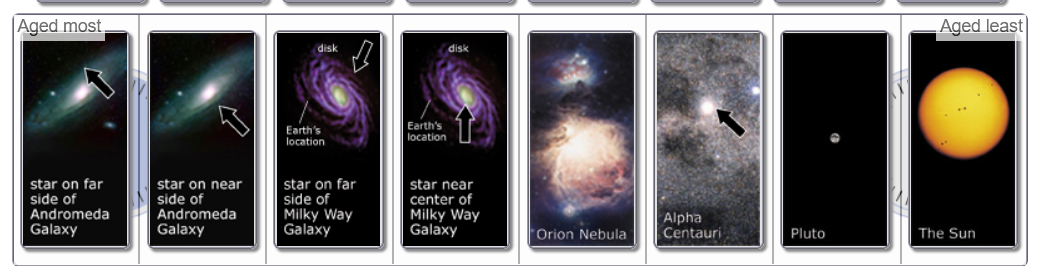
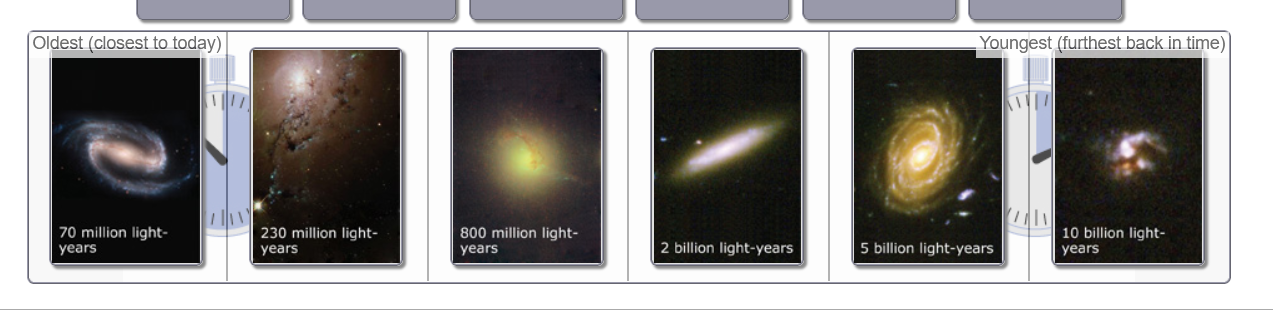
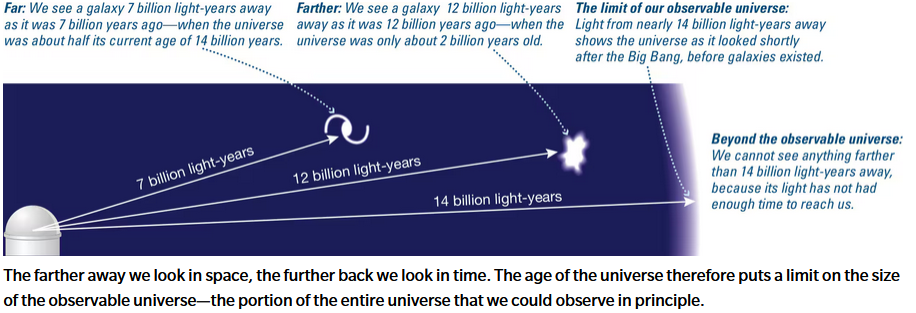
˙⋆✮ The farther away we look in distance, the further back we look in time.
when we look to very distant objects, we see them as they were long in the past, when the universe was much younger than it is today.
❊The distance to the Andromeda galaxy is about 2 ½ million light-years, which means light takes about 2 ½ million years to travel from the Andromeda galaxy to us.
◦ This implies that when we observe Andromeda, we are seeing it as it appeared 2 ½ million years ago, providing a unique glimpse into the early state of our universe.
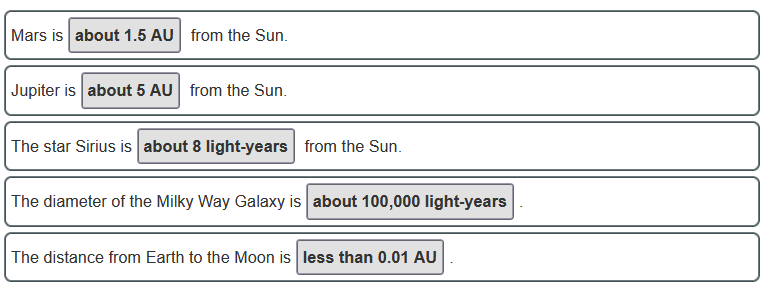
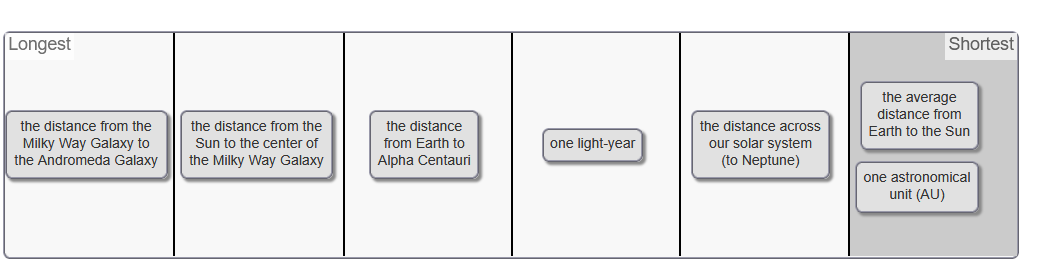
Earth to Moon = 1.29 light second
Earth to Sun = 8 light minuets
Earth to Mars = 12.7 light minuets
Earth to Proximal Centaun (nearest star) = 4.3 light years
Earth to the other side of the Milky Way Galaxy = 52.000 light years
The Observable Universe
˙⋆✮ The measured the age of the universe is about 14 billion years.
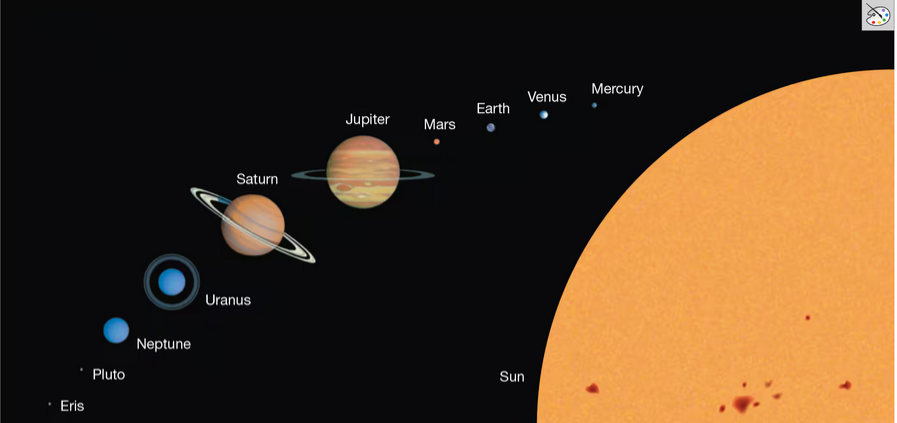
☾ On a scale in which the Sun is the size of a grapefruit, Earth is the size of the ballpoint in a pen, orbiting the Sun at a distance of 15 meters.
☾ In the billion galaxies and the billion stars in each galaxy, there is approximately 1022 billion stars in the universe which is equivalent to every grain of dry sand on every beach on Earth.
Diagrams