Hypothalamus, pituitary and thyroid function
Hypothalamus - an area at the base of the brain
Neurones send axons down from the hypothalamus
To from. The posterior pituitary, a neuroendicrine organ that releases the hormones oxytocin and vasopressin (ADH)
the posterior has a neuronal developmental origin as a down-growth from the diencephalon
Anterior pituitary = is ectodermal in origin - developmental origin as an up-growth of ectoderm from the primitive oral cavity
neurones in the hypothalamus will send axons to the median eminence
Neuropeptide hormones released at the median eminence enter the portal vessels
To control the release of hormones from the anterior pituitary
Secreted: - GH(growth hormone),
FSH - follicles simulating hormon
LH - leutinising hormone
ACTH - adrenocorticotrophic hormone
TSH - thyroid stimulating hormone
PL - prolactin
Hormones released from the anterior pituitary enter the venous drainage to reach their target tissues elsewhere in the body.
The main pituitary hormones and their actions
posterior
Neuronal , releases oxytocin and ADH
Anterior
Ectodermal - GH, FSH, LH, ACTH, TSH, PL - controls the release of hormones from other glands/ endocrine tissues
Hypothalamus and pituitary
Hypothalamus releases hormones to turn the anterior pituitary on or off. ON = RELEASING HORMONES, OFF= INHIBITNG HORMONES
releasing hormones
GHRH - growth hormone releasing hormone (cause GH to be released from the anterior pituitary)
CRH : corticotropin relasing hormone (stimulates release of ACTH)
TRH- Thyotropin rereleasing hormon (stimulate secretion of TSH)
GnRH - gonadotropin relasing hormone (stimulates release of LH, FSH)
Inhibitory hormones
SS: somatostatin (inhibits release of GH, TSH)
DA: dopamine - (stops release of PL - prolactin)
Anterior pituitary hormones: FSH/LH
Leutinising and follicle stimulating hormones
made in leuteotrophs - gonadotrophs
Released in response to hypothalamic GnRH
Control production of steroid hormones by the ovary - oestrogen and progesterone
Control production of steroid hormones by testis - testosterone
Gonadal steroid control sexual differentiation, behaviour and fertility
Loss of FSH/LH secretion
loss of function in children stops puberty
Extreme calorie deficit in adults - causes loss of reproductive function and loss of FSH/LH
Administration of GnRH, FSH/LH can be used to manipulate reproduction
Anterior pituitary : GH
Growth hormones
made in somatotrophs
Released in response to hypothalamic GHRH
Secretion is inhibited by hypothalamic SS
Direct anabolic effect in many tissues
Targets the liver to produce somatomedins (insulin like growth factor -1/ IGF-1)
Somatomedins stimulate growth in many tissues
Lack of GH
short statues, can be treated by GH (when young) - before growth plates fuse
Too much
giantism - if secreted through growth period
Acromegaly - if secreted after bones have fused - causes hands, feet and jaw to grow - due to usually a pituitary adenoma
Anterior pituitary hormone - PRL - Prolactain
made in mammotrophs
Released when inhibited by hypothalamic dopamine
Stimulates lactation in post-partum period
Anterior pituitary hormone : ACTH
produced and secreted by anterior pituitary gland
Released in response to hypothalamic CRH
Acts on the cortex of the adrenal gland to produce and release cortisol
Used as a medication (hydrocortisone) in hormone rppacement therapy and to suppress the body’s immune response
Anterior pituitary hormone - TSH
Thyroid stimulating horomr
made in throtrophs
Released in response to hypothalamic TRH
Acts on thyroid to generate Triiodothyronine (T3) and thyroxine(T4)
T3 , T4 regulat growth and development by multiple actions
Thyroid hormones and their actions
Thyroid anatomy
located in the anterior neck of the trachea, inferior to the larynx
Weighs 10-20g, 2 lobes connected by the isthmus
Highly vascular - main blood subtly from carotid and subclavian arteries
Thyroid structure and histology:
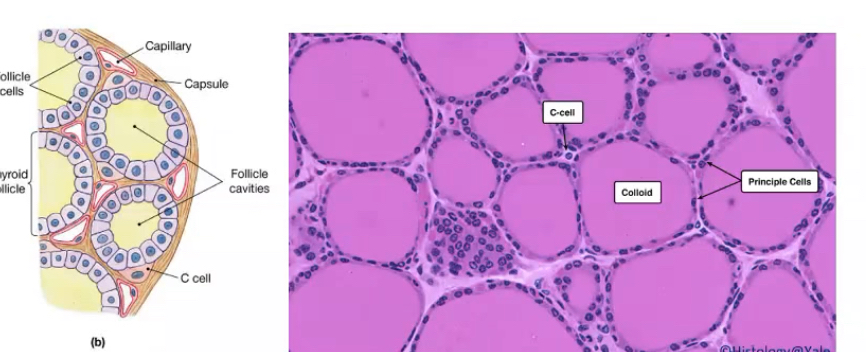
composed of hollow follicles - thyroid follicles
Lined by epithelial cells (principal cells) - responsible for the synthesis of thyroid hormones T3/T4
Filled with thyroid colloid - which stores T3/T4 before secretion :
C-cells -(clear cells, parafollicular cells)
Responsible for synthesis and secretion of calcitonin
Calcitonin regulates CA2+ homeostasis
What are thyroid hormones
amino acids from tyrosine
Iodine is essential for the synthesis of thyroid hormones
Generated fromiodination and coupling of tyrosine, hence the name TRI-IODOTHYRONNINE(T3) and Tetrea-iodothyronine(thyroxine/T4)
Synthesis and secretion of thyroid hormones
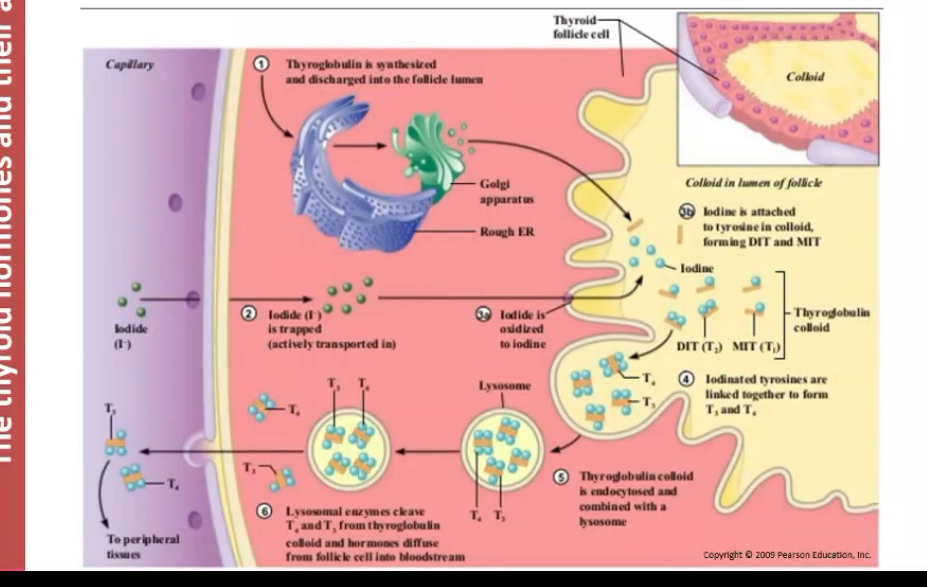
follicle (principal cells) make and secrete thyroglobulin into the colloid
At the sam time Iodide (I-) is absorbed from the blood into the follicle cells
Iodide is oxidised to iodine at the apical membrane, and released into the colloid
Iodide attaches to tyrosine, for one mono-iodotyrosine (MIT) or Di-iodotyrosine (DIT) which are incorporated into thyroglobulin (this is catalysed by thyroid peroxidase)
Tyrosine-iodide complexes joined together to form T4/T3
Colloid endocytosed and combines with lysosome
T3/T4 released into capillaries and bind to carrier proteins
Thyroid hormone actions
T4/T3 highly bound to serum protens( thyroid binding globulin -TGB) in the circulation less than 0.5% is present in the free form - biologically active
T4 - maybe a pro hormone, T3 is th most potent form (10x more active tan T4)
T3 is mainly produced by de-iodination of T4 within target cells outside the thyroid gland
Once released into circulation - thyroid hormones interact with DNA ad transcription factors and produce changes in gene transcription and protein synthesis
Thyroid receptor - TR/ THR
member of hormone responsive nuclear transcription factors
Consists of a DNA binding domain and a COOH-terminal domain (mediated ligand interactions and binding of coactivators and corepressors)
2 primary isoforms TR alpha and TR beta
TR forms a heterodimer complex with retinoids x receptor (RXR(
Once they form this receptor
TR-retinoids X receprtir (RXR)
bind to the thyroid response element TRE
Activation of TRE stimulates or inhibits gene transcription
Nuelcear receptor coregulators
co activators associate with liganfed nuclear receptors and enhance gene transcription
Compressors bind to unliganded preceptors and promote gene repression
Physiological effects of thyroid hormones
muscles - increase protein catabolism, increase glycogenolysis
Red blood cells - increase RBC formation - enhance oxygen delivery
CNS - increase growth and development of nervous system
Heart - increase heart rate and force contraction - blood pressure
Liver - increase gluconeogeneis, increase glycogenolysis
Bones - increase turnover of minerals, linear growth an maturation of bones
Hope is thyroid hormone secretion regulated
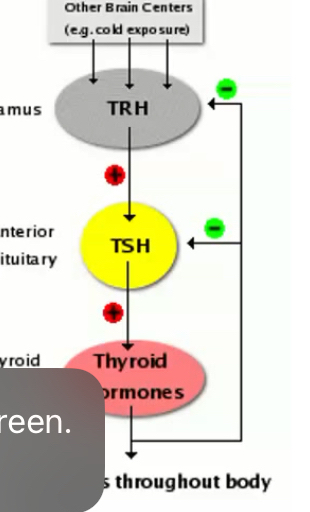
Classical negative feedback through the hypothalamic-pituitary-thyroid axis
Thyrotripin releasing hormone - TRH
Produced by hypothalamus
Down regulated by T4,T3
Stimulates TSH formation
Thyroid stimulating hormone - TSH
Produced by anterior pituitary
Upregulatef by TRH
Down regulated by T4,T3
Stimulates iodine uptake, colloid endocytosis, nume rand secretory activity, of thyroid cells, therefore secretion of T4,T3]
Thyroid gland disorders
underactive - hypothyroidism -
Due to thyroid failiure - from birth can do severe developmental abnormalities
Can be acquired later in life - lack of iodide in the diet - easily treated with sodium iodide in salt
Autoimmune - hashimotos thyroid it is - 1 in 1000 occurrence, 8-15x more in women’s and Middle Ages
Circulating antibodies against thyrod peroxidase and or thyroglobulin
Symptoms - bradycardia - reduced cardiac output
Cold intolerance - decreased BMR
Weight ain - decreased BMR
Reduction in ATP production
Slow mental processes - reduced stimulation of CNS
Slow reflexes
Muscle wasteing, hair loss, dry skin - decreased protein metabolism
Fatigue
Lack of T4/T3 means no inhibition of TSH release soo elevated TSH causes thyroid growth - goitres form - lack of negative feedback
Lab values -
Raised TSH, low T4
Precedes of anti-thyroid peroxidase antibody,/ anti-thyroglobulin antibody
Increased plasma cholesterol - effect of TH on lipid metabolism
Treatment
Oral thyroxine - levothyroxine - synthetic T4
Oral tri-iodothyronin - more potent but shorter duration
Start w low dose 25mcg/ day and slowly increase the dose every 3-4 weeks till TSH is normal
Hyperthyroidims
Graves’ disease
Most common form
Autoimmune disease with antibodies that stimulate the thyroid to secrete T3/T4 agonist antibody
Antibody binds to TSH receptor causes excess T3/T4
Symptoms
high metabolic rate, weight loss, heat sensitivity
Increased cardiac activity
Hyperactive nervous system, tremor, anxiety
Exopthalamus
Treatment
carbimazole or propylthiouracil - inhibit thyroid peroxidase, and decrease thyroid hormone synthesis
Propylthiouracil - prevents conversion of T4-T3
Partial ablation of the thyroid with surgery or radioactive iodin)(only used if carbimazole has not been effective)
B-blocker to counter cardiac effects