10-24-25 Energy Dissipation, Power
Energy Dissipation
Kinetic friction involves a large number of atomic collisions in random directions
Having collisions in random directions causes the kinetic energy of the object to spread out (dissipated) into many directions
Air Resistance
Air resistance: Friction-like force felt by an object moving through air
If the speed through the air is low enough that turbulence is not created, this force is given by the following formula, where:
is a constant determined by how aerodynamic the object is
is the density of the air
is the cross-sectional area of the object
Term)inal Speed
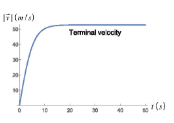
Terminal Speed: Maximum speed of a falling object
Terminal speed occurs when the force of air resistance is large enough to balance the gravitational force
Practice:
A single falling coffee filter quickly reaches a terminal speeds of . At this speed, what do we know about the air resistance force?
F_{air} > F_{grav}
F_{air} < F_{grav}
Not enough information
The terminal speed has been reached. This means that air resistance is balanced with gravity.
The correct answer is B
Practice:
A coffee filter with a mass of 1.2 grams is dropped from rest at a height of 3 m above the ground. The filter reaches the ground with a speed of . How much internal energy did the air + coffee filter system gain while the coffee filter was falling?
Not enough information
Gather)
r_i = <0,3,0>m
v_i = <0, 0.5, 0> m/s
r_f = <0,0,0>m
v_f = <0,0,0> m/s
Organize)
System: Air, Coffee filter
and can be ignored since they are not changing
can be ignored since, well, you know, ummmm, air doesn’t really change
Surroundings: Earth
Transfers
and can be ingored
Transfers
Analyze)
Transfers
can be crossed out
The answer is B
Spring-Mass System with Firction
A spring-mass system that experiences viscous friction (where force is proportional to velocity) will have an amplitude that decreases over time.
$$\overrightarrow F_{net} = m \frac {d²x}{dt²} \Rightarrow Ae^{-(\frac b{2m}t} \cos(\omega t)