Photosynthesis
C1.3.1: Transformation of light energy to chemical energy when carbon compounds are produced in photosynthesis
Light
Carbon Dioxide + Water ———> Glucose + Oxygen
-The reaction requires light energy to take place and is thus an endothermic reaction
-The carbon dioxide penetrates through the leaves via the stomata pores
Photosynthesis is the transformation of light energy into chemical energy in the form of carbon compounds. The glucose produced by photosynthesis has 5 uses:
Cellular respiration: Glucose is broken down to release energy (ATP)
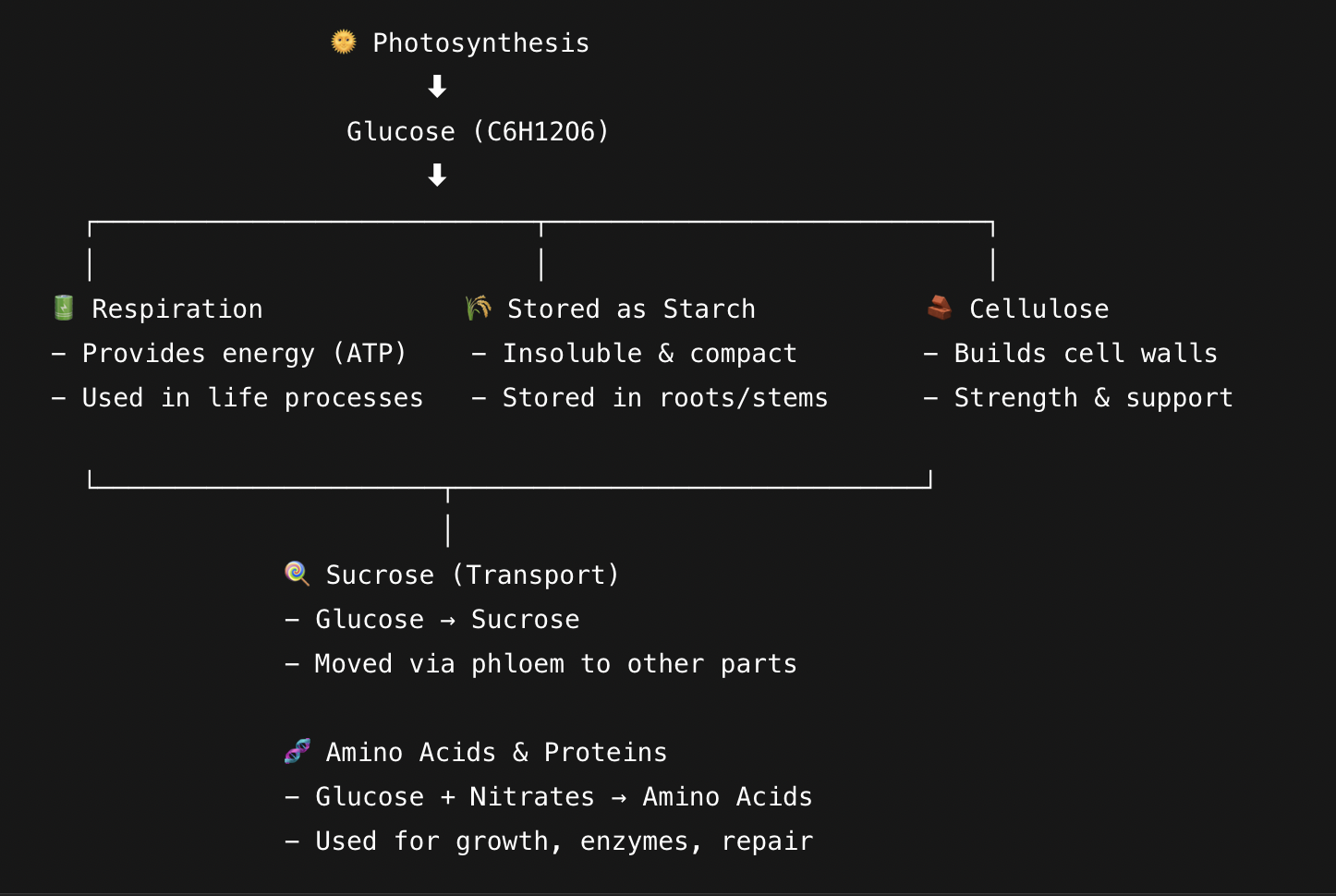
Factors that affect the rate of photosynthesis:
Light intensity
Temperature
Carbon dioxide concentration
The amount of chlorophyll
Photosynthesis in ecosystems:
C1.3.2: Conversion of carbon dioxide to glucose in photosynthesis using hydrogen obtained by splitting water
(Must know the word equation for photosynthesis)
Carbon Dioxide + Water ——→ Glucose+Oxygen
Photolysis is the use of light energy, absorbed by chlorophyll, to split water into hydrogen ions and oxygen gas.
The hydrogen ions are used with carbon dioxide to produce glucose (C6H12O6). Where oxygen gas is released as a waste product
C1.3.3: Oxygen as a by-product of photosynthesis in plants
Cyanobacteria, algae, and plants produce oxygen gas as a by-product of splitting water during photosynthesis. xygen is called a by-product as it is not the only product produced when splitting water
Light intensity, level of CO2, and temperature. start to increase, and once it reaches the maximum, it plateaus. Temperature reaches a maximum, and once increased above the rate of photosynthesis declines
Experiments to measure the independent variables impact on the dependant variable ( rate of photosynthesis)
Paper 2: Suggest an experiment to investigate carbon dioxide’s effect on the photosynthesis rate.
In carbon enrichment experiments, students wanted smaller-scale experiments where it would be easier to control contradicting variables. This is particularly important as atmospheric carbon dioxide levels are increasing.
Scientists have used enclosed greenhouses and free-air carbon dioxide enrichment experiments (FACE) to investigate the effect of carbon dioxide on plants on larger scales.
Scientists can artificially increase the carbon dioxide levels in the greenhouse and measure the effect of high levels of carbon dioxide on plants over time.
❓Suggest variables that scientists would want to control in enclosed greenhouse experiments.
Environmental Variables
Temperature: Affects plant growth, germination, and decay rates.
Light intensity and duration: Impacts photosynthesis; often controlled with grow lights or blackout shades.
CO₂ concentration: Can affect plant productivity.
Soil type or medium composition: Should be consistent to avoid nutrient or pH differences.
💧 Watering Variables
Amount of water: Should be precisely measured.
Watering schedule: Timing and frequency should be consistent.
Water source and quality: Avoid variation in mineral content or contaminants.
🧪 Nutrient Variables
Type of fertilizer used: Keep the same formulation.
Amount of nutrients: Control to avoid deficiencies or toxicities.
Application method: Spraying vs. soil feeding, for consistency.
🧬 Biological Variables
Plant species or variety: Same genetic background.
Plant age and initial size: Ensures comparability.
Microbial presence in soil: Especially important in decay or soil health studies.
Presence of pests or diseases: Should be monitored or eliminated.