Emile Durkheim
Sociology - Study of Society
society is greater than the sum of individuals who comprise society
society has its own reality - social relations, organizations, collective social forces
Society - Moral Order
how is social (moral) order achieved and maintained amidst social & economic change?
views society as a complex system of component parts (interdependent/interrelated)
all parts of the whole are necessary for the functioning of society (structural functionalism)
Scientific Sociology
durkheim believed society could be studied
sociology: “science of civlization”
introduced concept of “social facts” which are social phenomenon that are
external to the individual
collective, independent of the individual
Social Facts Include:
beliefs, tendencies, practices of the group taken collectively
not just statistical facts; social facts more encompassing to include ways of acting, thinking, and feeling
shape, structure, and constrains individual and social behavior
How to study society/social facts?
social facts are objective things that exist in society
can be studied objectively (observed)
use indicators - when the phenomenon itself can’t be directly observed
Examples of Studying Social Facts
can’t directly see social integration, but it can be measured using indicators assessing:
individuals’ social ties to others
frequency of interaction with others
participation in various social/community groups
Social Facts as Social Problems
social facts include marriage, divorce, religion, crime, homelessness, education
social “problems” (e.g. homelessness, unemployment) are sociologically “normal”
pathology occurs when these problems become abnormally high and begin to threaten social order
Human Nature and Society’s Nature
life in society means that individual appetites must be curbed
social life requires that we attach ourselves to “something other than ourselves”
attachment to others - social ties, social bonds - produced solidarity (social morality)
solidarity maintains society (order & cohesiveness)
Societal Constraints
society is a collection of rules that constrain behavior
socialization teaches individuals collective rules, norms, customs, obligations
social rules or expectations are socially inherited; exist external to, and independent of, individuals
social change can only emerge from society
Social Transformation
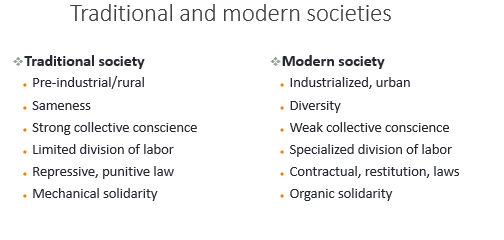
different types of societies (traditional vs. modern) produce:
different societal conditions
different social facts
different forms of social organization
how is social order (solidarity) maintained in different types of societies
Traditional Society (mechanical)
pre-industrial or rural society/community
sameness in social structure and relationships
shared backgrounds (family, occupational, cultural historical)
overlapping social ties and relationships
Traditional Society
strong collective conscience
deeply felt shared attachments and beliefs
regulates expectations and behavior
low level of individualism
social control exerted through repressive sanctions
Modern Society (organic)
industrialization/urbanization/population density
geographical and social mobility
cultural diversity
specialized division of labor
emphasis on individualism
requires interdependence
Social Interdependence (modern)
social interdependence requires contractual as well as moral expectations
contracts are expressions of social morality; how society defines expectations and obligations
contracts have legitimacy because they reflect and affirm societal expectations and customs
contracts originate in society to protect social relations
Suicide as a study of sociology
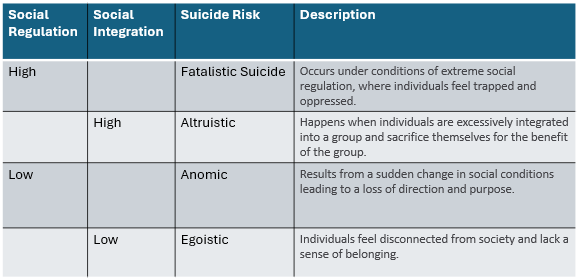
egoistic - too much individualism
anomic - conditions too chaotic
fatalistic - conditions too controlled
altruistic - too much group attachment
Social Conditions and Suicide
suicide
a social fact
varies inversely with the degree of social integration
durkheim’s sociological study of suicide highlights:
the significance of social interdependence
how social structures attach individuals to society
how different social conditions produce different social consequences
Suicide in tightly bound societies
altruistic suicide:
produced under societal conditions in which individuals’ are excessively tied to the society; over-attachment to social groups
the strong press of the collective conscience/community norms
becomes obligatory due to loss of honor in the community
Modern, egoistical conditions
egoistic suicide
societal conditions with a high emphasis on individualism; self-oriented achievement
focus on the self leaves little room for the development/maintenance of social attachments
social relationships and social groups
function as constraints against individualist (egoistic) appetites
protect the individual from detaching from society
Constraining Individualist Tendencies
some social structures/forms of social organizaiton more likely than others to exert a constraining-integrating force on the individual
marriage
parenthood
church
not religious doctrine per se, but variation in church structure
the catholic church has a more layered communal;/hierarchical structure than the protestant church
absorbs rather than isolates the individual
Catholics more tightly integrated than protestants
lower incidence of suicide among Catholics than protestants
Anomic Social Conditions
anomic suicide
produced by societal conditions of upheaval, rootless-ness
the norms and anchors in place are disrupted and overturned by some unanticiapted occurrence/event/crisis
terrorist attacks
natural disasters (earthquakes, hurricane, fires, tsunamis)
rapid economic change (economic recession or growth)
Anomie and Social Cohesion
societal anomie, social disturbance, is not solely linked to suicide
societal anomie can also produce new bonds of cohesion
people want to be with other people
unite around a shared grief/common cause
independent of social anomie, social abnormalities or social problems (excessive inequality, excessive individualism) can threaten social cohesion
Is suicide an acceptable outcome of modernity?
in 2022, 6407 veterans dued by suicide (latest available data)
rougly 17.6 deaths per day
the suicide rate among veterans is more than double that of civilians at around 34.7 per 100,000
some estimates as high as 40 to 44 veterans taking their lives each day
Religion
a social fact
interest in the relation between religion and social integration
broad definition of religion, of the sacred:
all societies divide things into two categories
the sacred: all things set apart as special; have high symbolic value; society demands reverence/awe toward them
the profane: ordinary or mundane things with no special symbolic significance
The Sacred
the sacred and profane are defined by society
what makes a thing holy/sacred is the collective feeling attached to it
each society/community designates the sacred through symbols; collective representations
symbols are collective representations of a society’s/community’s shared beliefs/attachments
societies/communities unify around shared sacred symbols
Beliefs and Rituals
the sacred can be identified by
collectively shared beliefs
collectively shared rituals
church: the collective coming together of people with shared beliefs and rituals
a moral community; shared solidarity
we see and experience the sacred at collective assemblies (e.g. funerals, sports events, national civic events)
the affirmation and regeneration of social ties
Science and Religion
religion compels us to act in unison together; compels us to be social
attaches us to something other than ourselves; strengthens our individual and collective life
science: creates knowledge
religion: creates action, the moral-social remaking of society; creates solidarities
science and religion: separate, interdependent functions; not incompatible
Spiritual Beliefs/Religious Affiliation
overall belief in god: as of 2023, 74% of Americans belief in god
spiritual beliefs: more than half of US adults beleif in god as described in the bible whereas a third (34%) belief in some other higher power or spiritual force in the universe
protestant - 33%
catholic 22%
mormon 1%
christian unspecified11%
jewish 2 %
another religion 6%
no religion 22%
no answer 3%