SIE Prep - Risk Matrix
Overview of Risks Associated with Financial Products
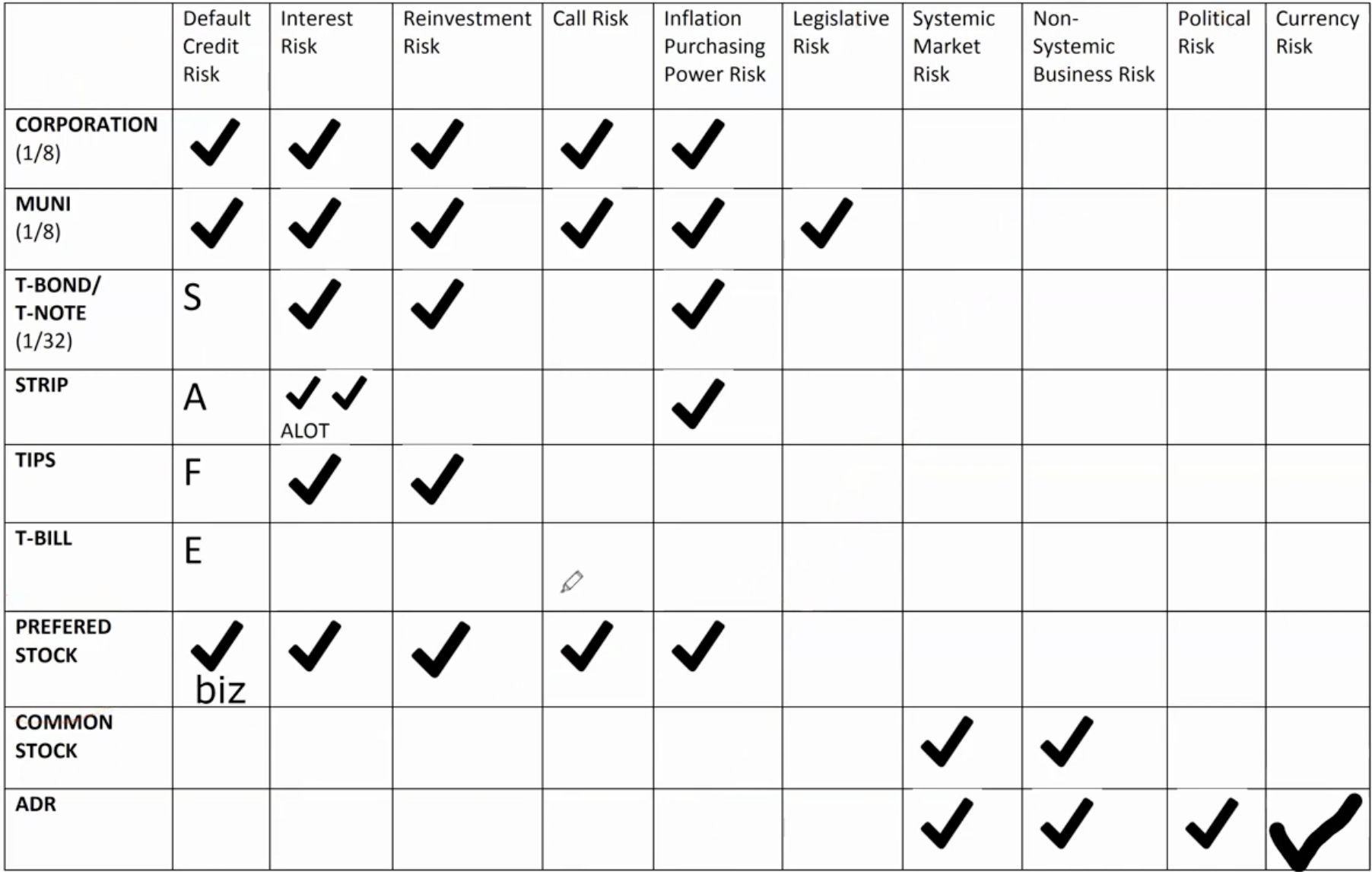
Introduction of a risk table, which encapsulates various risks linked with different financial products.
The table contains data on default risk and other categories relevant to bonds and returns.
1. Corporate Bonds
Characteristics:
Trades in eighths (e.g., price increments).
Risk Factors:
Default Risk: Measured by credit ratings (AAA, AA, A, BBB - investment grade; below BBB - speculative).
Interest Rate Risk: Risk of bond prices falling due to rising interest rates.
Reinvestment Risk: Risk associated with reinvesting coupon payments at lower interest rates when market rates decline.
Call Risk: Issuers may call bonds when interest rates drop to reissue at lower rates.
Inflation Risk: Risk that inflation will erode purchasing power; especially critical for fixed income securities.
2. Municipal Bonds (Munis)
Similarities with Corporate Bonds:
They also incur default, interest rate, reinvestment, call, and inflation risks.
Additional Risk:
Legislative Risk: Potential legislative changes that could impact the tax-free nature of municipals, appealing primarily to affluent investors.
3. Treasury Bonds (T-Bonds)
Trading Characteristics:
Trade in increments of 30 seconds.
Risk Assessment:
Minimal or no default risk (considered very safe).
Interest rate risk and inflation risk exist, with no call risk for T-bonds.
4. Treasury Inflation-Protected Securities (TIPS)
Features:
Par values adjusted with inflation measured by the Consumer Price Index (CPI).
They come with less interest rate risk compared to other bonds because they adjust for inflation.
Risk Exposure:
They have reinvestment risk due to the periodic payments received.
5. Treasury Bills (T-Bills)
Nature:
Known as the "risk-free rate of return".
Generally, no significant risks associated.
Usage: Commonly utilized as a safe place to “park” investment capital.
6. Preferred Stocks
Characteristics:
Generally described as fixed income, but the risk is categorized under business risk (i.e., the entity's ability to pay dividends).
Risk Types:
Interest rate risk, reinvestment risk, call risk, inflation risk.
Variants include convertible and adjustable preferred stocks.
7. Common Stocks
Differentiation: Not subjected to typical bond risks (e.g., default, interest rate, reinvestment, call, inflation risks).
Risk Aspects:
Systematic Risk: Market-wide risk that cannot be diversified away.
Non-Systematic Risk: Specific to the company or sector, which can be mitigated via diversification.
Lack of Political or Currency Risks: Since they trade within a stable economy's context.
8. American Depositary Receipts (ADRs)
Nature: Represents foreign securities traded in U.S. markets, packaged and sold to investors.
Risk Evaluation:
Lacks bond risks but is still subject to:
Systematic risk
Non-systematic risk
Political risk due to foreign investment exposure.
Currency risk affects investments in foreign markets significantly.
Conclusion
The speaker emphasizes the differences in risks associated with various securities and the importance for investors, especially those preparing for the SIE exam.
Encourages audience engagement with a Q&A session and to consider the implications of the content discussed.