Chapter 9: coral reefs and beaches
difference between dirt and soil:
dirt: mostly dead; mostly inorganic
soil: is alive; has microorganisms
structure of a reef
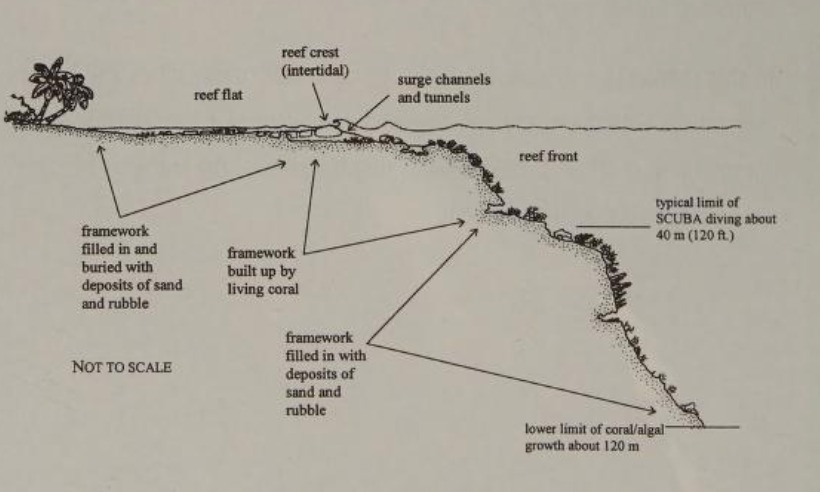
cross-section of reef
like a transect
think about gradients and zonation!
3 main parts
reef flat
the shallow part between the stone & the reef crest
the bottom is mostly sand and coral rubble, with any reef framework filled in
often see sea grass and sea cucumbers
as the water gets deeper begin to see
reef crest
shallower than the reef flat (the edge of the reef)
reef crest as seen at low tide
waves break at the edge of the reef, may be exposed at very low tide
live coral is essentially intertidal, so often has algae on the actual crest
is higher than the reef flat
e.g., Tagachang
often see channels resulting in “spur & groove” formation
reef front or forereef
Slopes steeply into deep water
often very productive, with lots of fishes
Limestone & sand from Reefs
coral reefs and all limestone rocks
Pacific islands are made of calcium carbonate,
the results of millions of years of growth by coral symbioses.
limestone
fossilized coral reef
as limestone weather, fossil corals are exposed
Sand is a product of bodies of hard organisms
the sand for beaches and filling in of reef flats and deep reef slopes comes from
coral skeletons
shells
calcified and coralline algae (e.g., Halimeda)
dies and the body on the reef crumbles to from sand
Star sand (foraminiferans)
Erosion of Limestone results in sand
limestone erodes easily
Corals are colonial
usually asexual reproduction
Share common “skin” and skeleton of calcium carbonate
“individuals” are termed polyps
growth of the colony occurs in 2 ways
extra-tentacular growth (outside tentacles)
Polyps from between older polyps
new polyps start a new trace in the skeleton
Intratentacular growth (inside tentacles)
new polyp buds off older polyps
new polyp trace branches off older polyp trace in the skeleton
Coral spawning
corals also reproduce sexually
Guam’s next coral spawn
7-10 days after a full moon (third quarter)
Reef symbioses
we are now familiar with the symbiosis between corals and their zooxanthellae
some sea anemones, some coralline algae, giant clams, and ciliates also have zooxanthellae
there are many other symbioses on a coral reef
some sea ha
Other symbioses
star sand
foraminiferans with star-shaped shell
symbiotic alga inside (dinoflagellate or diatoms)
Brownish-red in color
Ciguatera
food poisoning
symptoms of ciguatera poisoning generally begin six to eight hours after eating the contaminated fish.
symptoms include:
nausea
vomiting
diarrhea
muscle pain
numbness
tingling
abdominal pain
dizziness, and vertigo
Gambierdiscus toxicants is the main dinoflagellate (algae) that produces a toxin to discourage herbivores
small, 1/10 mm
chemical structure of the toxin complex
Biological Magnification
sometimes also termed bioaccumulation
toxins stored in fat, not lost
so each time a herbivore eats a toxic dinoflagellate, the toxins accumulate
each level of the food chain accumulates toxins
toxin concentration increases as we move up the food chain
this was the problem with the insecticide DDt
Sprayed on mosquitos → “nuked” swifts
diversity is important
most organisms are food for something else
Values of reef
fishing/harvest
protection from wave
cultural uses and beliefs
tourism & souvenirs
building materials
potential medicines
Fisheries
reef organisms are a renewable resources
but harvest is both valuable and a threat to reefs
note that archaeological evidence suggests that early Chamorro people didn’t have domestic animals, so they used fisheries extensively
fisheries are especially important where crops are few
What do fisheries include?
shellfish (clams, oysters, snails, etc.)
shrimp, lobster, crab, etc.
octopus
sea urchins & sea cucumbers
turtles (are now endangered)
federally protected through US Fish & Wildlife Act
internationally protected through CITES
Fishing is important for food, for cash, & to maintain families & culture
traditional fishing methods, combined with small populations were probably sustainable
but people now have much larger population
fisher now use monofilament instead of natural fiber
some fishers use poison & dynamite
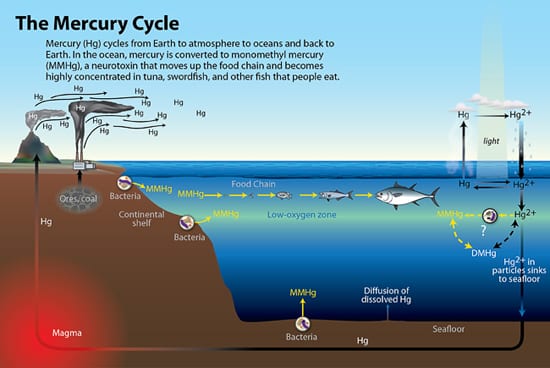
The mercury cycle
 Non-food harvest
shells, corals & shell crafts can be significant exports
are they sustainable?
Fishes may be harvested for sale to aquarists
many are not sustainable
Tourism & Coastal Development
may represent threats to reefs
construction for hotels, marinas, etc.
results in changes in sedimentation
may also need silt fences & ponding basins
sediment plumes may eventually kill the reef
fishes have nowhere to move to
unless new corals are recruited, then the fleshy seaweeds dominate and the community is lost
Tourism requires infrastructure, water pollution leads to eutrophication
could affect the growth of seagrasses & mangrove
other threats to reefs include:
the reef is sometimes dredged
to deepen channels for ships
to provide building materials
to develop tourist attractions
oil appears to affect the reproduction of some corals
other threats to reefs include:
drivers and dive boat anchors may potentially harm reefs
global warming, which may lead to ocean acidification (more on this later)
Climate Change and Corals
CO2 emissions that are part of global climate change have negative consequences for reefs
Coral bleaching
Ocean acidification
Coral Bleaching
rate of photosynthesis depends on the amount of light
saturation point: the amount of light at which more light does not produce more photosynthesis
photoinhibition: more light than saturation point & photosynthesis in inhibited
saturation is reached at lower light levels when the temperature increases
Coral near the surface are close to their tolerance levels for both light and temperature
When water temperature increases, the algal symbionts are damaged, so the corals eject them
we call this Coral Bleaching
Corals will die, if the algae are not replaced
it is the most extreme days that cause the greatest problem
especially if these days have conditions that are outside the boundary conditions of the habitat for the coral.
Ocean Acidification
there is relationship between CO2 in the atmosphere and acid in seawater
CO2 + H2O → H2CO3 → HCO3- + H+
more CO2 results in more H+
If pH is decreased by 0.11 units
there is a 30% increase in [H+]
note: that pH of seawater has averaged 8.2 for millions of years until the Industrial revolution
pH of seawater now averages 8.1
why does this matter?
animals can still use CO2 and HCO3- to build skeletons (no problem)
but increased acidity dissolves the CaCO3 skeletons & affects cellular functions
Modelling Climate Change
In summary, coral reef scientists are modeling climate change
they showed that an increase in temperatures & decrease in carbonate ions taken now
corals won’t grown if temp. increase to 2C
Mariana region Back-arc

open ocean
When we look at the open ocean we use a classification based on
1. the distance from shore
2. the depth
3. the penetration of sunlight
it will determine how much food is
oceanic zonation
the 3 systems of classification are not mutually exclusive
instead, used together to define a habitat & determine
Deep ocean
cold & dark
Close to pacific islands, compared to continental areas
once considered without life & just a place to dump waste & mine minerals
later ocean sampling found some animals, but they were
Hydrothermal vents
organisms live off energy from chemicals &/or heat coming out of the earth
3 types
black smokers
white smokers
serpentinite seeps
Black smokers
release hot water (360-400 C)
water saturated with H2, CH4 & minerals
cold seawater seeps into the crust & is superheated, dissolves minerals (mostly sulfides &irons) & rises out of the main chimney
typical in areas of sea
whiter smoker
release hot water (360-400)
water saturated with H2, CH4 & minerals
cold seawater seeps into the crust & is superheated, dissolves minerals (mostly barium, calcium, & silicon) & rises out the main chimney
typical in areas of seafloor spreading
cold seeps
release color water (40-90c); still warmer than 4C seawater
water saturated with H2, CH4, but low in minerals
typical of area with plate subduction
includes the Shinkai Seep Field (SSF) near Challenger deep
Hydrothermal Vent Ecosystems
Depend on chemicals in the water for both energy & nutrients
Primary producers are bacteria
both free-living &endosybionts
plants: CO2+ H2 → C6H12O6 + O2
Bacteria: CO2 + H2S → C6H12O6 +SO2
Vent Organisms
Giant tube worms (riftia)
get over 2m in length
no gut, instead their trophosome is filled with bacteria
bacteria fix, CO2 from the environment and make sugars (then share these with the tube worms)
Tube worms supply the bacteria with the CO2 & H2S from the surrounding seawater
both the worm and the bacteria need O2, which the worm takes from the seawater
Vent organisms not all are invertebrates
Mariana Trench Marine National Monument
2 parts:
Trench unit (red)
Island unit (yellow)
Note that the location of the Shinkai Seep Feild (SSF)
“HMRG Deep “ is now (after a competition by Marianas Students) named Seriana Deep
2nd or 3rd deepest location after challenger deep
Vocabulary:
calcareous
coral reefs
Biogenic rock
reef creatures deposited all of the limestones on tropical islands.
it has a biological origin, as opposed to rock derived from the earth’s crust, such as volcanic rock.
Foraminifera
feeding deterrents
chemical ecology
how plants and animals use chemicals to defend themselves against predators or to compete successfully.