Skeletal System
slideshow
skeletal system
- composed of the body’s bones and associated ligaments, tendons, and cartilages
- functions:
- ^^support^^
- the bones of the legs, pelvic girdle, and vertebral column support the weight of the erect body
- the mandible (jawbone) supports the teeth
- other bones support various organs and tissues
- ^^protection^^
- the bones of the skull protect the brain
- ribs and sternum (breastbone) protect the lungs and the heart
- vertebrae protect the spinal cord
- ^^movement^^
- skeletal muscles use the bones as levers to move the body
- ^^reservoir for minerals and adipose tissue^^
- 99% if the body’s calcium is stored in bone
- 85% of the body’s phosphorous is stored in the bone
- adipose tissue is found in the marrow of certain bones
- energy is really being stored
- ^^hematopoiesis^^
- aka blood cell formation
- red blood cells only last about 120 days
- all blood cells are made in the marrow of certain bones
- there are 206 named bones in the human body
- each one belongs to one of 2 large groups
- axial skeleton
- forms long axis of the body
- includes the bones of the skull, vertebral column, and rib cage
- these bones are involved in protection, support, and other parts of the body
- appendicular skeleton
- 4 types of bones
- ^^long bones^^
- much longer than they are wide
- all bones of the limbs except for the patella (kneecap) and the bones of the wrist and ankle
- consists of a shaft plus 2 expanded ends
- ^^short bones^^
- roughly cube shaped
- bones of the wrist and the ankle
- ^^flat bones^^
- thin, flattened, and usually a bit curved
- scapulae, sternum, ribs, and most bones of the skull
- ^^irregular bones^^
- have weird shapes that fit none of the 3 previous classes
- vertebrae, hip bones, 2 skull bones (sphenoid and the ethmoid bones)
- bones are organs, composed of multiple tissue types
- composed of
- bone tissue (osseous tissue)
- fibrous connective tissue
- cartilage
- vascular tissue
- lymphatic tissue
- adipose tissue
- nervous tissue
- ^^all^^ bones consist of a dense, solid outer layer known as ^^compact bone^^ and an inner layer of ^^spongy bone^^ - a honeycomb of flat, needle-like projections called trabeculae
- bone is an extremely dynamic tissue
bone structure
- bone tissue is a type of connective tissue, so it must consist of cells plus a significant amount of extracellular matrix
- bone cells
- osteoblasts
- bone-building cells
- osteocytes
- mature bone cells
- osteoclasts
- huge cells derived from the fusion of as many as 50 monocytes
fractures
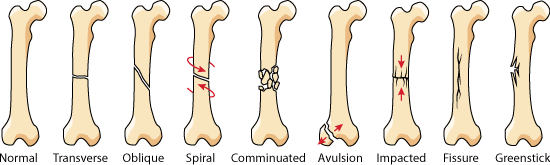
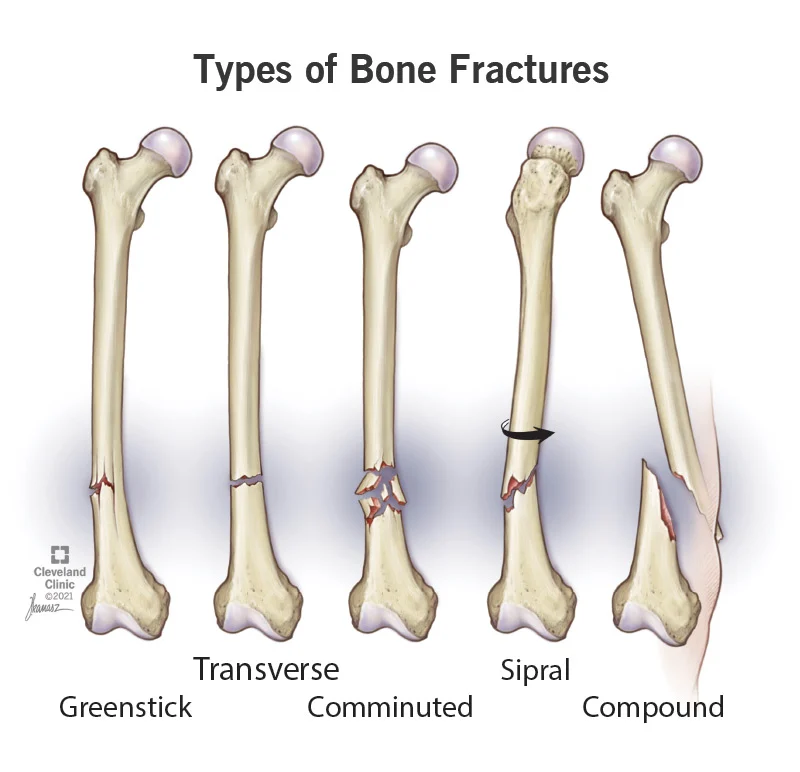
fracture types
- open (compound) → bone ends penetrate the skin
- closed (simple) → bone ends don’t penetrate the skin
- comminuted → bone fragments into 3 or more pieces (common in elderly)
- greenstick → bone breaks incompletely. one side bent, one side broken. common in children whose bone contains more collagen and are less mineralized
- spiral → ragged break caused by excessive twisting forces. sports injury/injury of abuse
- impacted → one bone fragment driven into the other