Combined Science
Cells
ANIMAL CELL
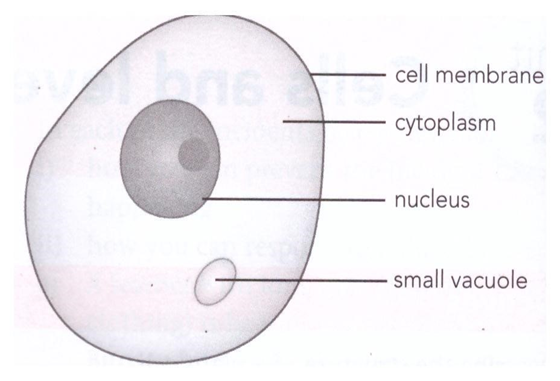
Cell Membrane - controls what can enter or leave the cell.
Cytoplasm - this is where chemical reactions take place
Nucleus - the control center of the cell.
Mitochondria - where respiration takes place
Vacuole - used to transport water salts waste and food particles
PLANT CELL
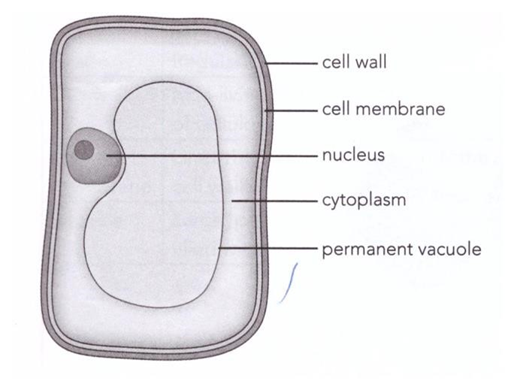
DIFFERENCES BETWEEN AN ANIMAL AND A PLANT CELL
Differences | Plant cell | Animal cell |
Shape | Regular | Irregular |
Cell wall | Non-living, made of cellulose | No cell wall is present |
Cell membrane | Lines the inside of the cell wall | surrounds the cell |
Vacuole | Large, permanent filled with cell sap | None or very small |
Respiratory system
COMPOSITION OF AIR
Oxygen = 21%
Carbon dioxide = 0.03%
Nitrogen = 78%
Water vapor varies due to humidity
RESPIRATION
Respiration is the process of burning food in the body cells to produce carbon dioxide, water and release energy.
Respiratory gases
Oxygen
Carbon dioxide
during respiration oxygen is taken in (inhaled when breathing) and carbon dioxide is taken out (exhaled when u breathe out)
Gas | Inhaled air% | Exhaled air % |
Oxygen | 21 % | 16% |
Carbon dioxide | 0.03% | 4% |
Nitrogen | 78% | 78% |
Water vapor | small percentage | large percentage |
Testing for carbon dioxide
You need :
lime water
test tube
Glass straw
The presence of carbon dioxide turns lime water into milky white and the red bicarbonate indicator yellow
Testing for oxygen
Light a wooden splint and the oxygen relights a glowing wooden splint
TRANSPORT SUSTEM
Diffusion
This is the movement of particles of any substance from a region of highly concentrated particles to a region where there is low concentration of particles
Example of diffusion :
Perfume: The particles of perfume spread out into the air, allowing you to smell it
OSMOSIS
Osmosis: is the movement of water molecules from a region of high concentration to a region of lower concentration through a semi-permeable membrane.
- Water moves through a semi-permeable membrane until the water particles are spread out evenly;
- Osmosis therefore stops when the water particles are in equilibrium.
- E.g. water moves by osmosis from the soil, where there is a high concentration of water into roots, where there is lower concentration of water.
Flower
Blood components
Red blood cells transport oxygen
White bloods cells fight infections and diseases
Platelets help with blood clot
Plasma help transport essential substances
Acid bases and salts
Acids:
- Taste sour
- Turn litmus paper red
- Examples: Lemon juice, vinegar, stomach acid
- Characteristics:
- Release hydrogen ions (H+)
- Corrode materials
Bases:
- Taste bitter
- Turn litmus paper blue
- Examples: Soap, baking soda, toothpaste
- Characteristics:
- Accept hydrogen ions (H+)
- Feel slippery
Salts:
- Formed when acids and bases combine
- Taste salty or bitter
- Examples: Table salt (sodium chloride), sea salt, Epsom salt
- Characteristics:
- Neutralize acids and bases
- Conduct electricity when dissolved in water
Acid-Base Reactions:
- Acids + Bases → Salts + Water
- Example: Hydrochloric acid (HCl) + Sodium hydroxide (NaOH) → Sodium chloride (NaCl) + Water (H2O)
Simple Analogy:
Think of acids, bases, and salts like a seesaw:
- Acids add hydrogen ions (H+), tipping the seesaw one way
- Bases absorb hydrogen ions, tipping the seesaw the other way
- Salts balance the seesaw, neutralizing acids and bases
Key Points:
- Acids release hydrogen ions, bases accept them
- Acids and bases react to form salts and water
- Salts neutralize acids and bases, conduct electricity in water
Common Acid-Base Pairs:
- Hydrochloric acid (HCl) and Sodium hydroxide (NaOH)
- Sulfuric acid (H2SO4) and Calcium hydroxide (Ca(OH)2)
- Acetic acid (CH3COOH) and Baking soda (NaHCO3)
Real-Life Applications:
- Chemistry: Cleaning products, pharmaceuticals
- Biology: Digestion, cellular processes
- Environment: Water treatment, soil pH management
Do you have any specific questions or areas you'd like me to