physiology
Notes / Aug 29
Topics of physiology (chapter 1 )
Chapter 1: The Human Organism
Introduction to Anatomy and Physiology:
Anatomy refers to the structure of the body and its parts, while physiology focuses on the functions of those structures. Both fields are interconnected and essential for understanding the human body.
Levels of Organization:
The human body is organized into several hierarchical levels:
Chemical Level: Atoms and molecules, including macromolecules like proteins and nucleic acids.
Cellular Level: Cells, the basic units of life, and their organelles.
Tissue Level: Groups of similar cells that perform a specific function, classified into four types: epithelial, connective, muscle, and nervous tissue.
Organ Level: Structures composed of two or more tissue types working together for a specific function (e.g., heart, liver).
Organ System Level: Groups of organs that work together to perform complex functions (e.g., circulatory system, respiratory system).
Organism Level: The complete human being, functioning as a whole.
Homeostasis:
Homeostasis is the maintenance of a stable internal environment despite external changes. This dynamic equilibrium is crucial for the proper functioning of cells and organs.
The chapter discusses feedback mechanisms (positive and negative) that help regulate physiological processes and maintain homeostasis.
Anatomical Terminology:
The chapter introduces essential anatomical terms and concepts, including directional terms (e.g., anterior, posterior), regional terms (e.g., thoracic, abdominal), and body planes (e.g., sagittal, frontal, transverse) to describe locations and relationships of body structures.
Body Systems Overview:
An introduction to the major organ systems of the body, including:
Integumentary
Skeletal
Muscular
Nervous
Endocrine
Cardiovascular
Lymphatic
Respiratory
Digestive
Urinary
Reproductive
Each system has specific functions that contribute to overall health and homeostasis.
Health and Disease:
The chapter briefly touches on how disruptions in homeostasis can lead to disease, emphasizing the importance of understanding anatomy and physiology in health care and disease prevention.
Goals of studying physiology include how the body responds to stimuli.
Anatomy and physiology are studied together because they are interwoven and changes in one will affect the other; structure and function are interdependent.
Single - celled bacteria = cell
Strict laws govern research to minimize suffering
Current knowledge is constantly being updated through research in anatomy and physiology.
Chemical level: interaction of atoms and molecules
Cell level: structure and function unit of living organisms. Combination of molecules for structures called organelles that carry out specific function.
Organ system level: group of organs function together
Organism level: any living thing,
Cardiovascular system: regulations temperature and consist of blood vessels
Homeostasis: maintenance of a relatively constant internal environment within the body.
Receptor: monitors the value of some variables by detecting a stimulus
Control center: establishes the set point and receives input from the receptor
Effector: generates the response which can change the value of the variable.
Values of variables (conditions) fluctuate around the set point (ideal normal value) to establish a normal range of value.
Serous membranes
Cover the organ of body cavities and line the cavity
First represents an organ
Inner balloon wall represents parietal serous membrane line lines the cavity.
Location of serous membranes
Pericardium: surrounds the heart: contains pericardial fluid.
Pleura: surrounds the lungs and lines the thoracic cavity contains pleural fluid.
Peritoneum: surrounds many abdominal organs and lines the abdominopelvic cavity; contains peritoneal fluid,
Mesentery: regions of double-folded visceral peritoneum that are attached to certain points to the posterior abdominopelvic wall.
Retroperitoneal: behind the peritoneum; organs or parts of organs that only have peritoneum on their peritoneal cavity side; includes the kidney, ureters, adrenal glands, part of the large intestine, and the urinary bladder.
Inflammation of serous membrane : inflammation due to infection
Pericarditis: inflammation of the pericardium
Pleurisy - inflammation of the pleura
peritonitis - inflammation of the peritoneum
Anatomical imaging
X-ray: electromagnetic radiation moves through the body and is exposed on photographic plates; creates radiographs.
Ultrasounds: sound waves pass into the body and bounce back to receiver; visualized as a sonogram.
Computed tomography (CT): computer- analyzed x-ray images
Digital subtraction angiography (DSA): similar to CT scan but uses a radiopaque dye to enhance differences in are
Digital subtraction angiography (DSA): similar to a ct scan but uses a radiopaque dye to enhance differences in area.
Magnetic resonance imaging (MRL): radio waves directed to the patient while under electromagnetic field, radio waves collected and analyzed by computer.
Positron emission tomography (PET): radioactively labeled glucose usag e by a tissue is detected; provided into an metabolic state.
Functional organization
-Tissue level: group of similar cells and the materials surrounding them. Four tissues types - epithelial, connective, muscular, and nervous.
-organ level: two or more tissues functioning together
Characteristics of life:
Press cancel on the lab
Organization: condition in which there are specific interrelationships and functions among the parts of an organism.
Metabolism: the ability to used energy to perform vital function; all chemicals reactions of the body
Responsiveness: ability to sense changes in the interior and exterior environment and adjust; cell to cell communication is necessary
Growth: increase in size and/ or number of cells.
Development: changes in an organism over time.
Differentiation: changes from general to specific.
Morphogenesis: change in shape of tissue,organ, or the entire organism.
Reproductions: formation of nex cells or new organisms for growth and development; allows organisms to pass on their genes to their genes to the offspring.
POSITIVE FEEDBACK:
Unusual in normal, healthy individuals, leads away from homeostasis and can result in death.
Ex: of normal positive feedback: childbirth location, blood clotting.
Ex: example of harmful positive feedback: after hemorrhage, blood pressure drops and the heart’s ability to pump blood decreases.
Anatomical position: face forward, feet together, palms face forward
Supine: lying face upward
Prone: lying face downward
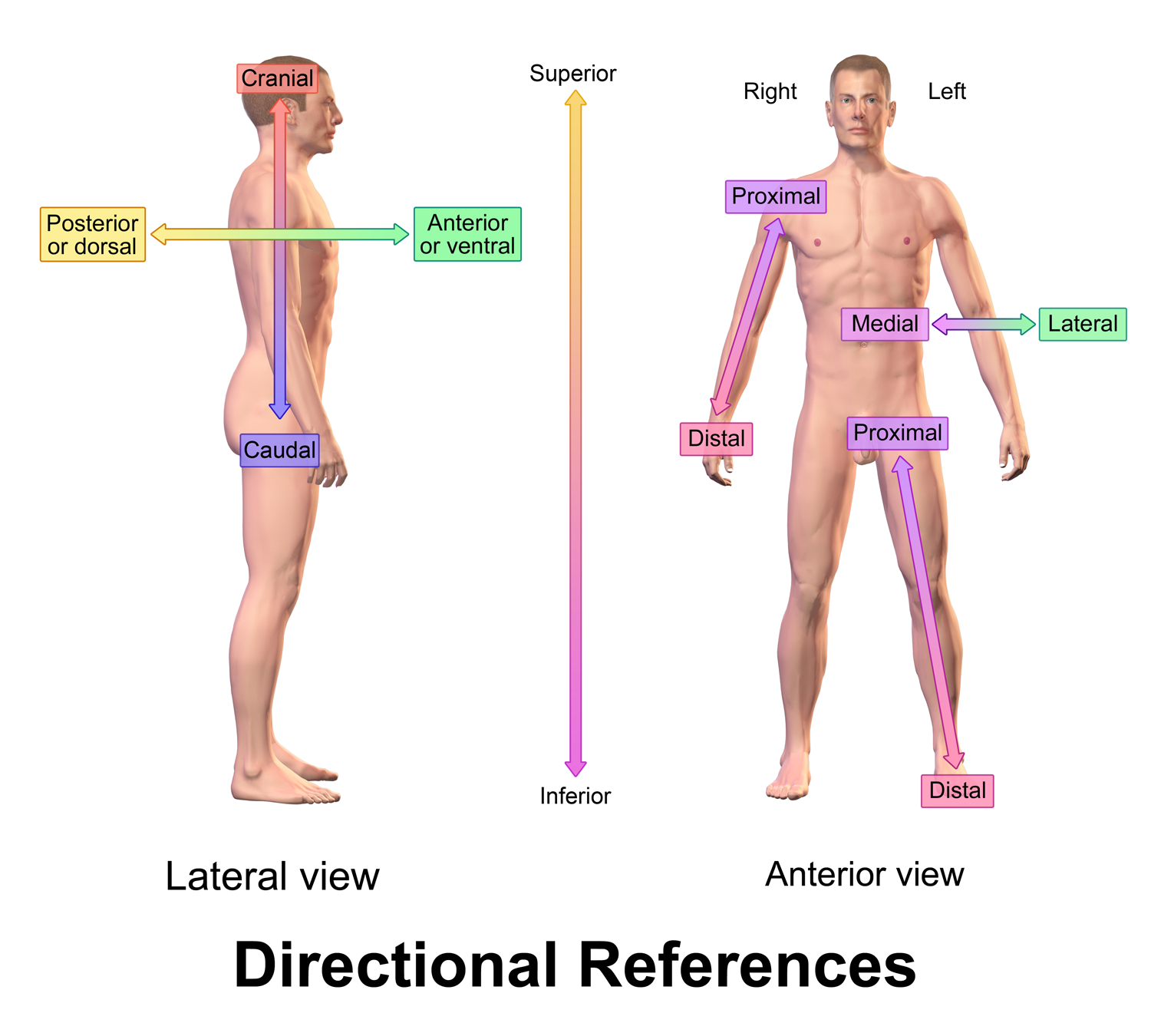
Superficial versus Deep relative to the surface of the body.
Anterior ( ventral )
posterior( dorsal ). Anterior is forward; posterior is toward the back.
Sagittal divides the body into anterior and posterior sections.
Transverse (horizontal) divides the body into superior and inferior sections.
Oblique: other than at a right angle.
BODY CAVITIES
-body contains dorsal and ventral body cavities.
DORSAL BODY CAVITY:
Cranial cavity houses the brain
Vertebral canal: houses the spinal cord
Ventral body cavity contains majority of viscero: divisions include:
Thoracic cavity: which is the further divided into pleural cavities each enclosing a lung and a mediastinum, which contains the heart , some major blood vessels, thymus, trachea, esophagus
Abdominopelvic cavity consisting of the abdominal cavity and pelvic cavity.
Pelvic: consist of the urinary bladder, urethra, rectum, reproductive organs.
Anatomy- is the scientific discipline that investigates the structures of the body parts such as the shapes and sizes of the bones - anatomy means to cut up or dissect
Physiology- the study of the functions and processes of how the body works together
Bone cells give strength and support
PLANES
Sagittal Plane or median plane - is where body is divided vertically down in half into left & right
Parasagittal- is parallel to sagittal but off to the side
Coronal Plane or frontal - is divided vertically into front and back
Transverse Plane or horizontal- is divided horizontally to from top and bottom

Axial parts- includes head (cranial) skull, neck, trunk like vertebral, ribcage
Appendicular- are arms, legs, or appendages
Anterior or ventral- means the front of the body Posterior or dorsal--the back or behind of the body - Superior (cranial) = top of the body - Inferior(caudal) = bottom of the body
-Medial is the structures towards the midline (heart)
-Lateral are structures further away from midline(arms)
Regional Anatomy: body study by area by area
Systemic Anat: the body is studied by system by system —--- systems is a group of structures that have one or more functions —ex: cardiovascular system, nervous system, respiratory system, etc
Gross Anatomy (macroscopic)- study of body structures without a microscope so it's visible to naked eye
Surface Anatomy- involves looking at the exterior body (studies the external features)
Superficial - means closer to the surface of the body(not deep)
Deep- away from the surface focuses on the internal
Developmental anatomy- is the studies of structural changes that occur between the conception(fertilization) and adulthood
Embryology- is the studies of formation and development of an embryo and fetuses of organism or animals - embryos are the initial stage of development
Cytology- cyto means “cells” logy “study” so it's the study of cells and how they work
- which can help diagnose and do examinations with the use of cells by utilizing body fluids such as urine, blood, and etc.
Histology (microscopic anatomy)- is anatomy at the microscopic level which studies tiny anatomical structures such as tissues and cells. four levels of tissue types include:
Muscle Tissue : can be located in the skeletal muscle, heart, and around blood vessels
↖has 3 types skeletal, cardiac(sends signal to heart) ,smooth
Nervous tissue: in your brain, spinal cord, and nerves
Neuron Sends nervous impulses
Glia support cells
Epithelial tissue : in your skin and organs
Can be cuboidal= cube shaped or squamous (squash). Columnar
Connective tissues: everywhere else like cartilage and tendons
Can be loose, dense, specialized
Describe the differences between the four basic tissue types in the human body. What are their primary functions?
Epithelial Tissue: Covers body surfaces and lines cavities; functions in protection, absorption, and secretion.
Connective Tissue: Provides support and binds other tissues together; functions in storing energy, transporting nutrients (e.g., blood), and structural support (e.g., bone).
Muscle Tissue: Responsible for movement; includes skeletal (voluntary movement), cardiac (heart contraction), and smooth (involuntary movements).
Nervous Tissue: Composed of neurons and glial cells; responsible for transmitting signals and processing information.