Bernoulli's Principle
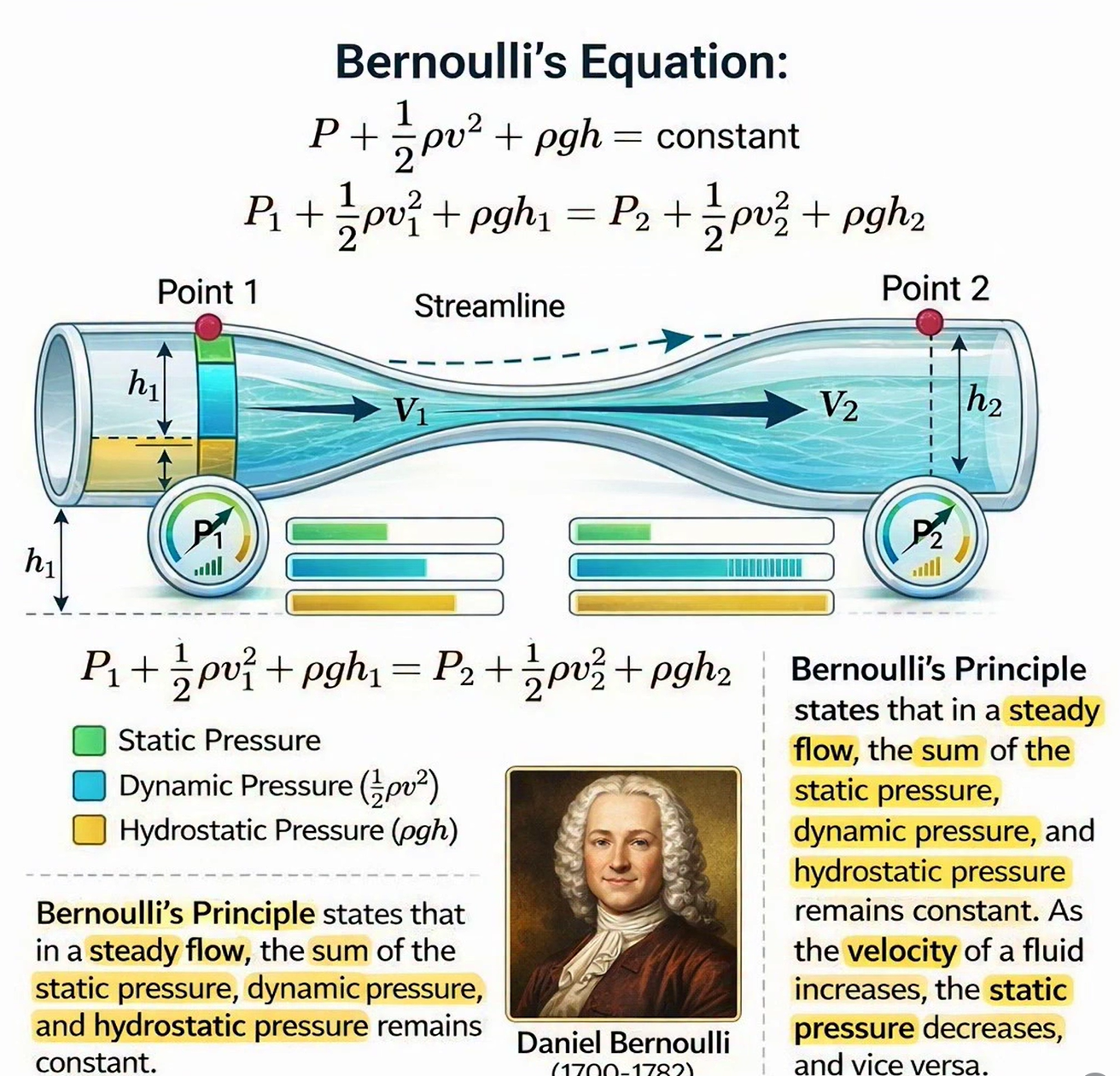
Bernoulli’s Principle is a fundamental concept based on the law of conservation of energy in fluid dynamics (the study of liquids and gases in motion). In its simplest form, it states that as the speed of a moving fluid increases, the pressure within that fluid decreases.
Imagine air or water moving through a pipe; if the fluid speeds up, it doesn’t push as hard against the sides of the pipe.
As a fluid moves, its total mechanical energythe sum of its kinetic, potential, and "pressure" energies remains constant along any given path (called a streamline).
The Core Concept
The principle is essentially a statement of the conservation of energy for flowing fluids. A fluid in motion has three main types of energy that must stay balanced:
1. Kinetic Energy: Energy from its velocity (speed).
2. Potential Energy: Energy from its elevation (height).
3. Internal Pressure Energy: The static pressure of the fluid.
If the speed (kinetic energy) goes up, another form of energy, usually pressure, must go down to keep the total energy constant. Because the total energy must remain constant, an increase in fluid speed causes a simultaneous decrease in internal pressure or a drop in elevation.