Notes: Sex, Gender and Sexuality - Sociological Perspectives
Exploring sociological perspectives of gender and sexuality
The transcript introduces sex, gender and sexuality as a sociological field of study.
Core aim: understand how gender and sexuality are socially constructed, reproduced, and contested across institutions and everyday life.
Structure of Part 1:
Theoretical perspectives on gender inequality: Functionalism, Conflict Theory, Symbolic Interaction.
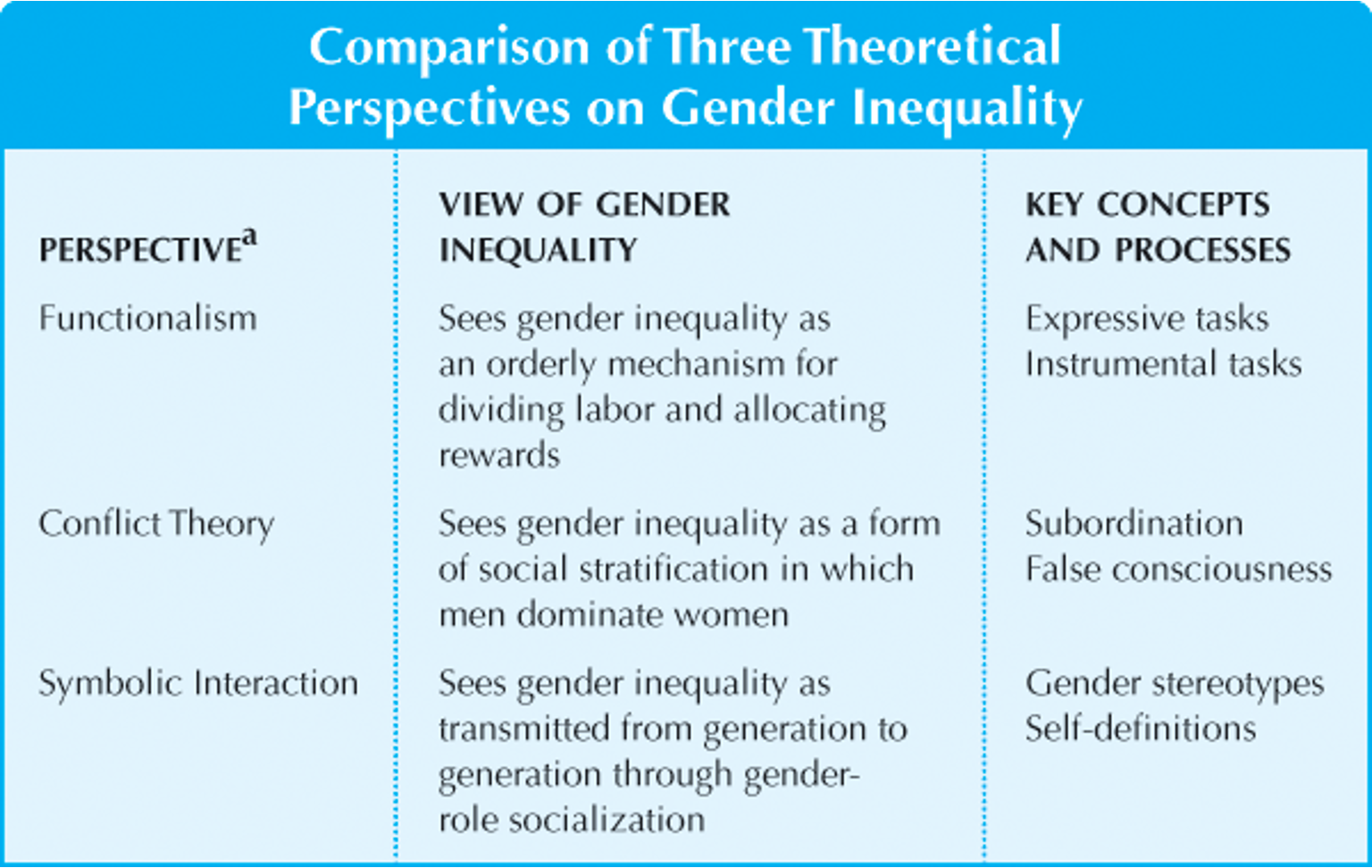
Comparison of three perspectives.
Key concepts and processes in gender analysis.
Subsequent sections cover gender essentialism, patriarchy, socialisation, social construction of gender, work and the gender order, different masculinities, feminism, sexuality theories, queer/crip theories, and contemporary politics.
Theoretical Perspectives on Gender Inequality
Perspective: Functionalism
View of gender inequality: Sees gender inequality as an orderly mechanism for dividing labor and allocating rewards.
Key concepts:
Expressive tasks
Instrumental tasks
Implication: Social roles contribute to social stability by matching tasks with gendered capabilities.
Perspective: Conflict Theory
View of gender inequality: Sees gender inequality as a form of social stratification in which men dominate women.
Emphasis: Power, domination, and class or gender-based exploitation within social structures.
Perspective: Symbolic Interaction
View of gender inequality: Sees gender inequality as transmitted from generation to generation through gender-role socialization.
Emphasis: Micro-level interactions, everyday practices, language, and symbols that perpetuate gender meanings.
Comparison of Three Theoretical Perspectives on Gender Inequality
Functionalism: stability through division of labor; rewards reinforced by roles.
Conflict Theory: structural domination by men; power dynamics shape institutions.
Symbolic Interaction: socialized gender norms through everyday interaction; maintenance of gender roles.
Overall takeaway: Each perspective highlights different levels (macro vs micro) and mechanisms (division of labor, power, socialization) in gender inequality.
Key Concepts and Processes
Expressive tasks: caregiving, nurturing, emotional labor associated with women in traditional divisions of labor.
Instrumental tasks: tasks connected to provisioning and practical problem-solving associated with men in traditional divisions of labor.
Subordination: the process by which one gender is placed in a subordinate position within social hierarchies.
False consciousness: a concept from Marxist theory where subordinate groups misperceive their true interests due to dominant ideologies.
Gender stereotypes: oversimplified beliefs about the traits and behaviors appropriate for men and women.
Self-definitions: how individuals define themselves in relation to gender identities and roles.
Gender Essentialism
Definition: The idea of a natural and innate inner feminine/masculine essence.
Historical backing: Underpins functional approaches (e.g., Talcott Parsons) and many religious perspectives by positing that women and men bring unique, complementary contributions to society (M = instrumental; F = expressive).
Sociological critique:
If differences between the sexes are ‘natural’, why is so much time and energy spent on affirming this natural state and policing transgressions?
Cordelia Fine popularized the term ‘neuro-sexism’ to critique purported scientific claims about gender differences.
Most science finds few robust differences, but media tends to magnify reported differences.
Methodological weaknesses and assumptions in research affect findings.
The Patriarchy
Definition: Literally means ‘the rule of the father’; a system in which men hold primary power and dominate in institutions (law, workplace, politics, etc.), with moral authority and privileges.
Nature of patriarchy: Structural, not only individual attitudes or behaviours.
Possibility for women to gain power via association with powerful men or inheritance, but still within a patriarchal framework.
Criticisms of the concept:
Ahistorical and decontextualized (gender operates differently across cultures).
Overly simplistic and universal (often based on white, middle-class women).
Does not fully address intersectionality of oppression (race, class, sexuality, disability, etc.).
Gender Socialisation
Debate on origins: Socio-biologists often argue gendered traits are biologically determined, while most sociologists see gender as socially learned.
Competing views:
Biological determinism (some scholars): gendered traits are innate.
Social learning: gender roles are learned through socialization from early childhood onward.
Heterosexual socialization: socialization into heterosexual norms as well as gender roles.
Lifespan socialisation: ongoing process through life via friends, family, media, schools, etc.
Methods of gender socialisation: sanction and rewards; social reinforcement of gender conformity.
The Social Construction of Gender
Doing Gender (West & Zimmerman, 1987): Gender is not something we are but something we do in everyday interactions. We perform gender through behavior, language, clothing, body movements, etc.; accountability for “doing it right” is constant.
Performative concept (Judith Butler, Gender Trouble, 1990): Gender is performed, not innate; repetition of actions and speech sustains gender norms.
Performativity: Gender is produced and sustained through repeated actions, behaviours and speech that align with social norms and expectations of ‘man’ or ‘woman’.
Significance: Challenges biological essentialism; opens space for viewing gender as fluid and non-binary.
Gender Inequality and Work
Socialisation directs men and women toward particular roles and jobs; traditional dichotomy of housewife vs breadwinner.
Australia-specific notes:
Marked occupational gendered segregation compared to other OECD countries.
Women concentrated in lower-paid, insecure jobs (sales, service, clerical, nursing, teaching).
Despite educational success, women often in low-paid, low-status jobs to balance family responsibilities; men do not face similar pressures.
Marked gendered division of domestic labour; women perform a ‘second shift’ of unpaid work after paid work.
Emotional labour: managing emotions to meet others’ needs; women often expected to perform more emotional labour due to femininity linked to nurturing.
Connell’s The Gender Order and Masculinities
Gender order: The intersection of institutional structures (gender regimes) and individual identities that sustains gendered social arrangements.
Focus on masculinity: masculinity is not just biological but learned; shiftable across trends (new man, lad culture, etc.).
Studying masculinities requires attention to images, texts, practices rather than just personality or behaviour.
Hegemonic Masculinity
Definition: Dominant form of masculinity in a culture; the “ideal” form valued by institutions (state, education, family).
Power structure: Male power is institutionalised in social structures and ideologies that support the gender order.
Real-world variability: Very few men occupy the hegemonic ideal; multiple definitions can co-exist (CEOs, athletes, judges).
Fluidity: Not natural or universal; created by society and changes over time and across cultures.
Hierarchical organization: Organises men in relation to women and to each other; non-conforming masculinities (e.g., gay, expressive men) face marginalisation.
Connell’s Theory of Gender
Patriarchal Dividend: unearned advantages that all men receive by living in a patriarchal society.
Hierarchies of Masculinity:
Complicit Masculinity: benefit from HM without fully embodying it; do not challenge it.
Subordinated Masculinity: masculinities perceived as ‘less than’ HM (e.g., gay or emotionally expressive men).
Marginalised Masculinity: men excluded from HM due to race, class, disability, etc.
Emphasised Femininity: the “ideal” way of being a woman in patriarchy; linked to submission, nurturance, heterosexuality, and pleasing men; contrasts with HM.
Other forms of femininity exist (resistant/alternative), but emphasised femininity is the most visible reward in mainstream culture.
Hybrid Masculinities (Bridges): men adopting elements of marginalized masculinities while maintaining overall male privilege; can appear as progress but often preserves privilege.
We Can Do It! Feminism and Feminist Theories
Section introduces feminism as a movement for social equality and opposition to patriarchy and sexism.
Core aims of feminism:
Increase equality across sexes
Expand human choices and opportunities
Eliminate gender stratification
Eliminate sexual coercion and violence
Promote sexual freedom for all
Feminism
Definition: Aims for social equality for sexes and opposes patriarchy and sexism; does not advocate female supremacy.
Basic ideas:
Work toward equality
Expand human choices and opportunities
Eliminate gender stratification
Eliminate sexual coercion and violence
Promote sexual freedom for all
Feminist Waves
First-wave feminism: emerged in 19th/early 20th century; focused on suffrage.
Second-wave feminism: emerged in the 1960s; addressed divorce, custody, domestic violence, reproductive rights, etc.
Third-wave feminism: emerged in the 1990s; characterized by intersectionality, representations in popular culture, Riot Grrl, social media; contested some second-wave ideas about sex work and pornography.
Fourth-wave feminism: around 2012; focuses on street harassment, rape culture, identity politics; stronger intersectional focus; uses social media for education and organization.
Types of Feminist Positions
Liberal feminists: seek equal access and representation in public life.
Socialist feminists: argue that social class position significantly affects women’s status; analyze patriarchy and capitalism together.
Radical feminists: view existing institutions (schools, family, church) as tied to patriarchy and advocate dismantling them; emphasize sexual assault and domestic violence.
Postcolonial feminists: focus on intersections of gender and race and the impacts of colonialism on gender.
Indigenous feminists: emphasize intersectionality, decolonization, Indigenous sovereignty.
Postfeminism and Neoliberal Feminism
Postfeminism (1980s/1990s): argues feminism achieved its goals; promotes personal empowerment and lifestyle choices rather than collective struggle; emphasizes self-surveillance (beauty, weight) with a sense of choice.
Neoliberal feminism: aligns with neoliberalism; argues women can succeed if they work hard enough and advance through individual effort, often overlooking structural barriers like racism or class.
Both strands link empowerment to consumerism and market logic (e.g., makeup, fashion, wellness products) and highlight corporate/elite women while shaping a marketable form of feminism.
Sexualities
Definition: Sexuality encompasses sexual orientation, desire, sexual identity, and sexual practice.
Regulation: Sexuality is regulated by legal and policing mechanisms (e.g., norms around marriage, reproduction).
From The History of Sexuality (Michel Foucault, 1976)
17th vs 19th century:
17th century: more open discussions about sex.
Victorian era (1800s): sex becomes private, controlled, and taboo in public discourse, yet there is increased discourse in science, medicine, law, and education.
Sexuality as a vector of oppression: institutions monitor, judge, and control individuals’ sexuality through discourse and knowledge production.
Rise of the bourgeoisie: middle-class norms push for self-control, proper family life; norms spread via schools, churches, medicine.
New sexual identities: the category of identities like ‘the homosexual’ didn’t exist before the 19th century; science helped classify and name sexuality.
Power/knowledge nexus: power operates through knowledge and language; discussions about sex shape self-understanding and social norms.
Coloniality of Gender (Lugones)
Core claim: Gender is not universal; Western ideas of gender were imposed on colonized peoples.
Two-spirit and Indigenous gender histories: Many Indigenous societies had flexible gender roles before colonization.
Colonialism linked gender to race: white European norms defined ‘normative’ gender; others were racialized or dehumanized.
Critique of Western feminism: Ignores how colonialism, racism, and capitalism shape gender differently for different groups; calls for intersectional and decolonial analysis.
Implication: Understanding gender today requires studying colonial history, racism, and global power relations.
Queer Theory
Emergence: 1990s; roots in feminist and LGBTQ+ studies and activist movements.
Origins: Adrienne Rich’s concept of compulsory heterosexuality; Teresa de Lauretis’ 1991 articulation of Queer Theory.
Core idea: Questions binaries such as male/female and heterosexual/homosexual; queer is a critique of normality and a statement that sexual identities are fluid.
Key terms:
Cisgender: gender identity corresponds to birth sex.
Transgender, Non-binary, Genderqueer: diverse gender identities beyond the binary.
Crip Theory
Framework: A critical disability theory that challenges norms about bodies, sexuality, and ability.
Origins: Inspired by queer theory; questions what is considered ‘normal’ or ‘healthy’.
Terminology:
“Crip” is a reclaimed term from “cripple”; used in some communities with pride.
Goals: Pushes back against ableism and celebrates diverse experiences of sexuality and relationships.
Homonormativity (Lisa Duggan, 2003)
Definition: LGBTQ+ people are expected to live in ways that conform to mainstream, heterosexual norms.
Characteristics:
Rewards monogamy, middle-class status, gender conformity, and emphasis on marriage/family/consumerism.
Exclusions: Excludes trans people, queer people of color, working-class or non-monogamous individuals.
Political effect: Depoliticizes queer movements by focusing on assimilation via legal rights (e.g., marriage equality) rather than challenging inequality.
Neoliberal linkage: Positions LGBTQ+ inclusion within a framework of citizenship that emphasizes private success and market-friendly norms.
Homonationalism (Jasbir Puar, 2007) and Femonationalism (Sara Farris, 2017)
Homonationalism: LGBTQ+ rights used to bolster national pride and to claim modernity/tolerance; can justify exclusion or racism against immigrants, Muslims, or the Global South by portraying outsiders as backward.
Pinkwashing: States promote LGBTQ+ rights to distract from human rights abuses (e.g., in Israel or the U.S.); used to sanitize national actions.
Limitations and inequities:
Often centers white, cisgender, middle-class gay men; excludes queer people of color, trans people, refugees, etc.
Nationalism and militarism: Queerness linked to nationalism; LGBTQ+ inclusion can be tied to border control and security priorities rather than liberation.
The Contemporary Moment in Sex, Gender and Sexuality Politics
Conceptual shift: Understandings of sex and gender have become contested and evolving.
The sex-gender binary and second-wave focus: Traditional feminist thought relied on sex as biological and gender as cultural, but this binary has been challenged.
TERF and Gender Critical Feminism (GCF):
TERF: Trans Exclusionary Radical Feminists; focus on biology and resistance to self-identification; push back against legalisation or decriminalisation of sex work and pornography (as seen by critics).
Trans visibility and backlash: Public visibility of trans people has increased in media, activism, and politics, but has also led to higher violence, discrimination, and symbolic violence (e.g., misgendering, political attacks, negative media framing).
Transgender moral panic: a term used in some discussions to describe heightened backlash in public discourse (referenced as discussed in Week 6).
Marginalization: Trans people remain a significantly disadvantaged group across many social measures; invisibility persists in public life and in media depictions.
In Summary: Concepts, Debates, and Future Topics
The sociology of sex, gender and sexuality is multi-faceted, contested, and evolving.
Broad topics include sexuality and consumption, sex work, digital sexuality, sex education, sexuality and disability, gendered bodies, fashion and beauty, sports and gender, queer representations, globalization, and more.
The course signals a critical turn toward race and ethnicity, with next week focusing on Race and Ethnicity and the critiques of whiteness in feminism (postcolonial, Black, Women of Colour, Indigenous feminists).
Next Week Preview
The strongest critiques of feminism have centered on whiteness; emphasis on how race and ethnicity intersect with gender and sexuality.
Plan: examine postcolonial, Black, Women of Colour and Indigenous feminist arguments and their impact on the study of gender and sexuality.
Conclusion
The material emphasizes that concepts of sex, sexuality, gender, and feminism are diverse, dynamic, and contested.
It invites further exploration of how power, race, class, sexuality, disability, and colonial histories shape gendered experiences and social outcomes.