Chemical Reactions and Equations
Valency can be termed as the combining capacity of an atom , ie the number of electrons it can gain , loose or share
Observations in a reaction
Change in state
Change in colour
Change in temperature
Formation of precipitate
Evolution of gases
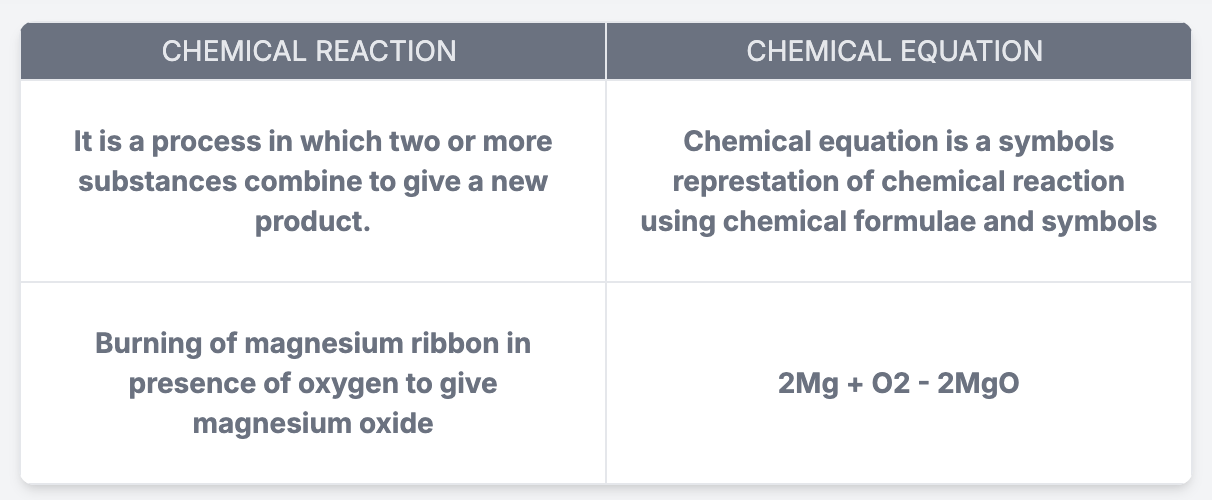
Chemical Equations vs Chemical Reaction
Balancing of Chemical Equations
LOCM
Matter can neither be created nor destroyed in a chemical reaction , ie: the sum of the masses of the reactants must be equal to the sum of the masses of the product.
We balance chemical equations so that the law of conservation of mass is followed.
Types of Chemical Reactions
1.Combination Reaction
The reaction in which two or more substances combine to form a new substance. Examples - burning of magnesium ribbons. They are generally exothermic
2. Decomposition Reactions
Decomposition Reactions are generally endothermic in nature.
A. Thermal Decomposition
Examples - Heating calcium carbonate , Iron Sulphide , Lead Nitrate
B. Electrolytic Decomposition
Example - electrolysis of water
C. Photolytic Decomposition
Examples - silver chloride , silver bromide