4.8 Jackson and Federal Power
LEARNING OBJECTIVE: Explain the causes and effects of continuing policy debates about the role of the federal government from 1800 to 1848.
INTRODUCTION
Era marked by the emergence of popular politics in the 1820s and presidency of Andrew Jackson is called the Age of Common Man/Era of Jacksonian Democracy
Historians debate whether Jackson was major molder of events, political opportunist explorting democratic times, or a symbol of the era
- this era and Jackson’s name are stongly linked
JACKSON VERSUS ADAMS
Political change in the Jacksonian era began before Jackson moved into the White House
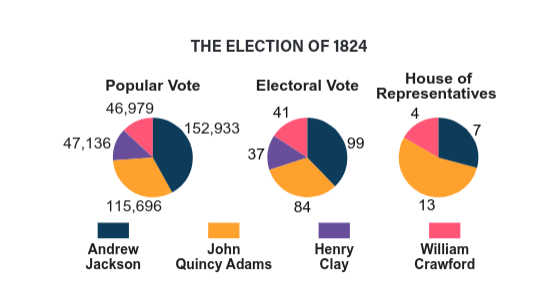
In the election of 1824, Jackson won more popular and electoral votes but still ended up losing the election
THE ELECTION OF 1824
Brief era of good feelings characterized US politics during the two-term presidency of James Monroe
Era ended in political bad feelings of 1824 (btterly contested and divisive)
- old congressional caucus system for choosing presidential candidates had broken down—→
- Candidates from the democratic-republican party of Jefferson campaighned for presidency
- John Quincy Adams, Henry Clay, William Crawford, and Andrew Jackson
Among voters in states that counted popular vote, Jackson won
- vote was split four ways and he ended up lacking majority of the electoral college required by the constituion.
- house of representatives had to choose a president from the other three candidates.
Henry Clay used his influence in the house to provide John Quincy Adams with enough votes to win the election
- president Adams appointed Clay as his secretary of state
- Jackson and his followers charged that the decision of voters had been foiled by secret political maneuvers (accused Adams and Clay of making corrupt bargains)
PRESIDENT JOHN QUINCY ADAMS
Adams further alienated followers of Jackson by asking congress for money for internal imrpovements, aid to manufacturing, national university, and atronomical obsrvatory
Jacksonians viewed all these measure as a waste of money and violation of the constitution
- congress patched together a new tariff law (satisfied northern manufactuers but alienated southern planters: ¨tariff of abominations¨)
THE REVOLUTION OF 1828
Adam sought reelection in 1828, but Jacksonians were ready to use the discontent of southerns and westerners, and new campaign tactics to sweep Jackson into office
Went beyond parades and barbecues
- Jackson’s party resorted to smearing the president and accusing Adams’s wife of being born out of wedlock
- Supporters of Adams retaliated accusing Jackson’s wife of adultery
- Mudslinging campaign attracted a lot of interest—→ Increase in voter turnout
THE PRESIDENCY OF ANDREW JACKSON
Jackson was a different kind of president from previous ones
He was a stong leader, dominated politics for 8 years, became a symbol for emerging working class and middle class (common man)
- gain fame as an Indian fighters and hero in the Battle of New Orleans
- came to live in fine mansion in Tennessee as wealthy planter and slaveowner
Was born in a frontier cabin and never lost the rough manners of the frontier
- chewed tobacco, fought several duels, displayed violent temper.
- first president since washington without college education
- could be describbed as an extraordinary man and self-made living legend (drew support from every social group and section of the country)
PRESIDENTAL POWER
Jackson presented himself as the representative of all the people and a protector of the common man against the abuses of power by the rich and priviledegd.
He was frugal Jeffersonian
- opposed increasing federal spending and national debt
- interpreted the powers of congress narrowly (vetoed the use of federal money to construct Maysville road, because it was within the state of his rival Henry Clay).
- Jackson’s closest advisers were known as the ¨kitchen cabinet¨ (did not belong to his official cabinent—→ less influcence of the appointed cabinet)
PEGGY EATON AFFAIR
Champion of the common man also went the aid of the common woman
Peggy O’Neale Eaton
- wife of Jackson’s secretary of war
- target of malicious gossip by other cabinet wives
- most of the cabinet resigned when Jackson tried to get the wives to socially accept Peggy.
- controversy contributed to the resignation of Jackson’s VP John C. Calhoun (later replaced by Martin Van Buren).
INDIAN REMOVAL ACT (1830)
Jackson’s concept of democracy did not extend to Natives
Jackson sympathized with land-hungry citizens who were impatient to take over lands held by Natives
- Jackson though the most humane solution was to relocate Natives to west of the Mississipi
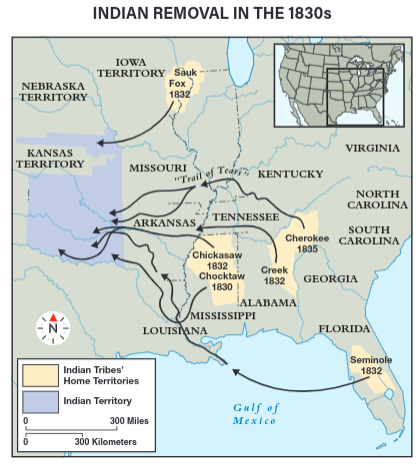
- Jackson signed the Indian removal act in 1830, which forced the resettlement of thousands of American Indians
Most eastern tribes reluctantly complied and moved west
- Bureau of Indian Affairs was created to assist resettled tribes
Most politicians supported the removal act
- other states passed laws requiring Cherokees to migrate to the west
- When Cherokees challenged Georgia in the courts, supreme court ruled in Cherokee Nation V. Georgia that Cherokess were not a foreign nation and couldnt’t sue in a federal court
- In a 2nd case, Worcester V. Georgia, high court ruled that the laws of Georgia had no force within Cherokee territory (clash between state’s laws and federal courts—→ Jackson siding with the states)
- courts were powerless to enforce it’s decisions without the president’s support.
TRAIL OF TEARS
Most Cherokees repudiated the settlement of 1835, which provided land in the Indian territory
After Jackson left office in 1838, US army forced 15,000 Cherokees to leave Georgia (known as the Trail of Tears)
- caused the deaths of 4,000 Cherokees
NULLIFICATION CRISIS
Jackson favored state’s rights, but not disunion
South Carolina legislature decalred the increased trariff of 1828
- also known as the Tariff of Abominations (unconstitutional)
- affirmed the nullification theory (each states had the right to decided whether to obey a federal law or declare it null and void) advanced by Calhoun
Conflicting views of the nature of the federal union under the constitution led to dramatic exchange of speeches between Daniel Webster (Massachusetts) and Robert Hayne (South Carolina)
- Hayne argued for the rights of states, Webster attacked the idea that any state could defy or leave the union.
Webster-Hayne debate led Jackson to declare his own position
- He declared that the federal union ¨must be preserved¨
- John Calhoun responded with ¨the union, next to our liberties, most dear!¨
Calhoun’s South Carolina increased tensions by holding convention to nullify hated 1828 tariff and new tariff of 1832
- convention passed resolution by forbidding collection of the tariff within the state
Jackson reacted decisively
- prepared military
- persuaded congress to pass Force Bill, giving him authority to act against South Carolina
- Issued Proclamation to the People of South Carolina (stating that nullification and disunion were treason)
Federal troops did not march in this crisis
- Jackson opened the door for compromise by suggesting Congress to lower the tariff
- South Carolina postponed nullification but rescinded it after congress enacted a new tariff along suggestions by the president and adjustment that appealed to Northern industrialist.
OPPOSITION TO ANTISLAVERY EFFORTS
Jackson’s strong defense of federal authroity forced militant advocates of states’ rights to retreat
Militant southerners still had Jackson’s support
- the president shared southerners’ alarm about the growing antislavery movement in the north
- used his executive power to stop antislavery literature in the mail
- southern jacksonians trusted that Jackson would not extend democracy to African Americans
BANK VETO
Rechartering the Bank of United States was another issue during Jackson’s presidency
The banks and its branches were privately owned
- received federal deposits and attempted to serve a public purpose by cushoning the national economy
- Nicholas Biddle managed bank effectively (Biddle’s arrogance contributed to popular suspicion that bank abused powers and only benefited wealthy)
- Jackson shared suspicion and believed bank was unconstutional.
Henry Clay (Jackson’s opp) favored bank
- In the election year of 1832, Clay challenged Jackson by persuading majority of congress to pass a bank charter bill.
- Jackson vetoed it (denounced bank as monopoly of the wealthy at the expense of the common people)
- Voter backed Jackson (won election with more than three-fourths of the electoral vote)
THE TWO-PARTY SYSTEM
One-party system had characterized Monroe’s presidency (Era of Good Feelings)—→
two-party system under Jackson
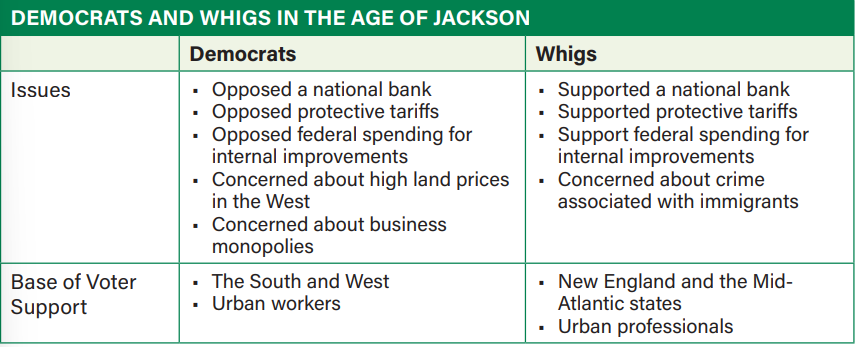
Supporters of Jackson were now Democrats, supporters of Henry Clay were Whigs
- Democratic party harked back to old Democratic-Republican party of Jefferson
- Whig party resembled the Federalist party of Hamilton (supported spending federal money for internal improvements and infastructure, like Federalist supported National bank and road).
New condions reflected change during Jacksonian era.
- Democrats and whigs alike were challenged to respond to westerward expansion of nation and new industrial economy.
JACKSON’S SECOND TERM
After winning reelection in 1832, Jackson moved to destroy Bank of United States
PET BANKS
Jackson attacked Bank by withdrawing federal funds
Aided by secretary of treasury Roger Taney
- transferred federal funds to state banks
- critics of Jackson called these “pet banks”
SPECIE CIRCULAR
Jackson’s financial policies and purchase of western lands—→ inflated prices for land and various goods.
Jackson hoped to check inflationary trend by issusing presidental order known as Species Circular.
- required future purchase of federal lands be made in specie (gold & silver) rather than paper banknotes—→
- Banknotes lost their value and land sales plummented
- Panic of 1837 plunged nation’s economy into a depression after Jackson left office
THE ELECTION OF 1836
Jackson followed the two-term tradition
Jackson persuaded Democratic party to nominate his loyal VP Martin Van Buren
- was to ensure that Jackson’s policies be carried out even in his retirement
Whig party adopted unusual strategy of nominating three candidates from three different regions
- hoped to throw election into house of representatives (where each state has one vote for president
- strategy failed (Van Buren took 58% of the electoral vote)
PRESIDENT VAN BUREN AND THE PANIC OF 1837
Country suffered finanicial panic as Van Buren took office
One bank closed after another
- Jackson’s opposition to rechartering bank was one of the many causes of the panic and economic depression
- Whigs blamed democrats for their laissez-faire economics (where there was little federal involvement in the economy)
THE “LOG CABIN AND HARD CIDER” CAMPAIGN OF 1840
In the election of 1840, Whigs were in strong position to defeat Van Buren and Democrats
Voters were unhappy with economy, whigs were better organized, and had a war hero, William Henry “Tippecanoe” Harrison, as their presidential candidate
Whigs took campaigning to new heights
- symbolized Harrison’s humble origins by putting log cabins on wheels and parading down cities and towns
- also passed out hard cider to voters, and buttons and hats to wear
- name-calling as a propaganda also marked the 1840 campaign (“Martin Van Ruin”)
78% of eligible voters/white men cast their ballots
- Harrison and John Tyler (former states’ rights democrats, who joined the whigs) took 53% of popular votes and majority of electoral votes in North, South, and West.
- established Whigs as a national party
Harrison died of pneumonia less than a month after taking officer
- John Tyler became first vp to succeed presidency
Tyler was not much of a whig
- vetoed national bank bills and other legislation
- favored southern and and expansionist democrats during his term
WESTERN FRONTIER
Jackson’s view of Natives and Trail of Tears reflected common opinion and approach during the 19th century
Expansion westward continuously changed the definition of “west,” attitudes towards the land and Native remained constant
- 1600s: West meant lands on other side of Appalachian Mountains
- Mid 1800s: West laid beyond Mississippi River and reached the pacific coast
AMERICAN INDIANS
Original settlers of the North American continent were various groups of American Indians
Natives continued to be pushed, and driven westward as white settlers encroached on their land after the arrival of Columbus
EXODUS
Vast majority of Natives were living west of the Mississipi River
Natives east had been killed by diseases or battles, emigrated reluctantly, or forced to leave by treaties or military actions
- the Great Plains would provide only temportary respite from conflict with White settlers
LIFE ON THE PLAINS
Horses brought by Spanish revolutionized life for Natives on the Great Plains
Tribes continued to live in villages anf farms
- horses allowed tribes such as the Cheyenne and Sioux to become nomadic hunters following buffalo (could easily move away from advancing settlers or oppose encroachments by force)
THE FRONTIER
Location of the western frontier constantly shifted, but concept of the frontier remained the same
Same forces that brought original colonist to America, motivated descendant and new immigrants to move westward
- west represented new start for those willing to venture
- west beckoned as a place promising greater freedom for American ethnic groups (in theory and myth at least)
MOUNTAIN MEN
From POV of white americans, rocky mountains were a far-distant frontier
Earliest white settlers has followed Lewis and Clark (known as Mountain Men)
- explored American Indian trails and trapped for furs
- served as guides and pathfinders for settlers crossing the mountains and into the pacific region
WHITE SETTLERS ON THE WESTERN FRONTIER
Daily life for white settlers was similar to that of early colonist
They worked hard from sunrise to sunset
live in log cabins, sod hunts, or other shelters from locally available resources
disease and malnutriction were greater dangers than Natives.
WOMEN
Often lvived many miles from the nearest neighboor—→
Pioneer women performed myriad daily tasks
- jobs of a doctor, teacher, seamstress, cook, and cheif assistant in the fields to their farmer husbands
Isolation, endless work, and rigors of childbirth—→
- shorter lifespan for frontier women
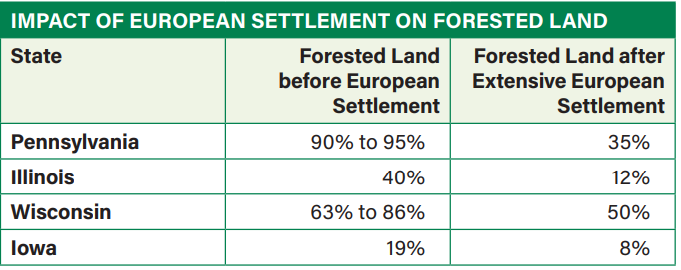
ENVIRONMENTAL DAMAGE
Settlers had little understanding of fragile nature of land and wildlife
As settlers moved in, they would clear forest and eventually exhuast the soil with poor farming techniques
- hunters and trappers also brough beavers and buffalo to the brink of extinction.