Sexual Behaviour
Two stages of sexual behaviour
1. Appetitive behaviour:
· Motivation
· Behaviour aimed at finding and obtaining a sexual partner
2. Consummatory behaviour:
· Behaviour of the sexual act
Appetitive Behaviour - Sexual Motivation
External stimuli
· Usually related to opposite-sex conspecifics
· Can be chemical stimuli we’re not consciously aware of (pheromones)
· Can also be learned and be from different sensory modalities
Conspecifics = of the same species
Putative role of pheromones in human sexual interest
· Pheromones: species-typical molecules that trigger a specific response in another animal of the same species (e.g. sexual interest)
· In other mammals, pheromones are detected by the vomeronasal organ
· There is debate about whether humans have a functional vomeronasal organ
· Olfactory epithelium can detect some pheromones in humans (and pigs)
Vomeronasal Organ
· Is located within the nose
· Separate organ to one used for normal smelling.
· Tissue in nasal septum POTENTIALLY could act as vomeronasal organ
· Ancestrally would have one.
Evidence:
· Women’s t-shirts smell “sexier” during fertile phase of menstrual cycle
· Androstadienone (in men’s sweat) triggers alertness, good mood and sexual arousal in women (but poor mood in heterosexual men)
· Estratetraene activates male, but not female hypothalamic areas
o Only exists in female urine during third trimester of pregnancy, unlikely it is a pheromone.
Androstadienone (male) and Estratetraene (female) have been found to have a mood effect on the opposite sex.
· Similar properties to a pheromone, secreted in similar areas (underarms and groin)
· Hair in these areas increase surface area, an disperse chemicals.
Learned aspects
· Might have a preference for partner’s smell, but not for any innate reason.
· Sexual fetishes may also be learned
HOWEVER sexual orientation is NOT learned
Internal motivations
· Hormones
(extra note:)
Functional explanation (doesn’t explain why but this can happen):
· Taking the pill can change what you are attracted to.
· Different parts of cycle, certain smells are preferred or repulsive.
· An argument made is that the pill imitates pregnancy, more likely to be attracted to more similar people.
· When not on pill, more likely to be attracted to people who are more different to you.
Males:
Within an individual…
· Suppression of testosterone (T) reduces sexual interest (but not performance)
o Only sexual MOTIVATION goes down, doesn’t change preference or ability.
· Anticipation of sexual encounter increases T
· No correlation with individual differences in T
o Not overall levels, relates to CHANGES in T
Females:
· Sexual interest fluctuates with cycling ovarian hormones (esp. oestradiol)
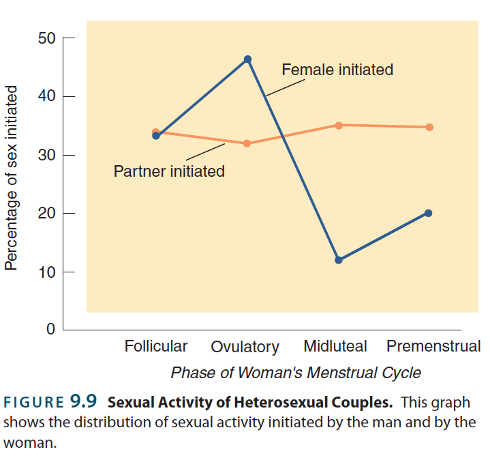
Long-term heterosexual couple
· Tracked initiation as frequency of sex
· Male partner initiated consistently
· Female partner initiated more during follicular and ovulatory phase.
· Similar patterns for masturbation.
HOWEVER…
· Midluteal and premenstrual phase, more likely to generally feel uncomfortable.
· This effect may not solely due to hormones, could be indirect factors.
Sexual interest fluctuates with cycling ovarian hormones (esp. oestradiol)
Androgens (testosterone from ovaries, androstenedione from adrenal gland) increase effect of oestradiol up to 3 times
Increase in T in females also with anticipation of sexual activity
Evidence:
Testosterone in females responds to anticipated sexual activity
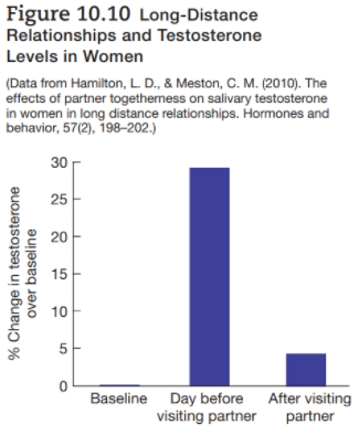
Saliva samples – testosterone in blood so is easy to test
· Anticipation – testosterone is 30% higher
· After – testosterone drops again
Consummatory Sexual Behaviour: 4 stages of Arousal
· Excitement
· Plateau
· Orgasm
· Resolution
Excitement and Plateau: Parasympathetic Nervous System
Male – erection
Female – clitoral stimulation
Parasympathetic nervous system: Autonomic nervous system, largely voluntary.
The Structure
Two sets of neurons/stages
Ganglion = ground of neural cell bodies, sit very close to target organs.
· Preganglionic neurons: Acetylcholine (nicotinic receptors)
· Post-ganglionic neurons: Acetylcholine (muscarinic receptors)
· Preganglionic neurons connect central nervous system to postganglionic neurons.
· Postganglionic neurons connect with all internal organs, including genital organs.
Acetylcholine: increases production of saliva, increases digestion, decreases heart rate.
The Mechanics
Parasympathetic stimulation relaxes smooth muscle in blood vessels
More blood enters the genitals
Penile/Clitoral erection (“tumescence”)
Engorgement of labia
· Vaginal lubrication (more blood flow to glands)
Aside:
Viagra
· Smooth muscle relaxation involves signalling by Nitric Oxide (NO)
· This increases the levels of cyclic GMP (cGMP)
· Viagra inhibits/blocks the breakdown of cGMP by Phosphodiesterase 5 (PDE5), keeping the smooth muscle relaxed
· Does not release cGMP or cause an erection, just maintains one that is already there.
Central and Peripheral Influences
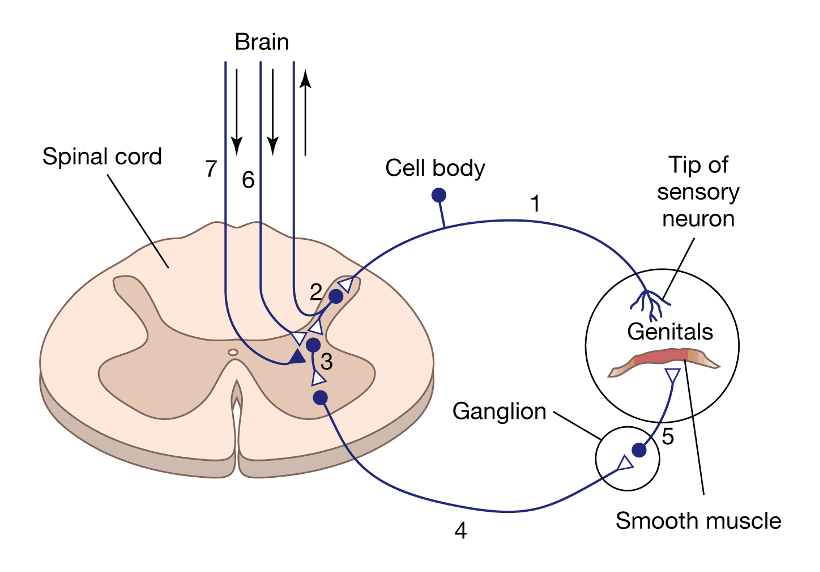
1. Stimulation of sensory neuron in genital
2. Activates sensory neuron in spinal cord, sends information to brain and neuron 3.
3. Activates parasympathetic neuron and receives excitatory and inhibitory information from the brain. This is an excitatory interneuron that activates preganglionic neurons.
4. Preganglionic neuron that activates smooth muscle (ganglion)
5. Post ganglionic neuron that activates genitals.
6/7. Potentially visual or auditory stimulation that adds to or inhibits arousal.
Note:
In puberty is the inhibition less for the neural circuit?
· Potentially.
· Testosterone is going up, therefore motivation will increase.
· Will be more sensitive to testosterone.
HOWEVER: social factors, difficult to determine.
Erectile Dysfunction
· Always “physical”
· Stress leads to increased sympathetic activity, which causes vasoconstriction
· Learned aversions can have central effects
· Many of these are difficult to tease apart
Week 3 Continued…
Orgasm – Sympathetic Nervous System
Organised similarly to parasympathetic
· Preganglionic neurons – Acetylcholine (nicotine receptors)
o (Nicotine excites sympathetic and parasympathetic at the same time)
· Postganglionic neurons – Noradrenaline (noradrenergic receptors)
o (different to parasympathetic which uses muscarinic)
· Noradrenaline is a neurotransmitter or a hormone.
o Adrenaline is a hormone only made by adrenal medulla which is derived from noradrenaline.
Sympathetic – “go” system
Sympathetic neurons localised to the thoracic area of the spinal cord
Orgasm
· Triggered by combination of local stimulation and central input.
· Sympathetic stimulation (NA) and pulsatile release of oxytocin results in series of smooth muscle contractions in the pelvic floor.
· Orgasm requires disinhibition by the central nervous system.
Central inhibition of orgasm
· Natural state of orgasm system is inhibited
Nucleus paragigantocellularis (nPGi) in medulla inhibits orgasm circuitry in lumbar spinal cord (neurotransmitter: serotonin)
Sends long axons down the spinal cord and constantly inhibits circuitry in the bottom of the spinal card.
Uses serotonin as its transmitter
During intercourse, hypothalamus inhibits the peri-aqueductal gray (PAG), which normally stimulates nPGi
Resolution: Satiety
Active inhibition of sexual motivation
During orgasm: blood oxytocin levels peak
Oxytocin is also involved in pair-bond formation
During orgasm: prolactin is released
o High prolactin levels suppress sexual motivation
Case study of man who could repeatedly orgasm – released less prolactin.
Prolactin – hormone (is also responsible for releasing milk in breastfeeding women)
Conclusions
· Sex steroids play an important role in sexual motivation
· The sexual response is controlled by a reflex arc with modulation by the central nervous system